Loading...
Done
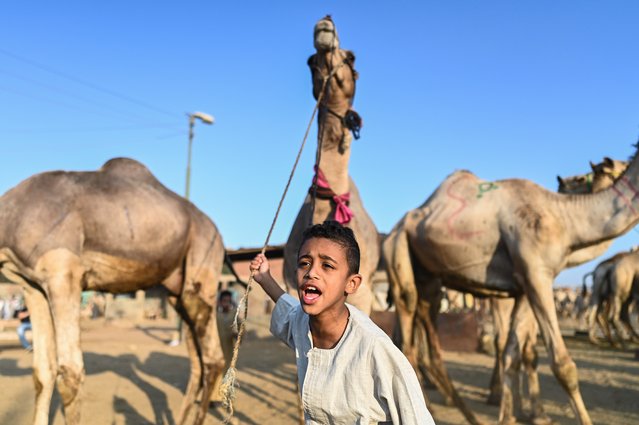
A child stands next to sacrificial camels at the camel market ahead of the Muslim festival of Eid al-Adha in the Birqash district, Giza, Egypt, 30 May 2025. Eid al-Adha is one of the holiest Muslim holidays, marking the annual Hajj pilgrimage to Mecca. (Photo by Mohamed Hossam/EPA/EFE)

A child stands next to sacrificial camels at the camel market ahead of the Muslim festival of Eid al-Adha in the Birqash district, Giza, Egypt, 30 May 2025. Eid al-Adha is one of the holiest Muslim holidays, marking the annual Hajj pilgrimage to Mecca. (Photo by Mohamed Hossam/EPA/EFE)
Details
24 Jun 2025 03:30:00
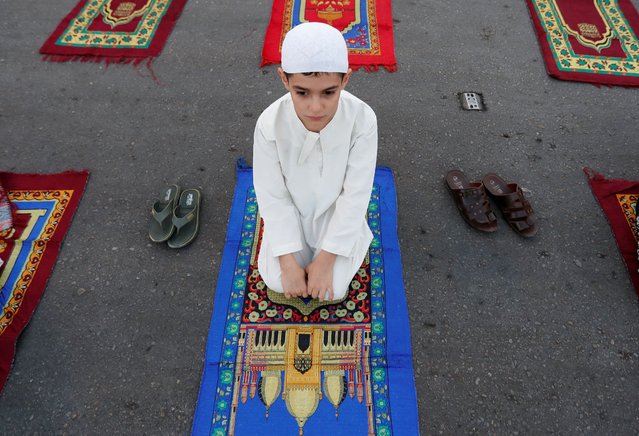
A boy attends Eid al-Adha prayers on the street outside Abu Hanifa mosque in Baghdad Adhamiya district, during the outbreak of the coronavirus disease (COVID-19), in Iraq, July 31, 2020. (Photo by Thaier Al-Sudani/Reuters)

A boy attends Eid al-Adha prayers on the street outside Abu Hanifa mosque in Baghdad Adhamiya district, during the outbreak of the coronavirus disease (COVID-19), in Iraq, July 31, 2020. (Photo by Thaier Al-Sudani/Reuters)
Details
08 Aug 2020 00:01:00
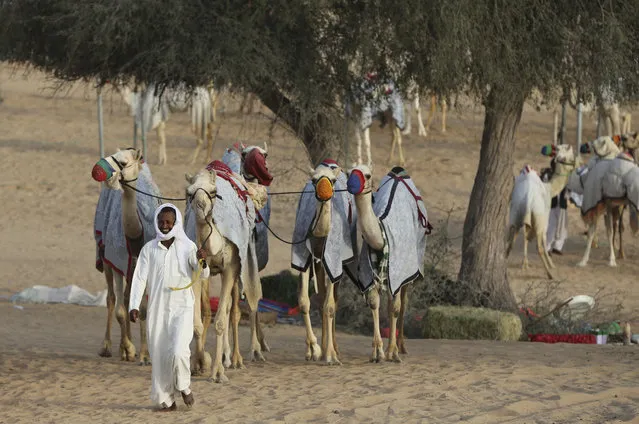
In this Saturday, April 8, 2017 photo, a keeper walks camels to the Al Marmoom Camel Racetrack, in al-Lisaili about 40 km (25  miles) southeast of Dubai, United Arab Emirates. (Photo by Kamran Jebreili/AP Photo)

In this Saturday, April 8, 2017 photo, a keeper walks camels to the Al Marmoom Camel Racetrack, in al-Lisaili about 40 km (25 miles) southeast of Dubai, United Arab Emirates. Camel racing is a big-money sport and fast thoroughbreds can fetch well over a million dollars. As rising temperatures across Gulf Arab countries signal the end of the winter camel racing season, Dubai is wrapping up its races with the annual Al Marmoom Heritage Festival that has drawn thousands of camels from across the oil-rich Gulf. (Photo by Kamran Jebreili/AP Photo)
Details
19 Apr 2017 08:44:00
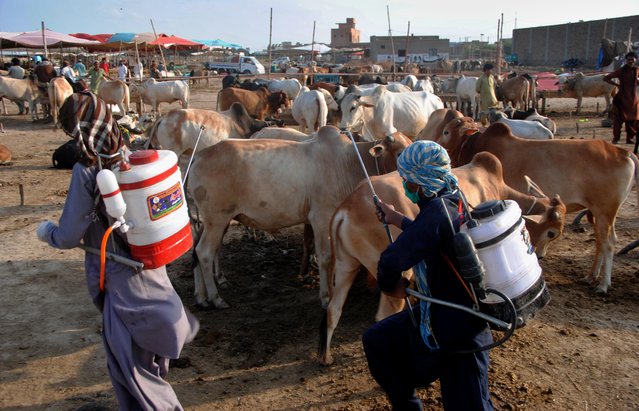
Health workers wearing face masks spray disinfectant liquid on sacrificial animals amid concerns over the spread of the SARS-CoV-2 coronavirus that causes the pandemic COVID-19 disease ahead of the Muslim festival of Eid al-Adha at an animal market in Hyderabad, southern Pakistan, 21 July 2020. Eid al-Adha, also known as the Festival of the Sacrifice, is the second and holiest of the two main Islamic holidays celebrated each year (the other one being Eid al-Fitr). Every year, on the 10th day of the Islamic lunar month of Dhu al-Hijjah, Muslims around the world ritually slaughter a sacrificial animal and split the meat into three parts: one is reserved for the family, another for friends and relatives, and the third is given to the poor and needy. The Saudi Supreme Court has declared that the first day of Eid al-Adha this year falls on 31 July. (Photo by Nadeem Khawar/EPA/EFE)

Health workers wearing face masks spray disinfectant liquid on sacrificial animals amid concerns over the spread of the SARS-CoV-2 coronavirus that causes the pandemic COVID-19 disease ahead of the Muslim festival of Eid al-Adha at an animal market in Hyderabad, southern Pakistan, 21 July 2020. (Photo by Nadeem Khawar/EPA/EFE)
Details
23 Jul 2020 00:07:00
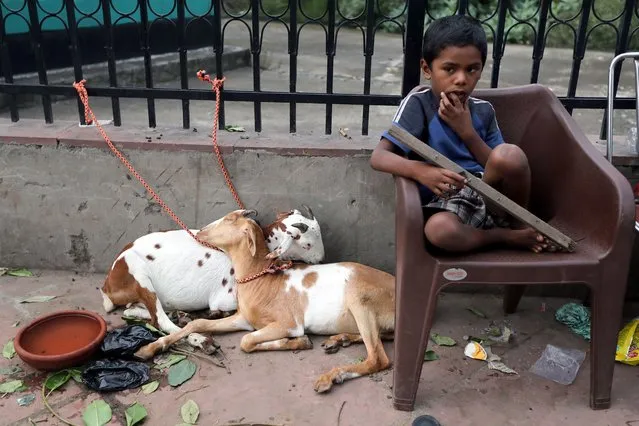
A boy sits next to sacrificial goats resting during Eid al-Adha in New Delhi, India, 29 June 2023. Muslims around the world celebrate Eid al-Adha or feast of sacrifice, by slaughtering sheep, goats and cows to commemorate Prophet Abraham's willingness to sacrifice his son Ismail at God's command. (Photo by Harish Tyagi/EPA)

A boy sits next to sacrificial goats resting during Eid al-Adha in New Delhi, India, 29 June 2023. Muslims around the world celebrate Eid al-Adha or feast of sacrifice, by slaughtering sheep, goats and cows to commemorate Prophet Abraham's willingness to sacrifice his son Ismail at God's command. (Photo by Harish Tyagi/EPA)
Details
07 Jul 2023 02:48:00
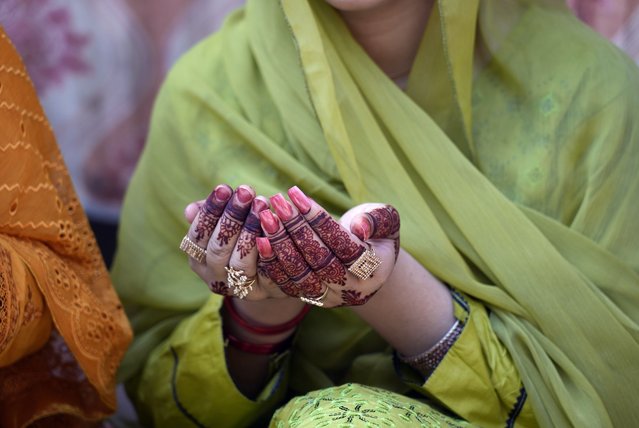
A woman has her hands painted with traditional henna as she attends Eid al-Adha prayers at historical Badshahi mosque in Lahore, Pakistan, Monday, June 17, 2024. Eid al-Adha or Feast of Sacrifice, the most important Islamic holiday, marks the willingness of the Prophet Ibrahim, Abraham to Christians and Jews, to sacrifice his son. During the holiday, which in most places lasts three days, Muslims slaughter goat, sheep or cattle, distribute part of the meat to the poor. (Photo by K.M. Chaudary/AP Photo)

A woman has her hands painted with traditional henna as she attends Eid al-Adha prayers at historical Badshahi mosque in Lahore, Pakistan, Monday, June 17, 2024. Eid al-Adha or Feast of Sacrifice, the most important Islamic holiday, marks the willingness of the Prophet Ibrahim, Abraham to Christians and Jews, to sacrifice his son. During the holiday, which in most places lasts three days, Muslims slaughter goat, sheep or cattle, distribute part of the meat to the poor. (Photo by K.M. Chaudary/AP Photo)
Details
06 Sep 2024 04:02:00
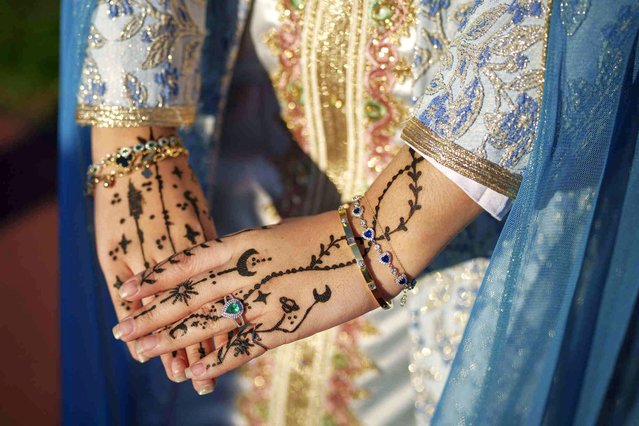
A young woman shows off her henna tattoos at the end of Eid al-Fitr prayers in Bucharest, Romania, Wednesday, April 10, 2024. Members of the Romanian Muslim community joined prayers at the Dinamo stadium in the Romanian capital, in the largest Muslim public gathering of the year. Eid al-Fitr marks the end of the holy fasting month of Ramadan. (Photo by Andreea Alexandru/AP Photo)

A young woman shows off her henna tattoos at the end of Eid al-Fitr prayers in Bucharest, Romania, Wednesday, April 10, 2024. Members of the Romanian Muslim community joined prayers at the Dinamo stadium in the Romanian capital, in the largest Muslim public gathering of the year. Eid al-Fitr marks the end of the holy fasting month of Ramadan. (Photo by Andreea Alexandru/AP Photo)
Details
31 Jul 2025 02:55:00
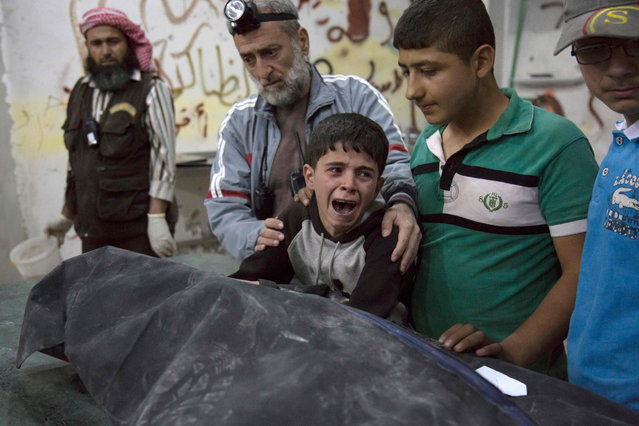
A Syrian boy is comforted as he cries next to the body of a relative who died in a reported airstrike on April 27, 2016 in the rebel-held neighbourhood of al-Soukour in the northern city of Aleppo. (Photo by Karam Al-Masri/AFP Photo)

A Syrian boy is comforted as he cries next to the body of a relative who died in a reported airstrike on April 27, 2016 in the rebel-held neighbourhood of al-Soukour in the northern city of Aleppo. The Syrian army was preparing an offensive to retake the whole of Aleppo, as fighting in the divided second city killed 38 civilians in a new blow for a tattered truce. Nearly 200 people have been killed in Aleppo in the past week as rebels have pounded government-held neighbourhoods with rocket and artillery fire and the regime has hit rebel areas with air raids. (Photo by Karam Al-Masri/AFP Photo)
Details
29 Apr 2016 11:37:00