Loading...
Done
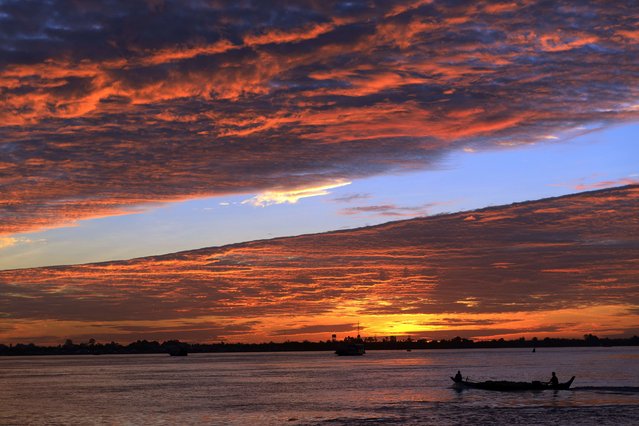
A boat commutes across the Mekong river in Phnom Penh on August 8, 2014. The Mekong is the world's twelth longest river running from the Tibetan Plateau through China's Yunnan province, Myanmar, Laos, Thailand, Cambodia and Vietnam. (Photo by Tang Chhin Sothy/AFP Photo)

A boat commutes across the Mekong river in Phnom Penh on August 8, 2014. The Mekong is the world's twelth longest river running from the Tibetan Plateau through China's Yunnan province, Myanmar, Laos, Thailand, Cambodia and Vietnam. (Photo by Tang Chhin Sothy/AFP Photo)
Details
09 Aug 2014 12:41:00
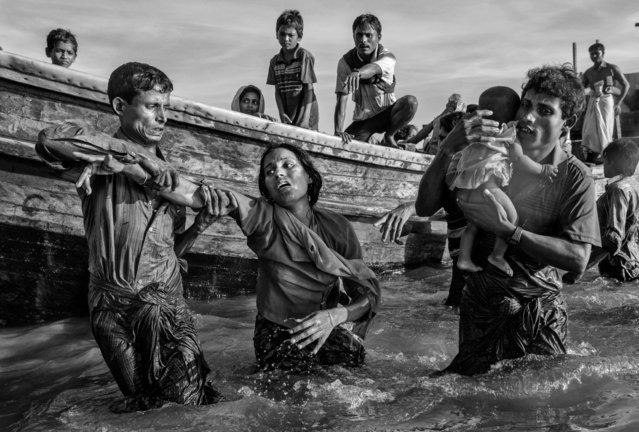
A Rohingya refugee woman is helped from a boat as she arrives exhausted on the Bangladesh side of the Naf River at Shah Porir Dwip after fleeing her village in Myanmar, on October 1, 2017 in Cox's Bazar, Bangladesh. (Photo by Kevin Frayer/Getty Images)

A Rohingya refugee woman is helped from a boat as she arrives exhausted on the Bangladesh side of the Naf River at Shah Porir Dwip after fleeing her village in Myanmar, on October 1, 2017 in Cox's Bazar, Bangladesh. (Photo by Kevin Frayer/Getty Images)
Details
17 Oct 2017 05:51:00
Boats of fishermen are seen on the dried Poopo lakebed in the Oruro Department, south of La Paz, Bolivia, December 17, 2015. (Photo by David Mercado/Reuters)

Boats of fishermen are seen on the dried Poopo lakebed in the Oruro Department, south of La Paz, Bolivia, December 17, 2015. Lake Poopo in Bolivia, the Andean nation's formerly second largest after the famed Titicaca, has dried up entirely. With the water now gone, animals have died off in the millions, according to studies. And the local families, having lost much of their sustenance, have been forced to migrate. (Photo by David Mercado/Reuters)
Details
20 Dec 2015 08:04:00
“The knight and his steed”. This picture was taken in a natural but controlled environment. There are pictures that can not be done in nature or that would imply a very high cost of both time and money, thats why photography workshops are run conducted at strategic locations and bringing EVERYONE who is interested, the basic notions (lighting, camera handling, composition, etc...) or the specimens, and afford them the opportunity to take pictures like this. (Photo and caption by Nicolas Reusens Boden (Sweden)/2014 Sony World Photography Awards)

“The knight and his steed”. This picture was taken in a natural but controlled environment. There are pictures that can not be done in nature or that would imply a very high cost of both time and money, thats why photography workshops are run conducted at strategic locations and bringing EVERYONE who is interested, the basic notions (lighting, camera handling, composition, etc...) or the specimens, and afford them the opportunity to take pictures like this. Although controlled, this shot was not prepared at all, I was performing a workshop with the agalychnis callidryas treefrog from Costa Rica when the frog managed to jump to the branch where this huge titan was sleeping... I had my gear ready so I only had to change a few settings and shoot... the rest is history. (Photo and caption by Nicolas Reusens Boden (Sweden)/2014 Sony World Photography Awards)
Details
10 Dec 2013 07:23:00
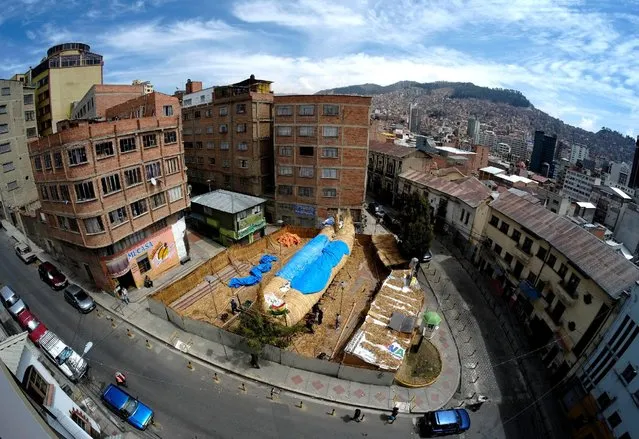
Aerial view of the “Viracocha III”, a boat made only from the totora reed, as it is being prepared to cross the Pacific from Chile to Australia on an expected six-month journey, La Paz, Bolivia, October 19, 2016. An expedition in a boat made only of reeds crafted by indigenous Bolivians is getting ready to cross the Pacific from South America to Australia, in a fresh attempt to prove that ancient mariners were capable of making the journey. Phil Buck, a 51-year-old explorer from the United States, already has led two similar expeditions and will captain the “Viracocha III” set to depart from northern Chile in February on an expected six-month journey. (Photo by David Mercado/Reuters)

Aerial view of the “Viracocha III”, a boat made only from the totora reed, as it is being prepared to cross the Pacific from Chile to Australia on an expected six-month journey, La Paz, Bolivia, October 19, 2016. An expedition in a boat made only of reeds crafted by indigenous Bolivians is getting ready to cross the Pacific from South America to Australia, in a fresh attempt to prove that ancient mariners were capable of making the journey. (Photo by David Mercado/Reuters)
Details
20 Oct 2016 10:53:00
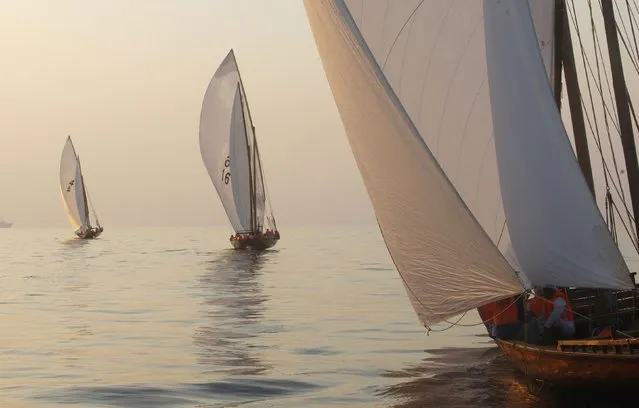
Traditional wooden boats, or dhows, compete at sunrise during the Al Gaffal race, a long-distance dhow sailing race, near Sir Bu Nuayr, near Sharjah May 18, 2014. (Photo by Martin Dokoupil/Reuters)

The Al-Gaffal is an annual long-distance race between crews sailing 60-ft. traditional wooden boats called dhows and takes place in the Persian Gulf, between the island of Sir Bu Nair, near the Iranian coast and the Gulf emirate of Dubai. Photo: Traditional wooden boats, or dhows, compete at sunrise during the Al Gaffal race, a long-distance dhow sailing race, near Sir Bu Nuayr, near Sharjah May 18, 2014. (Photo by Martin Dokoupil/Reuters)
Details
19 May 2014 10:59:00
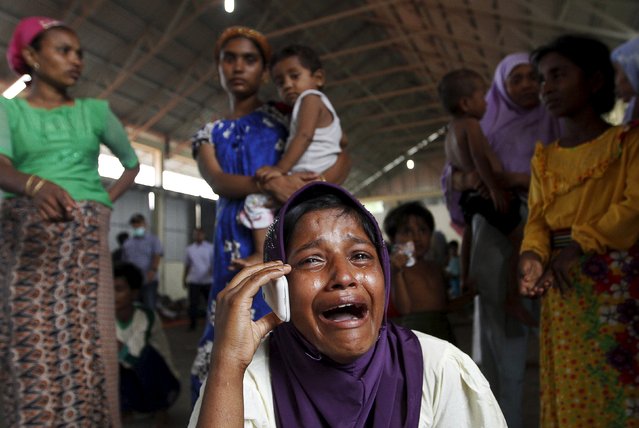
A Rohingya migrant who arrived in Indonesia by boat cries while speaking on a mobile phone with a relative in Malaysia, at a temporary shelter in Kuala Langsa in Indonesia's Aceh Province May 16, 2015. (Photo by Roni Bintang/Reuters)

A Rohingya migrant who arrived in Indonesia by boat cries while speaking on a mobile phone with a relative in Malaysia, at a temporary shelter in Kuala Langsa in Indonesia's Aceh Province May 16, 2015. Nearly 800 migrants were brought ashore in Indonesia on Friday, but other vessels crammed with them were sent back to sea despite a United Nations call to rescue thousands adrift in Southeast Asian waters with dwindling food and water. Thousands of Rohingya Muslims fleeing Myanmar and Bangladesh are stranded on boats as regional governments block them from landing. (Photo by Roni Bintang/Reuters)
Details
20 May 2015 08:53:00
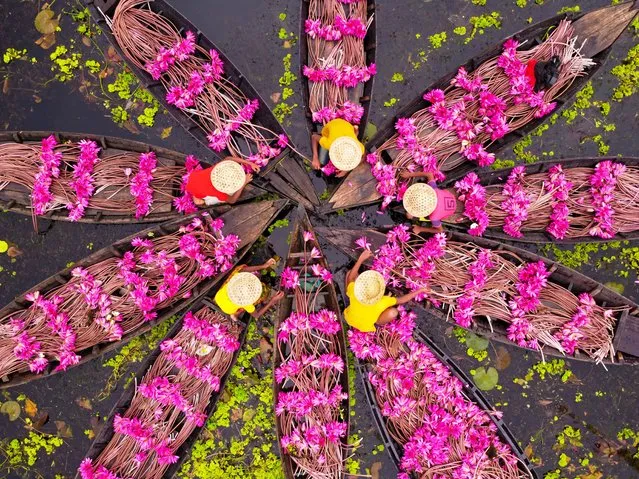
Farmers arrange bunches of water lilies after harvesting them from the wetlands in Barishal, Bangladesh on March 21, 2023. Floating through 10,000 acres of canal, farmers use their little boats to fetch the flowers. They break through the layer of water lilies on the surface of the water as they practice the traditional craft of picking water lilies by hand. Every flower is carefully hand-picked, collected inside the farmers' little wooden boat, tied in bundles, and sold to markets. After working for an entire day, a farmer can pick around 80 to 120 bundles of water lilies. Water lily harvesting is a major source of income for more than 250 families in the area. (Photo by Joy Saha/Cover Images)

Farmers arrange bunches of water lilies after harvesting them from the wetlands in Barishal, Bangladesh on March 21, 2023. Floating through 10,000 acres of canal, farmers use their little boats to fetch the flowers. (Photo by Joy Saha/Cover Images)
Details
01 May 2023 04:00:00