Loading...
Done
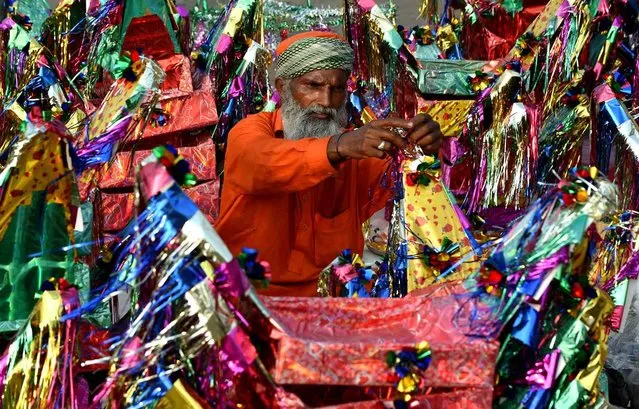
In this photograph taken on September 22, 2016, a Pakistani devotee decorates symbolic paper boats, an offering to Muslim saint Abdulqadir Jilani as a way of giving thanks after their desire to give birth to a son was fulfilled, before dropping it into the water during an annual ceremony on the banks of the River Ravi in Lahore. The ceremony commemorates a centuries-old tale that Muslim saint Abdulqadir Jilani raised a sunken ship carrying a wedding party, at the pleading of the groom's mother, saving all the occupants. (Photo by Arif Ali/AFP Photo)

In this photograph taken on September 22, 2016, a Pakistani devotee decorates symbolic paper boats, an offering to Muslim saint Abdulqadir Jilani as a way of giving thanks after their desire to give birth to a son was fulfilled, before dropping it into the water during an annual ceremony on the banks of the River Ravi in Lahore. The ceremony commemorates a centuries-old tale that Muslim saint Abdulqadir Jilani raised a sunken ship carrying a wedding party, at the pleading of the groom's mother, saving all the occupants. (Photo by Arif Ali/AFP Photo)
Details
06 Oct 2016 09:19:00
A man and a woman jump over a bonfire during Ivan Kupala Day celebrations held by the Belarusian State Museum of Folk Architecture and Rural Lifestyle in the village of Ozertso near Minsk, Belarus on July 4, 2020. Ivan Kupala Day, also known as Ivana-Kupala or Kupala Night, is a traditional pagan holiday celebrated in eastern Slavic cultures. Various rituals are traditionally performed on Kupala Night, including making flower wreaths, fortune-telling, jumping over bonfires, and burning a wheel-like effigy symbolizing the sun. (Photo by Natalia Fedosenko/TASS)

A man and a woman jump over a bonfire during Ivan Kupala Day celebrations held by the Belarusian State Museum of Folk Architecture and Rural Lifestyle in the village of Ozertso near Minsk, Belarus on July 4, 2020. Ivan Kupala Day, also known as Ivana-Kupala or Kupala Night, is a traditional pagan holiday celebrated in eastern Slavic cultures. Various rituals are traditionally performed on Kupala Night, including making flower wreaths, fortune-telling, jumping over bonfires, and burning a wheel-like effigy symbolizing the sun. (Photo by Natalia Fedosenko/TASS)
Details
23 Jan 2021 09:53:00
vVisitors view Patricia Piccinini's “The Embrace” artwork during the “You Know Who” exhibition at the Abdulmecit Efendi mansion in Istanbul, Turkey, 27 September 2022. The exhibition, which by the organizers is described as questioning “the representation of the unknown in contemporary art, based on the symbolic world of the supernatural and unknown in the Byzantine period”, is shown from 20 September until 11 December 2022. (Photo by Erdem Sahin/EPA/EFE/Rex Features/Shutterstock)

Visitors view Patricia Piccinini's “The Embrace” artwork during the “You Know Who” exhibition at the Abdulmecit Efendi mansion in Istanbul, Turkey, 27 September 2022. The exhibition, which by the organizers is described as questioning “the representation of the unknown in contemporary art, based on the symbolic world of the supernatural and unknown in the Byzantine period”, is shown from 20 September until 11 December 2022. (Photo by Erdem Sahin/EPA/EFE/Rex Features/Shutterstock)
Details
28 Sep 2022 05:03:00
An activist with a painted face symbolizing the count of days spent in captivity attends the Free Azov rally in support of the captured defenders of Mariupol on April 21, 2024 in Kyiv, Ukraine. The participants came out to remind about the Ukrainian soldiers who have been held in Russian captivity for more than two years. (Photo by Yan Dobronosov/Global Images Ukraine via Getty Images)

An activist with a painted face symbolizing the count of days spent in captivity attends the Free Azov rally in support of the captured defenders of Mariupol on April 21, 2024 in Kyiv, Ukraine. The participants came out to remind about the Ukrainian soldiers who have been held in Russian captivity for more than two years. (Photo by Yan Dobronosov/Global Images Ukraine via Getty Images)
Details
05 May 2024 04:35:00
circa 1925:  A Zulu woman playing the piano while a group of others sit and listen.  (Photo by General Photographic Agency/Getty Images)

“The Zulu are the largest South African ethnic group, with an estimated 10–11 million people living mainly in the province of KwaZulu-Natal. Small numbers also live in Zimbabwe, Zambia, and Mozambique. Their language, Zulu, is a Bantu language; more specifically, part of the Nguni subgroup. The Zulu Kingdom played a major role in South African history during the 19th and 20th centuries. Under apartheid, Zulu people were classed as third-class citizens and suffered from state-sanctioned discrimination. They remain today the most numerous ethnic group in South Africa, and now have equal rights along with all other citizens”. – Wikipedia.

Photo: A Zulu woman playing the piano while a group of others sit and listen (to put it briefly, Englishmen scoff over Zulu). South Africa, circa 1925. (Photo by General Photographic Agency)

Details
03 Feb 2014 09:40:00
Gertrude “Billie” Murphy, 22, is brought in for questioning in the murder case of Michael Stopec, who was shot and killed in an apartment hotel, circa July 1927.  Murphy had been friends of the married Stopec and his suspected killer Henry Guardino, 31. (Photo by Chicago Herald & Examiner Historical Photo)

Gertrude “Billie” Murphy, 22, is brought in for questioning in the murder case of Michael Stopec, who was shot and killed in an apartment hotel, circa July 1927. Murphy had been friends of the married Stopec and his suspected killer Henry Guardino, 31. It is said that Stopec and Guardino were “bitter rivals for the favor of Billie” and that Murphy had tired of Guardino and was going to stay with Stopec. Murphy was also married to a man in the Joliet penitentiary. (Photo by Chicago Herald & Examiner Historical Photo)
Details
29 Jul 2014 11:28:00
Oil Paintings By Paul David Bond

Paul Bond's art lives in the spaces between dreaming and reality. Drawing from the Latin American genre of Magic Realism where symbolic, surreal and fantastic elements blend with realistic atmospheres, they remove the veil on a world where everything is possible.
Details
31 May 2013 15:58:00
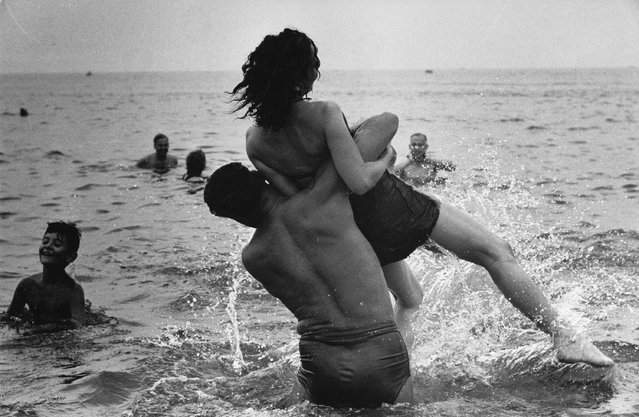
"The Family of Man" opened at The Museum of Modern Art in January 1955 and was curated by Edward Steichen. It was groundbreaking in its scope – 503 images by 273 photographers from 68 countries – as well as in the numbers of people who experienced it on its tour through 88 venues in 37 countries. The touring exhibit drew over 9 million people and the accompanying catalog sold over 2.5 million copies. Here: "Coney Island, New York," by American photographer Garry Winogrand, circa 1952. (Photo by Garry Winogrand)

“The Family of Man” opened at The Museum of Modern Art in January 1955 and was curated by Edward Steichen. It was groundbreaking in its scope – 503 images by 273 photographers from 68 countries – as well as in the numbers of people who experienced it on its tour through 88 venues in 37 countries. The touring exhibit drew over 9 million people and the accompanying catalog sold over 2.5 million copies. Here: “Coney Island, New York”, by American photographer Garry Winogrand, circa 1952. (Photo by Garry Winogrand)
Details
04 Jan 2016 08:02:00