Loading...
Done
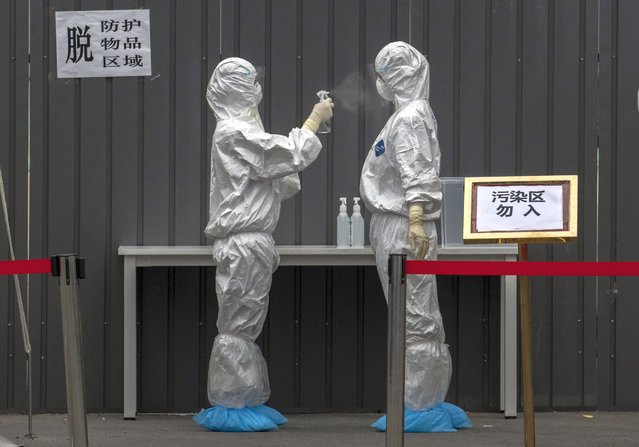
Chinese epidemic control workers wear protective suits as they disinfect each other after performing nucleic acid swab test for COVID-19 on citizens at a government testing site in Xicheng District during an organized tour on June 24, 2020 in Beijing, China. While Chinese government medical officials have said they believe they have controlled the spread, authorities are trying to contain the outbreak linked to the Xinfadi wholesale food market, Beijing's biggest supplier of produce and meat. More than 2.5 million people have undergone nucleic acid tests for COVID-19 at dozens of sites across the city in recent days, with officials using contact tracing to target high and middle risk areas and people who may have had contact with the market or food that came from there. Several neighborhoods have been locked down and a number of other food markets have been closed, The outbreak has triggered fears of a second wave of infection after 56 straight days with no domestically transmitted cases in the capital. (Photo by Kevin Frayer/Getty Images)

Chinese epidemic control workers wear protective suits as they disinfect each other after performing nucleic acid swab test for COVID-19 on citizens at a government testing site in Xicheng District during an organized tour on June 24, 2020 in Beijing, China. While Chinese government medical officials have said they believe they have controlled the spread, authorities are trying to contain the outbreak linked to the Xinfadi wholesale food market, Beijing's biggest supplier of produce and meat. (Photo by Kevin Frayer/Getty Images)
Details
26 Jun 2020 00:01:00
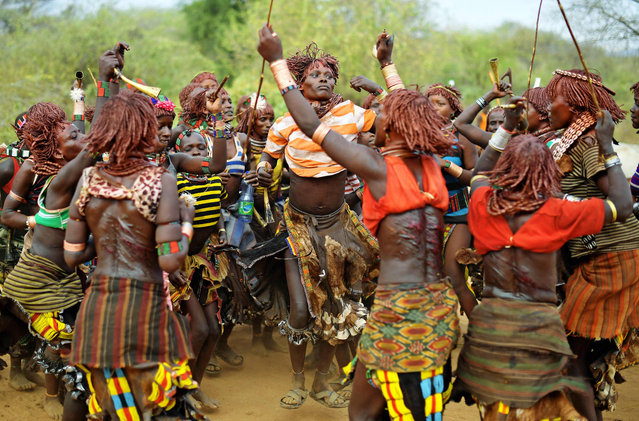
Hamar women dance before a bull jumping ceremony in Ethiopia's southern Omo Valley region near Turmi on September 19, 2016. The Hamar are a Nilotic ethnic group in Ethiopia. The construction of the Gibe III dam, the third largest hydroelectric plant in Africa, and large areas of very “thirsty” cotton and sugar plantations and factories along the Omo river are impacting heavily on the lives of tribes living in the Omo Valley who depend on the river for their survival and way of life. Human rights groups fear for the future of the tribes if they are forced to scatter, give up traditional ways through loss of land or ability to keep cattle as globalisation and development increases. (Photo by Carl De Souza/AFP Photo)

Hamar women dance before a bull jumping ceremony in Ethiopia's southern Omo Valley region near Turmi on September 19, 2016. The Hamar are a Nilotic ethnic group in Ethiopia. The construction of the Gibe III dam, the third largest hydroelectric plant in Africa, and large areas of very “thirsty” cotton and sugar plantations and factories along the Omo river are impacting heavily on the lives of tribes living in the Omo Valley who depend on the river for their survival and way of life. (Photo by Carl De Souza/AFP Photo)
Details
02 Oct 2016 08:45:00
Mayu adjusts Koiku’s kimono, as Koiku wears a protective face mask while posing for a photograph, before they work at a party where they will entertain with other geisha at Japanese luxury restaurant Asada in Tokyo, Japan, June 23, 2020. The coronavirus pandemic has made Tokyo's geisha fear for their centuries-old profession as never before. Though the number of geisha - famed for their witty conversation, beauty and skill at traditional arts - has been falling for years, they were without work for months due to Japan's state of emergency and now operate under awkward social distancing rules. Engagements are down 95 percent, and come with new rules: no pouring drinks for customers or touching them even to shake hands, and sitting 2 meters apart. Masks are hard to wear with their elaborate wigs, so they mostly don't. “I was just full of anxiety”, said Mayu, 47. “I went through my photos, sorted my kimonos ... The thought of a second wave is terrifying”. (Photo by Kim Kyung-Hoon/Reuters)

Mayu adjusts Koiku’s kimono, as Koiku wears a protective face mask while posing for a photograph, before they work at a party where they will entertain with other geisha at Japanese luxury restaurant Asada in Tokyo, Japan, June 23, 2020. (Photo by Kim Kyung-Hoon/Reuters)
Details
23 Jul 2020 00:03:00
A surfer braves a large wave at Queenscliff in Sydney, Monday, June 6, 2016. Storms have lashed Australia's easter coast for several days whipping up waves as high as 12 meters (40 feet), which caused serious beach erosion and forced hundreds of coastal residents to evacuate. (Photo by Rick Rycroft/AP Photo)

A surfer braves a large wave at Queenscliff in Sydney, Monday, June 6, 2016. Storms have lashed Australia's easter coast for several days whipping up waves as high as 12 meters (40 feet), which caused serious beach erosion and forced hundreds of coastal residents to evacuate. (Photo by Rick Rycroft/AP Photo)
Details
07 Jun 2016 13:39:00
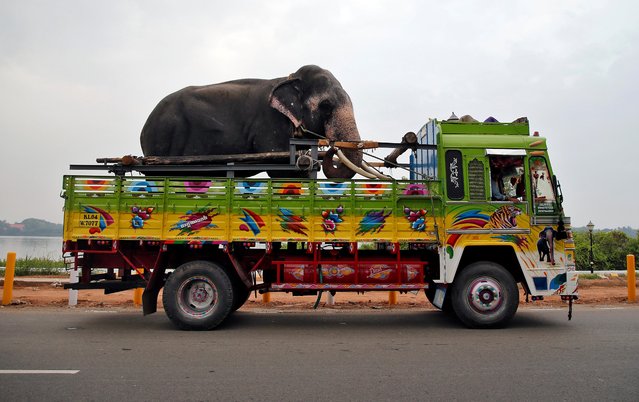
A male elephant named Mahadevan is tied in a truck as he is being transported for an annual temple festival in Kochi, India, March 10, 2020. (Photo by Sivaram V/Reuters)

A male elephant named Mahadevan is tied in a truck as he is being transported for an annual temple festival in Kochi, India, March 10, 2020. (Photo by Sivaram V/Reuters)
Details
18 Mar 2020 00:01:00
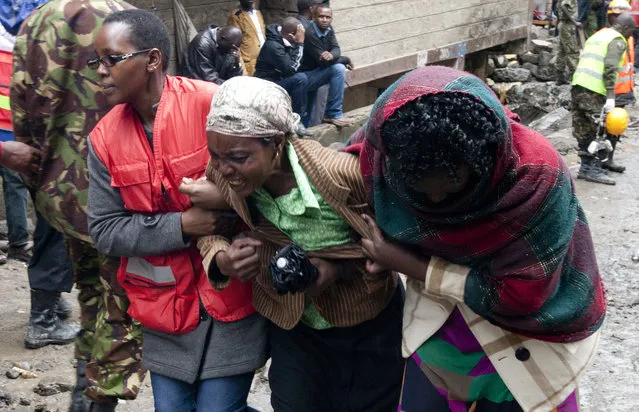
A Kenyan Red Cross personnel and a volunteer console a relative of a victim, at the site of a building collapse in Nairobi, Kenya, Saturday, April 30, 2016. A six-story residential building in a low income area of the Kenyan capital collapsed Friday night under heavy rain and flooding, killing at least seven people and injuring over 100 others, Kenyan officials said. (Photo by Sayyid Abdul Azim/AP Photo)

A Kenyan Red Cross personnel and a volunteer console a relative of a victim, at the site of a building collapse in Nairobi, Kenya, Saturday, April 30, 2016. A six-story residential building in a low income area of the Kenyan capital collapsed Friday night under heavy rain and flooding, killing at least seven people and injuring over 100 others, Kenyan officials said. (Photo by Sayyid Abdul Azim/AP Photo)
Details
01 May 2016 11:05:00
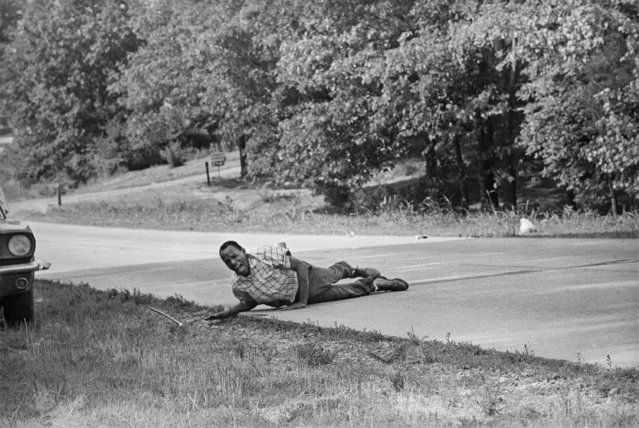
In this  June 6, 1966 file photo, civil rights activist James Meredith pulls himself across Highway 51 after being shot in Hernando, Miss. Meredith, who defied segregation to enroll at the University of Mississippi in 1962, completed the march from Memphis, Tenn., to Jackson, Miss., after being treated for his wounds. (Photo by Jack Thornell/AP Photo)

In this June 6, 1966 file photo, civil rights activist James Meredith pulls himself across Highway 51 after being shot in Hernando, Miss. Meredith, who defied segregation to enroll at the University of Mississippi in 1962, completed the march from Memphis, Tenn., to Jackson, Miss., after being treated for his wounds. (Photo by Jack Thornell/AP Photo)
Details
25 Jul 2016 11:18:00


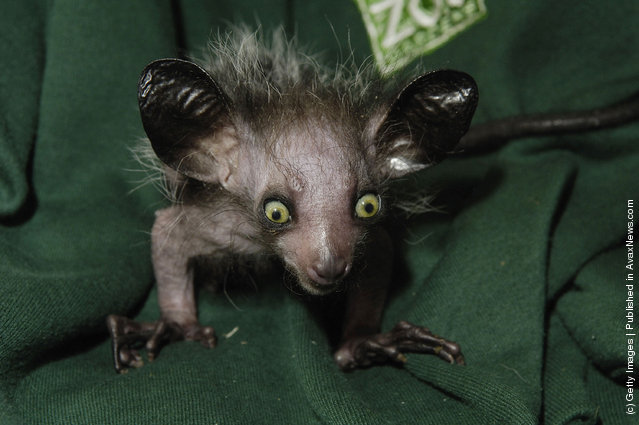
“The aye-aye (Daubentonia madagascariensis) is a lemur, a strepsirrhine primate native to Madagascar that combines rodent-like teeth and a special thin middle finger to fill the same ecological niche as a woodpecker. It is the world's largest nocturnal primate, and is characterized by its unusual method of finding food; it taps on trees to find grubs, then gnaws holes in the wood and inserts its narrow middle finger to pull the grubs out. The only other animal species known to find food in this way is the striped possum. From an ecological point of view the aye-aye fills the niche of a woodpecker as it is capable of penetrating wood to extract the invertebrates within”. – Wikipedia

Photo: In this handout image from Bristol Zoo is seen the first captive bred aye-aye in the UK named “Kintana” (meaning star in Malagasy) April 15, 2005 at Bristol Zoo Gardens, England. The zoo announced today only the second baby aye-aye to be hand-reared in the world (the first was in Jersey Zoo) and has now made his first public appearance since his birth on 11 February 2005. (Photo by Rob Cousins/Bristol Zoo via Getty Images)
Details
13 Apr 2011 13:33:00