Loading...
Done
A mother raise her glass filled with 2017 Beaujolais Nouveau wine as she holds her child in a colored hot water “wine bath” at Hakone Kowakien Yunessun hot spring resort in Hakone, west of Tokyo, Japan, 16 November 2017, on the day of the Beaujolais Nouveau official release. With Germany and the United States, Japan is a major market for the Beaujolais Nouveau. (Photo by  Franck Robichon/EPA/EFE)

A mother raise her glass filled with 2017 Beaujolais Nouveau wine as she holds her child in a colored hot water “wine bath” at Hakone Kowakien Yunessun hot spring resort in Hakone, west of Tokyo, Japan, 16 November 2017, on the day of the Beaujolais Nouveau official release. With Germany and the United States, Japan is a major market for the Beaujolais Nouveau. (Photo by Franck Robichon/EPA/EFE)
Details
17 Nov 2017 06:32:00
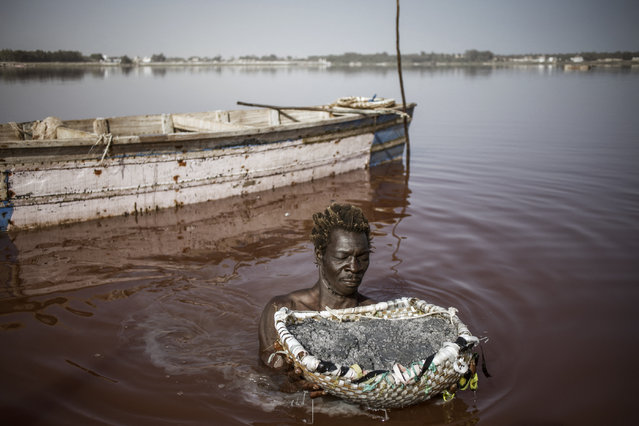
Toure, a Gambian salt harvester, holds a basket filled with  the salt collected from the crust of the bottom of the Lake Retba (Pink Lake) in Senegal on March 16, 2021. Lake Retba, divided from the Atlantic Ocean by a narrow corridor of dunes, owes its name to the pink waters caused by the Dunaliella salina algae and is known for its high salt content, up to 40% in some areas. (Photo by Marco Longari/AFP Photo)

Toure, a Gambian salt harvester, holds a basket filled with the salt collected from the crust of the bottom of the Lake Retba (Pink Lake) in Senegal on March 16, 2021. Lake Retba, divided from the Atlantic Ocean by a narrow corridor of dunes, owes its name to the pink waters caused by the Dunaliella salina algae and is known for its high salt content, up to 40% in some areas. (Photo by Marco Longari/AFP Photo)
Details
24 Mar 2021 10:29:00
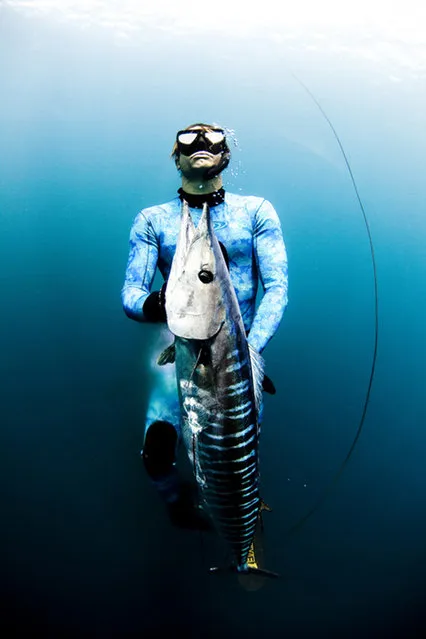
Free Dive Hunters

Without the use of any type of scuba equipment, divers descend to great depths armed with underwater guns, harpoons and strong line to stalk and hunt prey. Some of the best free-divers in the world can hold their breath for up to 5 minutes under water and go to depths greater than 100 feet.
(All photography © Eyeconic Images.)
Details
26 Jun 2013 14:17:00
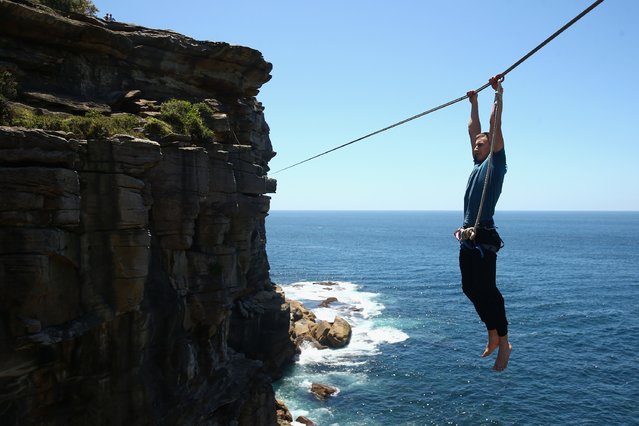
Antek Marciniec holds onto a slackline after falling off as he highlines between two cliffs at Diamond Bay on December 21, 2014 in Sydney, Australia. Slacklining is a balance sport in which participants walk on a flat nylon webbing anchored between two points with the tension adjusted to allow for slack, providing an experience similiar to that of walking on a trapmoline. Highlining is a style of slacklining where the two anchor points are set up with significant elevation from the ground or water. (Photo by Cameron Spencer/Getty Images)

Antek Marciniec holds onto a slackline after falling off as he highlines between two cliffs at Diamond Bay on December 21, 2014 in Sydney, Australia. Slacklining is a balance sport in which participants walk on a flat nylon webbing anchored between two points with the tension adjusted to allow for slack, providing an experience similiar to that of walking on a trapmoline. Highlining is a style of slacklining where the two anchor points are set up with significant elevation from the ground or water. (Photo by Cameron Spencer/Getty Images)
Details
28 Dec 2014 11:50:00
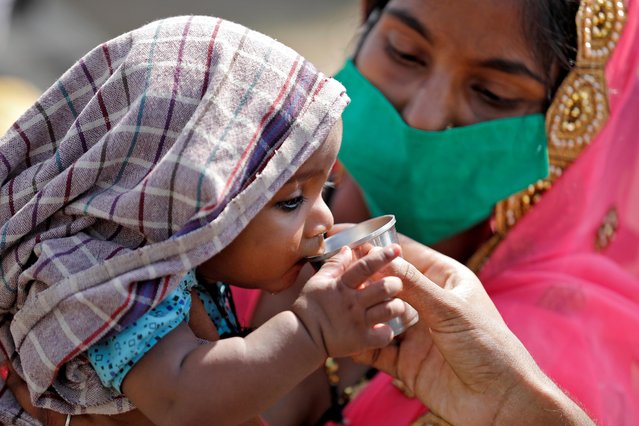
A child of a migrant worker drinks water as his mother holds him while waiting in a queue for transport to reach to a railway station to board a train to their home state of northern Uttar Pradesh, after a limited reopening of India's giant rail network following a nearly seven-week lockdown to slow the spreading of the coronavirus disease (COVID-19), in Ahmedabad, India, May 15, 2020. (Photo by Amit Dave/Reuters)

A child of a migrant worker drinks water as his mother holds him while waiting in a queue for transport to reach to a railway station to board a train to their home state of northern Uttar Pradesh, after a limited reopening of India's giant rail network following a nearly seven-week lockdown to slow the spreading of the coronavirus disease (COVID-19), in Ahmedabad, India, May 15, 2020. (Photo by Amit Dave/Reuters)
Details
23 May 2020 00:01:00
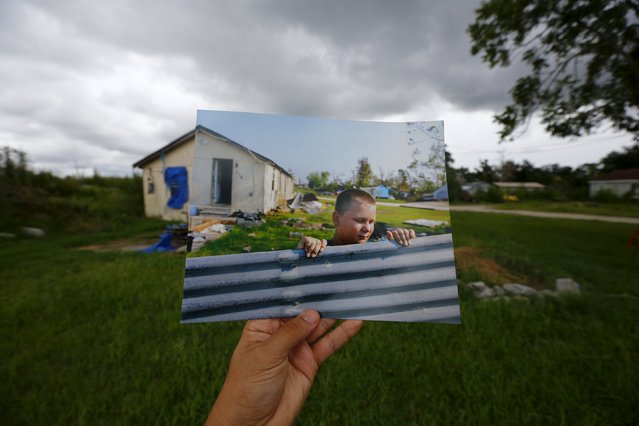
Photographer Carlos Barria holds a print of a photograph he took in 2005, as he matches it up at the same location 10 years on, in Lafitte, south of New Orleans, United States, August 16, 2015. The print shows Tyler Teal cleaning up his home, September 14, 2005, after Hurricane Katrina struck. (Photo by Carlos Barria/Reuters)

Photographer Carlos Barria holds a print of a photograph he took in 2005, as he matches it up at the same location 10 years on, in Lafitte, south of New Orleans, United States, August 16, 2015. The print shows Tyler Teal cleaning up his home, September 14, 2005, after Hurricane Katrina struck. In 2005, Hurricane Katrina triggered floods that inundated New Orleans and killed more than 1,500 people as storm waters overwhelmed levees and broke through floodwalls. (Photo by Carlos Barria/Reuters)
Details
23 Aug 2015 10:00:00
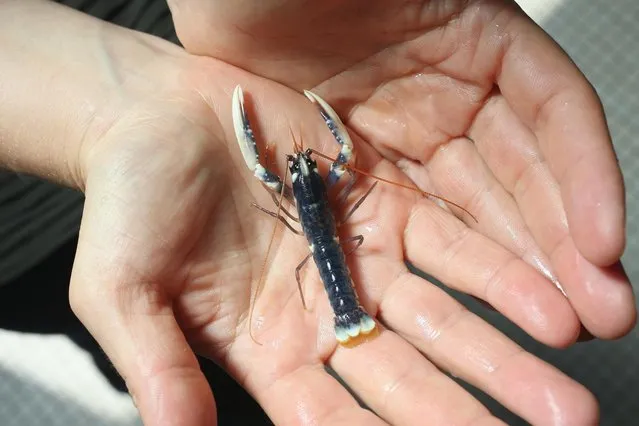
Isabel Schmalenbach, an environmental scientist with the Helgoland Biological Institute (Biologische Anstalt Helgoland), part of the Alfred Wegener Institute for Polar and Marine Research, holds a one-year old baby European lobster (Homarus gammarus) raised at the institute on August 3, 2013 on Helgoland Island, Germany. (Photo by Sean Gallup/Getty Images)

Isabel Schmalenbach, an environmental scientist with the Helgoland Biological Institute (Biologische Anstalt Helgoland), part of the Alfred Wegener Institute for Polar and Marine Research, holds a one-year old baby European lobster (Homarus gammarus) raised at the institute on August 3, 2013 on Helgoland Island, Germany. Later in the day Schmalenbach and her colleagues released a total of 415 one-year old lobsters into the North Sea as part of an effort to repopulate the lobster population around Helgoland (also called Heligoland). In the 19th century local fishermen caught up to 80,000 lobsters a year in the surrounding waters, combined with the heavy allied bombing of the island during and after World War II, as well as other environmental factors, decimated the lobster population. (Photo by Sean Gallup)
Details
05 Aug 2013 08:39:00
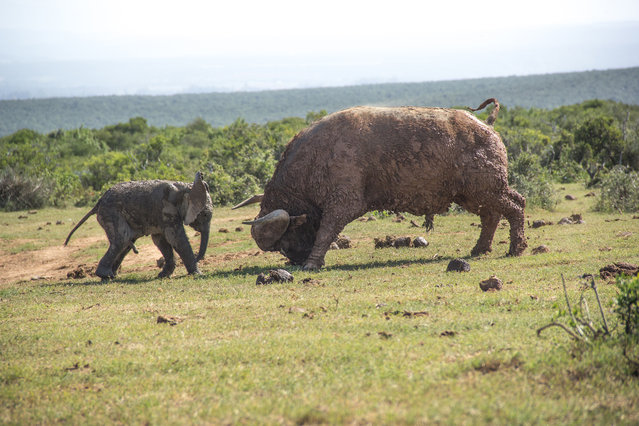
The buffalo bull charges, on March 23, 2014, in Addo Elephant National Park, South Africa. A young elephant calf tried to attack an old buffalo bull  and was taught a lesson it will never forget. (Photo by Conrad Cramer/Barcroft Media)

The buffalo bull charges, on March 23, 2014, in Addo Elephant National Park, South Africa. A young elephant calf tried to attack an old buffalo bull and was taught a lesson it will never forget. The calf was with its herd at a watering hold Addo Elephant National park, South Africa, when the buffalo ventured towards the water. The elephant ran towards the buffalo but the larger animal picked up the young calf and tossed it four metres in the air. Luckily, the elephant was not hurt, but its pride was seriously injured. (Photo by Conrad Cramer/Barcroft Media)
Details
29 Aug 2014 11:30:00