Loading...
Done
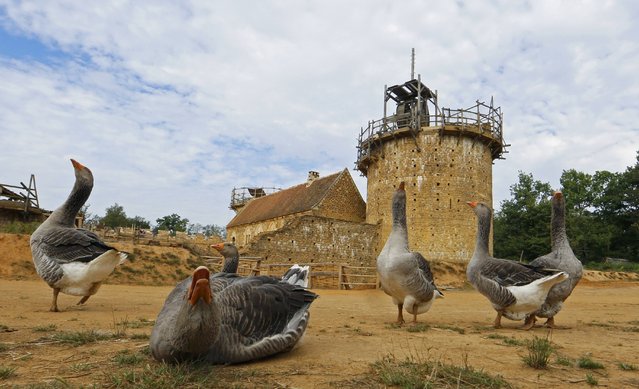
A view of the construction site of the Chateau de Guedelon near Treigny in the Burgundy region of France, September 13, 2016. Blacksmiths, stonemasons and quarry men are hard at work in a Burgundy forest building a 13th-century-style castle using the most basic tools and materials, replicating the methods used hundreds of years ago to better understand them. Forgoing all modern technology, workers use hammers to break stones and forge iron, operate wooden wheels to hoist their materials up to where they are needed, and rely on a quarry for stone, clay and sand as they build up a castle from scratch. Construction on Guedelon Castle in central France began in 1997 after an archaeological survey revealed a medieval fortress hidden inside the walls of nearby Chateau de Saint-Fargeau. Those behind the project hope to answer questions about medieval construction and provide lessons on sustainable building. (Photo by Jacky Naegelen/Reuters)

A view of the construction site of the Chateau de Guedelon near Treigny in the Burgundy region of France, September 13, 2016. Blacksmiths, stonemasons and quarry men are hard at work in a Burgundy forest building a 13th-century-style castle using the most basic tools and materials, replicating the methods used hundreds of years ago to better understand them. (Photo by Jacky Naegelen/Reuters)
Details
15 Sep 2016 09:43:00
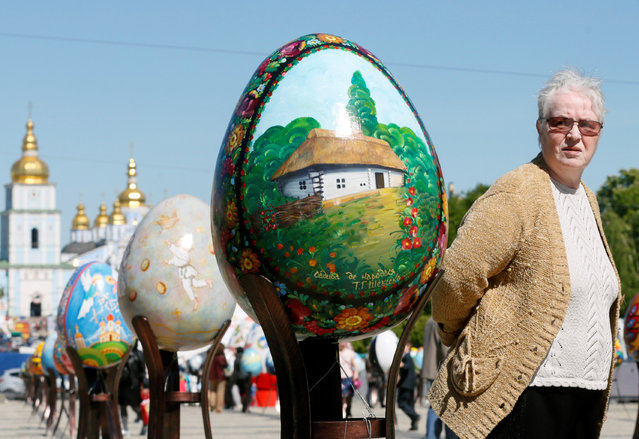
A woman looks at traditional Ukrainian Easter eggs “Pysanka”, installed as part of the upcoming celebrations of Easter, in central Kiev, Ukraine, April 29, 2016. A pysanka is a Ukrainian Easter egg, decorated with traditional Ukrainian folk designs using a wax-resist (batik) method. The word pysanka comes from the verb pysaty, “to write”, as the designs are not painted on, but written with beeswax. Many other eastern European ethnic groups decorate eggs using wax resist for Easter. These include the Belarusians, Bulgarians, Croats, Czechs, Hungarians, Lithuanians, Poles, Romanians, Serbs, Slovaks, Slovenes and Sorbs. (Photo by Valentyn Ogirenko/Reuters)

A woman looks at traditional Ukrainian Easter eggs “Pysanka”, installed as part of the upcoming celebrations of Easter, in central Kiev, Ukraine, April 29, 2016. A pysanka is a Ukrainian Easter egg, decorated with traditional Ukrainian folk designs using a wax-resist (batik) method. The word pysanka comes from the verb pysaty, “to write”, as the designs are not painted on, but written with beeswax. Many other eastern European ethnic groups decorate eggs using wax resist for Easter. These include the Belarusians, Bulgarians, Croats, Czechs, Hungarians, Lithuanians, Poles, Romanians, Serbs, Slovaks, Slovenes and Sorbs. (Photo by Valentyn Ogirenko/Reuters)
Details
30 Apr 2016 09:00:00
Clashes At Golden Temple

Sikhs wield swords during their clash inside the complex of the holy Sikh shrine, the Golden Temple, in Amritsar June 6, 2014. Sikhs wielding swords clashed inside the compound of their religion's holiest shrine on Friday, the 30th anniversary of a controversial raid by security forces that flushed out separatist militants holed up in the temple. REUTERS/Munish Sharma
Details
07 Jun 2014 10:33:00
Egg Sculptures By Franc Grom

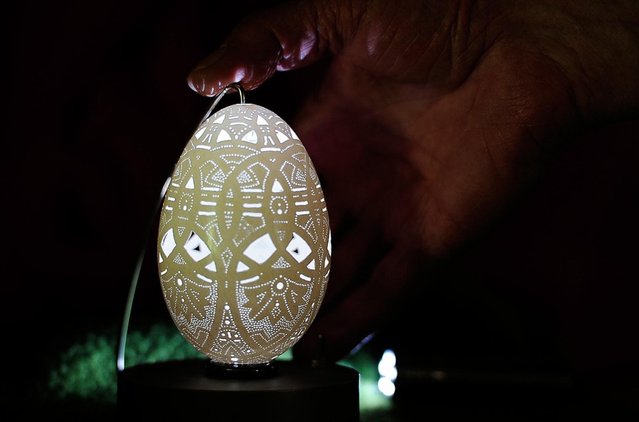
Slovenian artist Franc Grom, aged 72, makes unbelievably intricate egg sculptures using just a tiny electric drill and enormous patience. According to National Geographic, when finished, each egg contains approximately 2,500 to 3,500 holes. While Slovene artisans usually paint their eggs using a technique called drsanka by lightly scratching intricate patterns into the surfaces of colored eggs, carving them was solely Grom’s idea.
Details
24 Nov 2016 08:00:00
Sculptures By Hu Shaoming

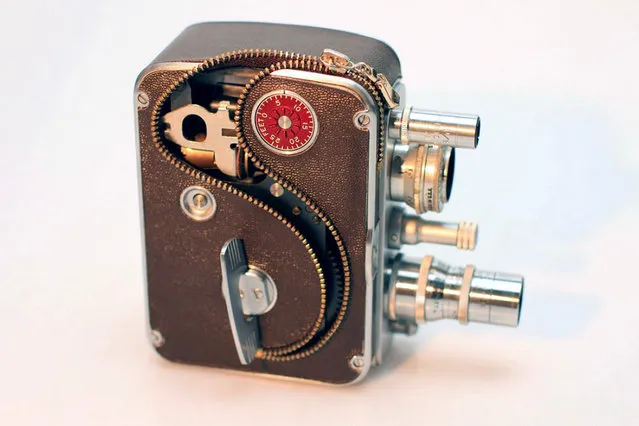
The works of Hu Shaoming immediately catch the eye of the onlookers with their level on intricacy and uniqueness. To provide a glimpse into the intricate workings of vintage cameras he uses a very unique method. He made it seem as if the fine leather covering of the camera was opened by zipper, showing its innards. A similar technique was used on an ancient telephone, though there it looks more like an embellishment. The idea was so marvelously put into life that it seems as if those items can actually be zipped up, though of course that is not possible.
Details
05 Mar 2015 11:31:00
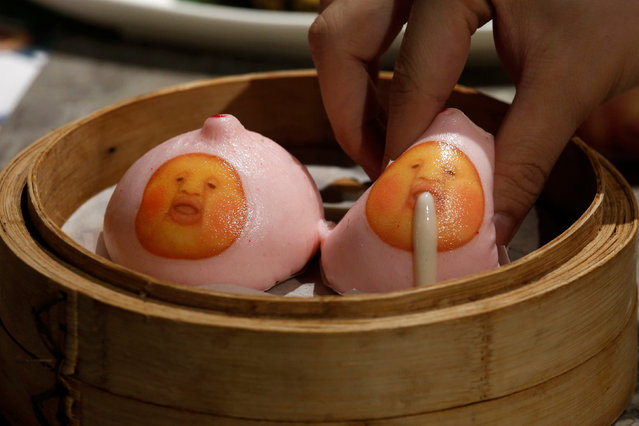
A milk custard bun made to resemble one of the popular Japanese “Kobitos” characters is squeezed during a display for the photographer at Dim Sum Icon restaurant in Hong Kong, China July 25, 2016. A dim sum restaurant in Hong Kong encourages diners to play with their food, and the result will either disgust or delight you. At Dim Sum Icon customers can squeeze a strange creature to poo or vomit on their plate before eating it. Hungry punters poke a hole into the mouth – or the rear – of the dim sum with a chopstick, squeeze it and watch the brown or white cream ooze out. (Photo by Bobby Yip/Reuters)

A milk custard bun made to resemble one of the popular Japanese “Kobitos” characters is squeezed during a display for the photographer at Dim Sum Icon restaurant in Hong Kong, China July 25, 2016. A dim sum restaurant in Hong Kong encourages diners to play with their food, and the result will either disgust or delight you. At Dim Sum Icon customers can squeeze a strange creature to poo or vomit on their plate before eating it. Hungry punters poke a hole into the mouth – or the rear – of the dim sum with a chopstick, squeeze it and watch the brown or white cream ooze out. The unique dim sums are made with a face to resemble Japanese Kobitos characters. (Photo by Bobby Yip/Reuters)
Details
31 Jul 2016 11:25:00
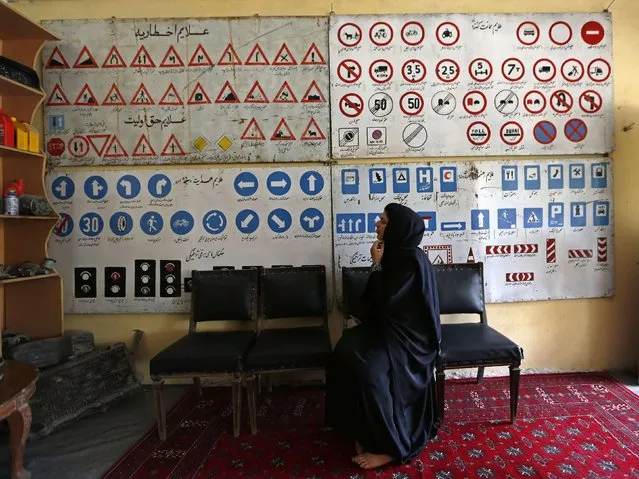
A women attends a class at a driving school in Kabul August 17, 2014. Kabul is one of the world's fastest growing cities and its streets are increasingly blocked by cars and buses. In the city's private driving schools, students pay a $60 fee for a 45-day course, which includes oral and practical driving tests at the country's Traffic Department. (Photo by Mohammad Ismail/Reuters)

A women attends a class at a driving school in Kabul August 17, 2014. Kabul is one of the world's fastest growing cities and its streets are increasingly blocked by cars and buses. In the city's private driving schools, students pay a $60 fee for a 45-day course, which includes oral and practical driving tests at the country's Traffic Department. Some of the women who have signed up say learning to drive is a way to escape unwanted gazes and physical harassment on the cramped, crowded minibuses that are often the only method of urban public transport. (Photo by Mohammad Ismail/Reuters)
Details
19 Dec 2014 12:56:00
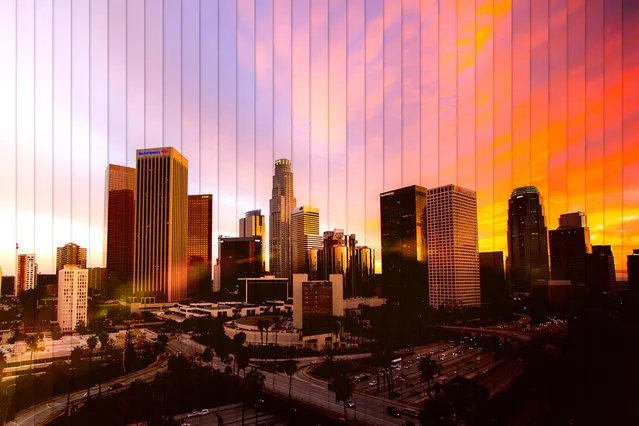
Chicago: 35 photographs, 15 minutes. (Photo by Daniel Marker-Moors/Caters News)

A photographer is using a unique method to show the shift from day to night across famous cities in spectacular images. Daniel Marker-Moors' take on time-lapse photography – which he calls time slice – sees the photographer snap image after image, before combining them to create beautiful, vibrant works. His images usually focus on a point in the day with the most dramatic change in light, such as sunrise or sunset. Marker-Moors, from Los Angeles, begins by shooting hundreds and sometimes thousands of images from the same spot. Here: Chicago – 35 photographs, 15 minutes. (Photo by Daniel Marker-Moors/Caters News)
Details
21 Dec 2015 08:04:00