Loading...
Done


“The Red River Hog (Potamochoerus porcus), also known as the Bush Pig (but not to be confused with P. larvatus, common name “Bushpig”), is a wild member of the pig family living in Africa, with most of its distribution in the Guinean and Congolian forests. It is rarely seen away from rainforests, and generally prefers areas near rivers or swamps.

Red River Hogs eat grass, berries, roots, insects, molluscs, small vertebrates and carrion. They are capable of causing damage to plantations. Red River Hogs typically live in herds of 6-20 members led by a dominant boar. Sows rear 3-6 piglets at a time.”

Photo: Two 17 day old red river hoglet twins forage for food next to their mother Bahiti at London Zoo on August 23, 2007 in London, England. Red River hoglets inhabit the forests and swamps of West and Central Africa. The recent additions to the London Zoo pig pen have been eagerly awaited by zoo keepers. (Photo by Chris Jackson/Getty Images)
Details
18 Mar 2011 15:15:00
In this Tuesday, February 5, 2019, photo, fire-eater performs during celebrations of the Lunar New Year in the Chinatown district of Manila, Philippines. This year is the Year of the Earth Pig in the Chinese Lunar calendar and is supposed to represent abundance, diligence and generosity. (Photo by Bullit Marquez/AP Photo)

In this Tuesday, February 5, 2019, photo, fire-eater performs during celebrations of the Lunar New Year in the Chinatown district of Manila, Philippines. This year is the Year of the Earth Pig in the Chinese Lunar calendar and is supposed to represent abundance, diligence and generosity. (Photo by Bullit Marquez/AP Photo)
Details
07 Feb 2019 08:22:00
In this Friday, February 1, 2019, photo, Filipino-Chinese display piggy banks at the start of celebrations leading to next week's Lunar New Year in Chinatown, Manila, Philippines. This year is the Year of the Earth Pig on the Lunar calendar and is supposed to represent abundance, diligence and generosity. (Photo by Bullit Marquez/AP Photo)

In this Friday, February 1, 2019, photo, Filipino-Chinese display piggy banks at the start of celebrations leading to next week's Lunar New Year in Chinatown, Manila, Philippines. This year is the Year of the Earth Pig on the Lunar calendar and is supposed to represent abundance, diligence and generosity. (Photo by Bullit Marquez/AP Photo)
Details
09 Feb 2019 00:05:00
Youtubers wearing masks of pigs film a video at a shopping district which has fewer people than usually amid the coronavirus disease (COVID-19) outbreak in Tokyo, Japan, May 19, 2020. (Photo by Kim Kyung-Hoon/Reuters)

Youtubers wearing masks of pigs film a video at a shopping district which has fewer people than usually amid the coronavirus disease (COVID-19) outbreak in Tokyo, Japan, May 19, 2020. (Photo by Kim Kyung-Hoon/Reuters)
Details
31 May 2020 00:01:00
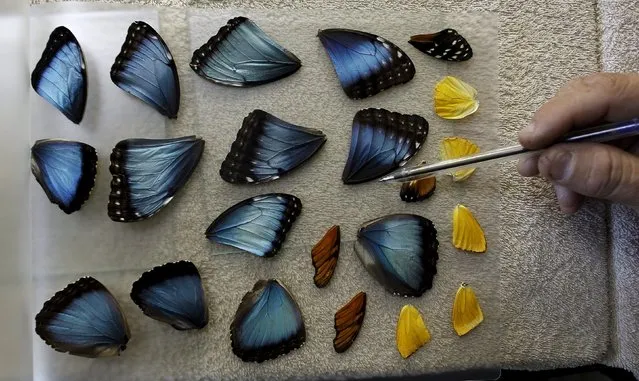
Frander Arroyo, select wings of butterflies at Blue Morpho Butterfly House in Alajuela, Costa Rica, March 10, 2016. According to Arroyo, owner of Blue Morpho Butterfly House, he collects dead butterflies from his garden to mount as handicraft like earrings, necklaces, paintings and rings for export with prices ranging from $12 to $16 a piece. (Photo by Juan Carlos Ulate/Reuters)

Frander Arroyo, select wings of butterflies at Blue Morpho Butterfly House in Alajuela, Costa Rica, March 10, 2016. According to Arroyo, owner of Blue Morpho Butterfly House, he collects dead butterflies from his garden to mount as handicraft like earrings, necklaces, paintings and rings for export with prices ranging from $12 to $16 a piece. (Photo by Juan Carlos Ulate/Reuters)
Details
12 Mar 2016 14:29:00
A young Ukrainian woman wears an ear of grain braid during a traditional Ukrainian celebration of Kupalo Night, in Warsaw, Poland, on Saturday, June 22, 2024. Ukrainians in Warsaw jumped over a bonfire and floated braids to honor the vital powers of water and fire on the Vistula River bank Saturday night, as they celebrated their solstice tradition of Ivan Kupalo Night away from war-torn home. (Photo by Czarek Sokolowski/AP Photo)

A young Ukrainian woman wears an ear of grain braid during a traditional Ukrainian celebration of Kupalo Night, in Warsaw, Poland, on Saturday, June 22, 2024. Ukrainians in Warsaw jumped over a bonfire and floated braids to honor the vital powers of water and fire on the Vistula River bank Saturday night, as they celebrated their solstice tradition of Ivan Kupalo Night away from war-torn home. (Photo by Czarek Sokolowski/AP Photo)
Details
10 Oct 2025 04:37:00
Hamlet the micro pig may already be a hit on Instagram, but its not stopped her from hogging the limelight on her birthday. Known for her adorable costume play, the miniature pig, from Pasadena, California, celebrated her first birthday in style, inviting all her furry Instagram friends to join her party. Pictured wearing a bright pink tutu and a tiara fit for a princess, Hamlet, who is named after Lady Hamlet from the Shakespeare play, shows that shes no boar when it comes to partying. Here: Hamlet enjoying his birthday party. (Photo by Caters News)

Hamlet the micro pig may already be a hit on Instagram, but its not stopped her from hogging the limelight on her birthday. Known for her adorable costume play, the miniature pig, from Pasadena, California, celebrated her first birthday in style, inviting all her furry Instagram friends to join her party. Pictured wearing a bright pink tutu and a tiara fit for a princess, Hamlet, who is named after Lady Hamlet from the Shakespeare play, shows that shes no boar when it comes to partying. Here: Hamlet enjoying his birthday party. (Photo by Caters News)
Details
31 Mar 2015 12:53:00
Arctic Hare

The arctic hare, or polar rabbit, is a species of hare which is adapted largely to polar and mountainous habitats. The arctic hare survives with a thick coat of fur and usually digs holes in the ground or under snow to keep warm and sleep. Arctic hares look like rabbits but have shorter ears, are taller when standing, and, unlike rabbits, can thrive in cold climates. They can travel together with many other hares, sometimes huddling with dozens or more, but are usually found alone, taking, in some cases, more than one partner. The arctic hare can run up to 60 kilometres per hour (40 mph). Its predators include the arctic wolf, arctic fox, and ermine.
Details
17 Mar 2014 13:56:00