Loading...
Done
“Peat Fire”. Taken in March 2013 on the east coast of Harris. The fire is from muir-burning, when farmers burn off grasses and heather to improve grazing for their sheep. (Photo by John Maher/The Guardian)

Photographer John Maher, once the drummer with punk bank Buzzcocks, travelled to the Outer Hebrides to photograph abandoned crofters’ cottages – many of which, like this one, have seemingly been untouched since. Here: “Peat Fire”. Taken in March 2013 on the east coast of Harris. The fire is from muir-burning, when farmers burn off grasses and heather to improve grazing for their sheep. (Photo by John Maher/The Guardian)
Details
19 Aug 2016 11:39:00
Prakash Amte is seen playing with a Hyena from his orphanage on September 19, 2017 in Maharashtra, India. (Photo by Haziq Qadri/Barcroft Media)

A couple have taken their love of animals to the extreme – by opening up their home to over 100 rescued animals. Dr Prakash Amte and his wife, Dr. Mandakini Amte have dedicated their lives to helping both the animals – and people – of Hemalkasa, Maharashtra in India. Here: Prakash Amte is seen playing with a Hyena from his orphanage on September 19, 2017 in Maharashtra, India. (Photo by Haziq Qadri/Barcroft Media)
Details
20 Oct 2017 06:38:00
CT4 Crocodile cave on the Salamat river. Set up with Nathan Williamson last chip rain came while we were with the nomads. (Photo by Michael Nichols/National Geographic)

National Geographic has created “Air, Land & Sea: the 50 greatest wildlife photographs” exhibition. Here: CT4 Crocodile cave on the Salamat river. Set up with Nathan Williamson last chip rain came while we were with the nomads. (Photo by Michael Nichols/National Geographic)
Details
13 Sep 2018 00:03:00
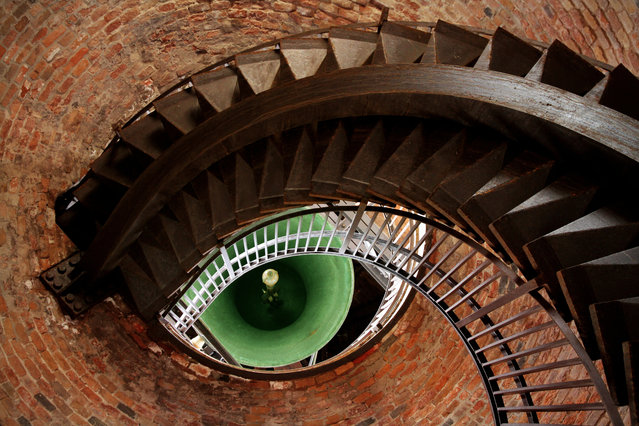
“Eye of the Tower” by Mehmet Yasa; Verona, Italy. “The staircase and the bell looks like an eye. Architecture can fascinate us in many ways”. (Photo by Mehmet Yasa/Art of Building Photography Awards 2017)

“Eye of the Tower” by Mehmet Yasa; Verona, Italy. “The staircase and the bell looks like an eye. Architecture can fascinate us in many ways”. (Photo by Mehmet Yasa/Art of Building Photography Awards 2017)

Details
12 Dec 2017 06:41:00
“The V-30 Warhawk was designed by Blackshaw Avionics as a long-range fighter and was primarily used by the Arcadian Air Force for escort duties. . (Jon Hall)

“The V-30 Warhawk was designed by Blackshaw Avionics as a long-range fighter and was primarily used by the Arcadian Air Force for escort duties. The plane pictured is the “Spirit of Freedom” and was one of the four planes that escorted the Arcadian Royal Airship during and after the Great War. The three other fighters were the “Spirit of Hope”, the “Spirit of Justice” and the “Spirit of Destiny”. All pilots were hand-picked by the Head of Airborne Forces and included some of the very finest pilots in the Kingdom. The crew consisted of one pilot and one gunner although both cabins were fitted so that if either crew member was killed the other could take over their duties. Each Warhawk was fitted with four Haverlock “Banshee” engines and four 24mm machine guns”. (Photo and comment by Jon Hall)


Details
11 Feb 2013 10:36:00
Yalena Leuliette, 7, of Greenbelt, Md., throws seeds from a cattail plant up in the air as she plays while visiting the Kenilworth Aquatic Gardens in northeast Washington, on Sunday, August 9, 2015. Leuliette visits the public garden with her parents a few times a year. (Photo by Jacquelyn Martin/AP Photo)

Yalena Leuliette, 7, of Greenbelt, Md., throws seeds from a cattail plant up in the air as she plays while visiting the Kenilworth Aquatic Gardens in northeast Washington, on Sunday, August 9, 2015. Leuliette visits the public garden with her parents a few times a year. (Photo by Jacquelyn Martin/AP Photo)
Details
06 Sep 2015 13:07:00
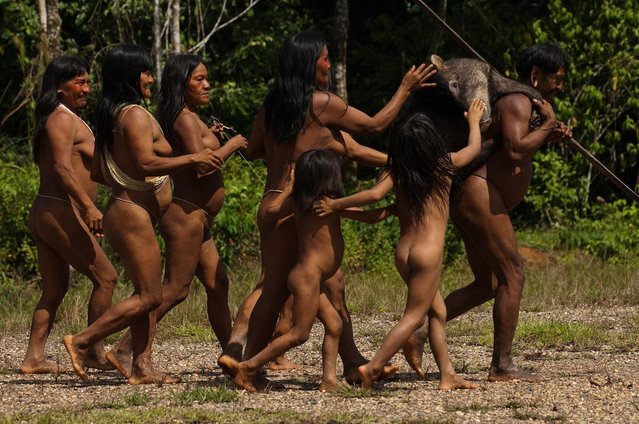
Spectacular images offering insight into the lives of the Huaorani people in the Ecuadorian Amazon have been revealed showing how they use traditional methods to hunt monkeys for food. The stunning pictures were taken by conservation photographer Pete Oxford from Torquay, Devon in the Ecuadorian Amazon. “The Huaorani Indians are a forest people highly in tune with their environment. Many are now totally acculturated since the 1950s by missionaries”, said Pete. “Today they face radical change to their culture to the proximity of oil exploration within their territory and the Yasuni National Park and Biosphere Reserve, they are vastly changed. Some still live very traditionally and for this shoot, through my Huaorani friend, a direct relative of those photographed he wanted to depict them as close to their original culture as possible. They still largely hunt with blow pipes and spears eating a lot of monkeys and peccaries”. The Huaorani are also known as the Waorani, Waodani or the Waos and are native Amerindians. Their lands are located between the Curaray and Napo rivers and speak the Huaorani language. Pete says that during his visit he was welcomed into the group and hopes that ancient cultures can be saved. Here: The tribe were seen celebrating after a hunter returned to camp with a wild pig. (Photo by Pete Oxford/Mediadrumworld.com)

Spectacular images offering insight into the lives of the Huaorani people in the Ecuadorian Amazon have been revealed showing how they use traditional methods to hunt monkeys for food. The stunning pictures were taken by conservation photographer Pete Oxford from Torquay, Devon in the Ecuadorian Amazon. Here: The tribe were seen celebrating after a hunter returned to camp with a wild pig. (Photo by Pete Oxford/Mediadrumworld.com)
Details
20 Jan 2017 07:58:00
A seagull who turned bright orange after he plunged into a vat of chicken tikka masala in Beckford, England on June 9, 2016. The bird fell into a container of the food while trying to scavenge a piece of meat from a food factory bin in Wales. (Photo by Vale Wildlife Hospital/PA Wire)

A seagull who turned bright orange after he plunged into a vat of chicken tikka masala in Beckford, England on June 9, 2016. The bird fell into a container of the food while trying to scavenge a piece of meat from a food factory bin in Wales. (Photo by Vale Wildlife Hospital/PA Wire)
Details
12 Jun 2016 10:11:00