Loading...
Done
GIF Art By James Kerr

James Kerr started his project “Scorpion Dagger” without any real direction, except for the intention to make one GIF everyday(ish) for one year. He had been making collages for some time and “Scorpion Dagger” started out to be a test of discipline and a way for him to learn how to animate. Making GIFs was a logical evolution to him. The project represents many different things to him, the works from which he draws upon are so powerful and inspirational to him, that he is now nearly obsessed with repurposing them to share his vision of the world, and perhaps inspire people to look at art differently. The project is tremendously personal to him, it’s a lot more than the humor that’s at its surface and he is still trying to work out what “Scorpion Dagger” really is.
Details
23 Dec 2013 10:39:00
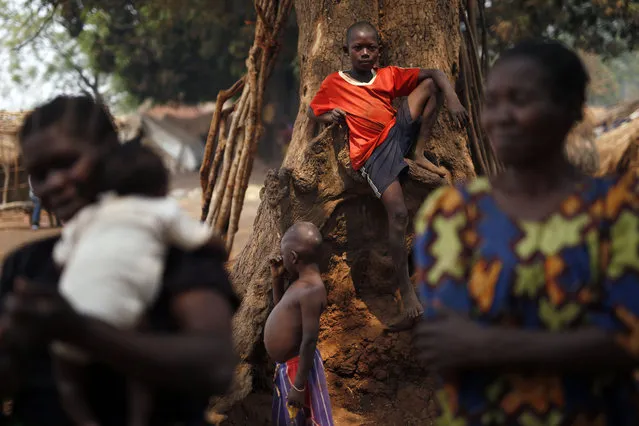
Christian families living in a refugee camp stand under a tree in Kaga-Bandoro, Central African Republic, Tuesday February 16,  2016. (Photo by Jerome Delay/AP Photo)

Christian families living in a refugee camp stand under a tree in Kaga-Bandoro, Central African Republic, Tuesday February 16, 2016. Refugees in the north of Central African Republic say they hope the new president will bring peace but no one is heading home just yet. Thousands are still living in displacement camps in Kaga-Bandoro, a stronghold of the former Muslim rebel group known as Seleka that was in power for nearly a year. The one-time rebels say they are waiting to see how the election turns out before taking any action. (Photo by Jerome Delay/AP Photo)
Details
20 Feb 2016 10:13:00
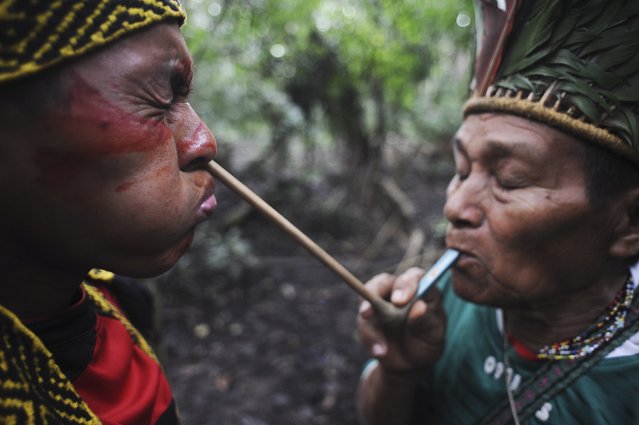
A spiritual leader (R) of the Huni Kui Indian tribe blows an herbal powder into the nose of a tribal member during a ceremony outside the village of Novo Segredo along the Envira river of Brazil's northwestern Acre state, March 9, 2014. (Photo by Lunae Parracho/Reuters)

A spiritual leader (R) of the Huni Kui Indian tribe blows an herbal powder into the nose of a tribal member during a ceremony outside the village of Novo Segredo along the Envira river of Brazil's northwestern Acre state, March 9, 2014. Many indigenous groups, including the Huni Kui, Ashaninka, and Madija, live in villages in the Brazilian rainforest near the border with Peru. (Photo by Lunae Parracho/Reuters)
Details
04 Apr 2014 08:18:00
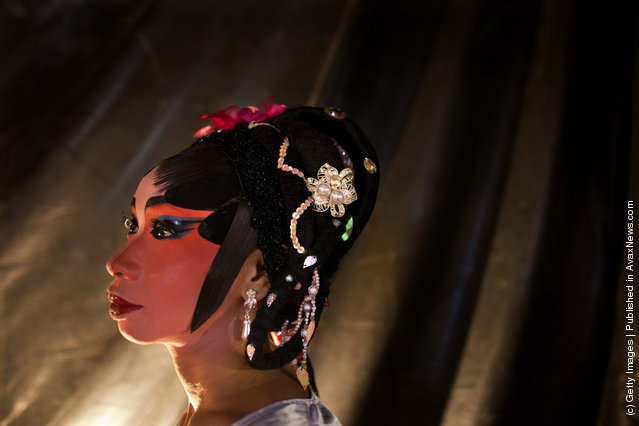
Behind The Scenes At The Chinese Opera In Thailand

Wanwisa, a Lao Yi Lai Heng Chinese opera performer waits backstage at the Plub Plachai temple on January 25, 2012 in Bangkok, Thailand. The traditional Chinese art form involving music, singing, martial arts and acting has a history of more than 500 years. There are about 30 members working with the group doing specials shows all week to celebrate the Chinese New year. The Chinese opera is popular in many parts of China, Malaysia, Singapore, Thailand and Macau. (Photo by Paula Bronstein/Getty Images)
Details
28 Jan 2012 12:14:00
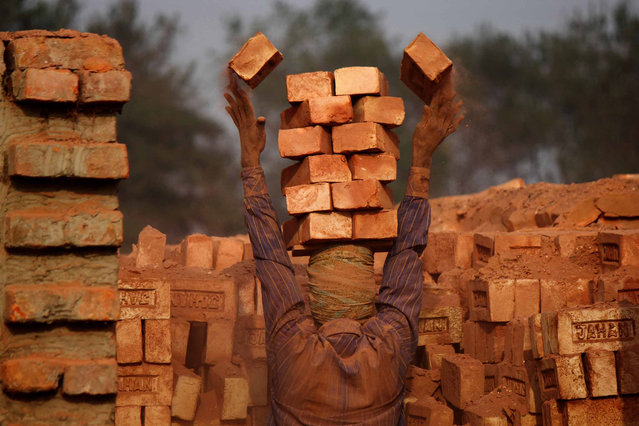
CGAP Photo Contest – South Asia Regional Winner: Bricks Worker, Bangladesh. A private enterprise worker is working at a brick field. These small businesses are creating new job opportunities for many poor people. (Photo by Moksumul Haque)

The shoemaker in Turkey, the potato seller in Vietnam, and the weaver in Bolivia are among the billions of low-income entrepreneurs who make the world go round. They are also the type of people who can benefit significantly from microfinance. Every year, the Consultative Group To Assist The Poor (or CGAP) hosts a photo contest asking entrants to submit photos based around the idea of microfinance.The purpose of the contest is to give amateur and professional photographers a chance to show the different ways that poor households manage their financial lives and make their lives better through financial inclusion. Photo: South Asia Regional Winner – “Bricks Worker”, Bangladesh. A private enterprise worker is working at a brick field. These small businesses are creating new job opportunities for many poor people. (Photo by Moksumul Haque)
Details
14 Aug 2014 10:58:00
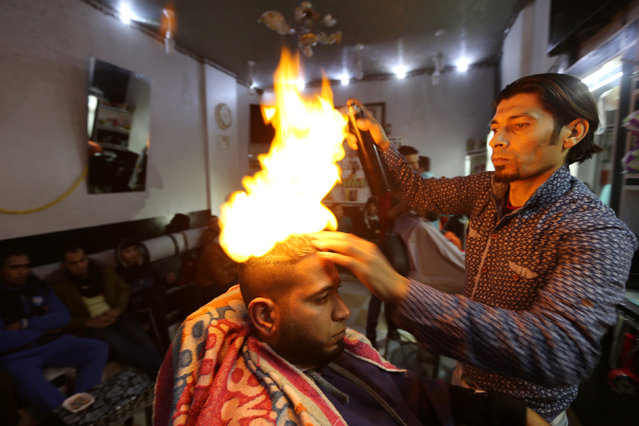
Palestinian barber Ramadan Odwan styles and straightens the hair of a customer with fire at his salon in Rafah, in the southern Gaza Strip February 2, 2017. In Ramadan Odwan's barbershop in Gaza, hair isn't just blow-dried, it's blowtorch-dried. “People have gone crazy about it, many people are curious to go through the experience and they are not afraid”, he told Reuters. “People here love adventures”. Odwan, 37, is not the first stylist in the world to use flame to straighten hair, but his craft is unique in the Gaza Strip. In his salon in the southern Gaza town of Rafah, Odwan applied what he described as a protective liquid coating to a customer's hair – he declined to disclose its contents – before aiming for the head and pressing the button on a small blowtorch. “I control how long I apply fire, I keep it on and off for 10 seconds or 15 seconds. It is completely safe and I have not encountered any accident since I started it two months ago”, Odwan added. Odwan charges 20 shekels ($5.20) for a haircut and fire-straightening. A barber for the past 18 years, he said part of the reason he uses the technique is to show that Palestinian barbers are as “professional as those out there around the world”. (Photo by Ibraheem Abu Mustafa/Reuters)

Palestinian barber Ramadan Odwan styles and straightens the hair of a customer with fire at his salon in Rafah, in the southern Gaza Strip February 2, 2017. In Ramadan Odwan's barbershop in Gaza, hair isn't just blow-dried, it's blowtorch-dried. “People have gone crazy about it, many people are curious to go through the experience and they are not afraid”, he told Reuters. “People here love adventures”. (Photo by Ibraheem Abu Mustafa/Reuters)
Details
11 Feb 2017 00:05:00
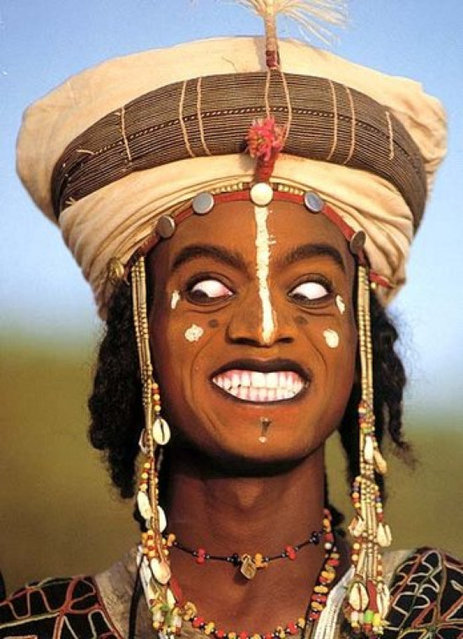
Beauty_By_Fulani

Fula people or Fulani or Fulbe are an ethnic group spread over many countries, predominantly in West Africa, but found also in Central Africa and Sudanese North Africa. African countries where they are present include Mauritania, Ghana, Senegal, Guinea, The Gambia, Mali, Nigeria, Sierra Leone, Benin, Burkina Faso, Guinea Bissau, Cameroon, Côte d'Ivoire, Niger, Chad, Togo, the Central African Republic, Liberia, and as far as Sudan and Egypt in the East. Fula people form a minority in every country they inhabit, but in Guinea they represent a plurality of the population (40%).
Details
25 Sep 2012 10:17:00


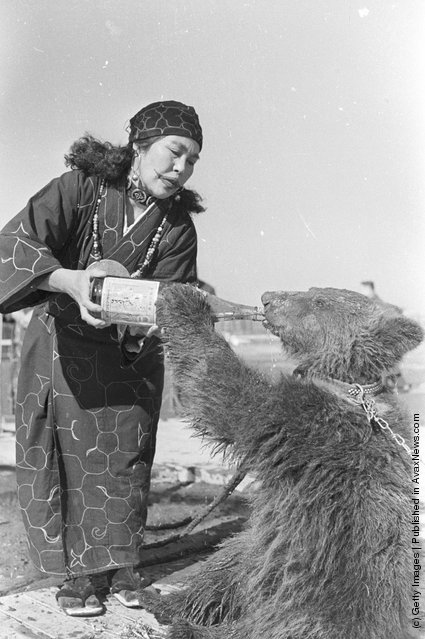
“The Ainu (アイヌ?), also called Aynu, Aino (アイノ), and in historical texts Ezo (蝦夷), are indigenous people or groups in Japan and Russia. Historically they spoke the Ainu language and related varieties and lived in Hokkaidō, the Kuril Islands, and much of Sakhalin. Most of those who identify themselves as Ainu still live in this same region, though the exact number of living Ainu is unknown. This is due to ethnic issues in Japan resulting in those with Ainu backgrounds hiding their identities and confusion over mixed heritages. In Japan, because of intermarriage over many years with Japanese, the concept of a 'pure Ainu' ethnic group is no longer feasible. Official estimates of the population are of around 25,000, while the unofficial number is upwards of 200,000 people”. – Wkipedia

Photo: A captive bear drinking from a large bottle held by an Ainu tribeswoman. (Photo by Evans/Three Lions/Getty Images). Circa 1955
Details
24 Mar 2011 14:01:00