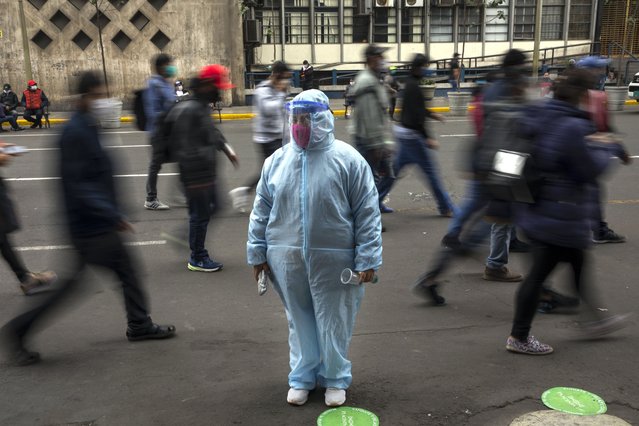
A woman waits outside a shop wearing protective gear due to the COVID-19 pandemic in downtown Lima, Peru, Monday, July 6, 2020. (Photo by Rodrigo Abd/AP Photo)
French fashion designer Julien Fournie (R) poses with his Czech model Michaela Tomanova during the shooting of a film designed in place of the fashion show on June 30, 2020 as France eases lockdown measures taken to curb the spread of the COVID-19 disease caused by the novel coronavirus. (Photo by Franck Fife/AFP Photo)
A woman wears a face mask in the part of the city near neighbourhoods known for burning coal for heating in Ulaanbaatar, Mongolia January 26, 2017. Not many people in Ulaanbaatar wear masks to protect themselves against pollution. (Photo by B. Rentsendorj/Reuters)
A general view of atmosphere at the annual VOLT Festival in Sopron, 208 kms west of Budapest, Hungary on August 16, 2016. (Photo by Rockstar Photographers)
Fans react as they watch HBO's “Game of Thrones” series finale at a viewing party at Brennan's bar in Marina del Rey, California, May 19, 2019. (Photo by Robyn Beck/AFP Photo)
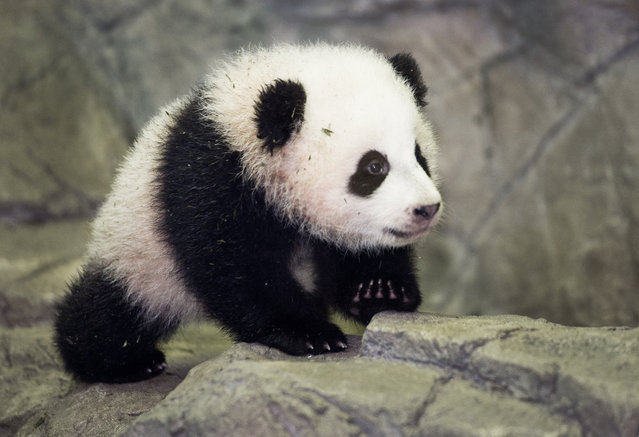
Bao Bao, the Giant Panda cub is seen by the media for the first time January 6, 2014 inside his glass enclosure at the Smithsonian's National Zoo in Washington, DC, a few days before going on display to the general public. Bao Bao was born at the Smithsonian's National Zoo August 2, 2013. (Photo by Paul J. Richards/AFP Photo)
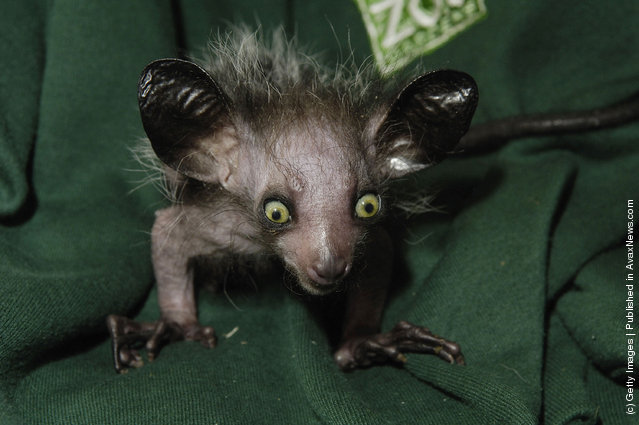
“The aye-aye (Daubentonia madagascariensis) is a lemur, a strepsirrhine primate native to Madagascar that combines rodent-like teeth and a special thin middle finger to fill the same ecological niche as a woodpecker. It is the world's largest nocturnal primate, and is characterized by its unusual method of finding food; it taps on trees to find grubs, then gnaws holes in the wood and inserts its narrow middle finger to pull the grubs out. The only other animal species known to find food in this way is the striped possum. From an ecological point of view the aye-aye fills the niche of a woodpecker as it is capable of penetrating wood to extract the invertebrates within”. – Wikipedia
Photo: In this handout image from Bristol Zoo is seen the first captive bred aye-aye in the UK named “Kintana” (meaning star in Malagasy) April 15, 2005 at Bristol Zoo Gardens, England. The zoo announced today only the second baby aye-aye to be hand-reared in the world (the first was in Jersey Zoo) and has now made his first public appearance since his birth on 11 February 2005. (Photo by Rob Cousins/Bristol Zoo via Getty Images)
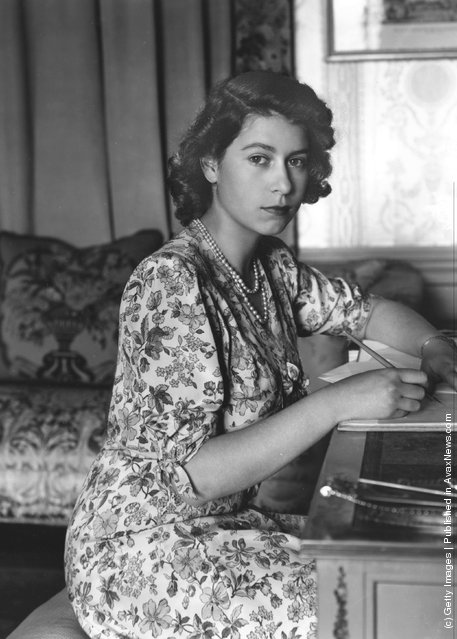
Queen Elizabeth II (as Princess Elizabeth) writing at her desk in Windsor Castle, Berkshire. (Photo by Lisa Sheridan/Studio Lisa/Getty Images). 30th May 1944