Loading...
Done
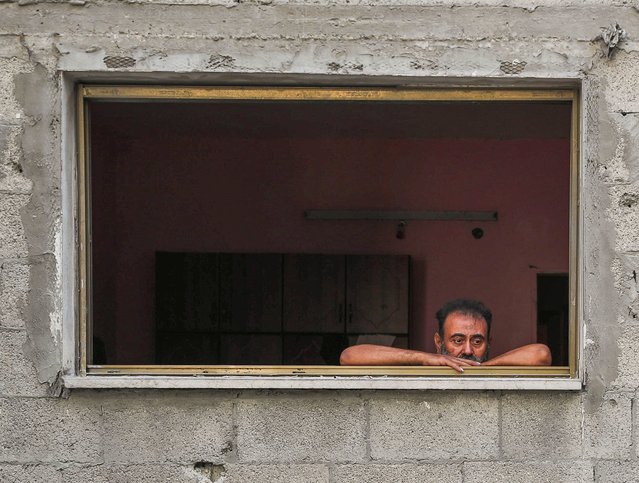
A man looks out of a window as Palestinians inspect the site and search for casualties of an overnight Israeli air strike on a house at al-Shati (Beach) refugee camp, in Gaza City, on July 15, 2025. (Photo by Mahmoud Issa/Reuters)

A man looks out of a window as Palestinians inspect the site and search for casualties of an overnight Israeli air strike on a house at al-Shati (Beach) refugee camp, in Gaza City, on July 15, 2025. (Photo by Mahmoud Issa/Reuters)
Details
15 Aug 2025 03:21:00
A Lebanese man rides his horse in a village destroyed by an Israeli air and ground offensive, in the town of Kfar Kila, southern Lebanon, Tuesday, February 18, 2025. (Photo by Hassan Ammar/AP Photo)

A Lebanese man rides his horse in a village destroyed by an Israeli air and ground offensive, in the town of Kfar Kila, southern Lebanon, Tuesday, February 18, 2025. (Photo by Hassan Ammar/AP Photo)
Details
26 Aug 2025 04:51:00
A newly born Yangtze finless porpoise (top) swims with his mother at the Hydrobiology Institute of the Chinese Academy of Sciences

“The finless porpoise (Neophocaena phocaenoides) is one of six porpoise species. In the waters around Japan, at the northern end of its range, it is known as the sunameri. A freshwater population found in the Yangtze River in China is known locally as the jiangzhu or «river pig»”. – Wikipedia

Photo: A newly born Yangtze finless porpoise (top) swims with his mother at the Hydrobiology Institute of the Chinese Academy of Sciences on June 3, 2007 in Wuhan of Hubei Province, China. (Photo by China Photos/Getty Images)
Details
20 Feb 2012 12:23:00
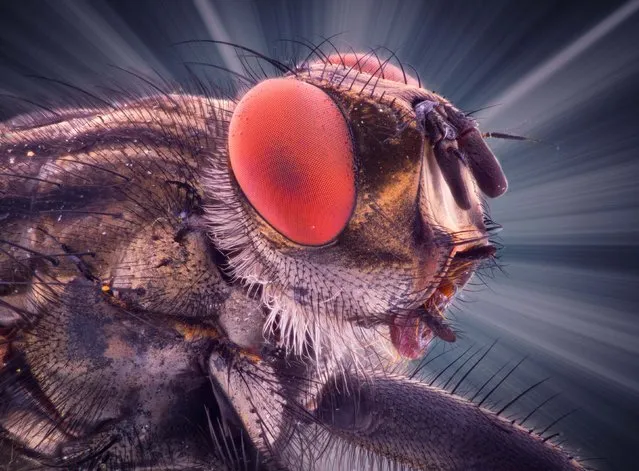
House Fly. (Photo by Kutub Uddin/Caters News)

“Creepy crawlies have become stunning examples of the natural world in these incredible close-up pictures. Photographer Kutub Uddin, 28, snapped the tiny creatures in a forest near his home of Bognor Regis over the course of the summer. Taken in close-up using special macro lenses and filters, he managed to turn house flies, damsel flies and wasps into gorgeous jeweled works of art. Kutub said: “I found the bugs in the forest near where I live when I was taking pictures”. – Cater News
Details
01 Sep 2014 10:29:00
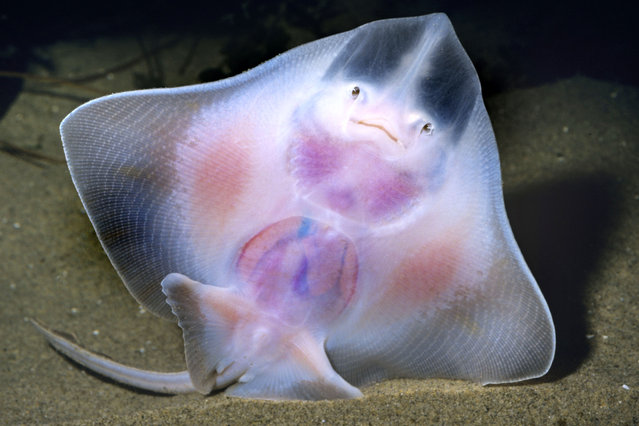
Thornback Skate. (Photo by Ken Lucas/Caters News)

“They're some of the most intriguing and complex creatures on the planet but they really do have nothing to hide – because theyre totally see-through. Transparent animals – creatures with clear glass-like skin – can be found all over the world but their very existence is still shrouded in mystery. The fascinating organisms verge on the invisible and their translucent skin often helps them elude predators”. – Caters News. Photo: Thornback Skate. (Photo by Ken Lucas/Caters News)
Details
04 Sep 2014 08:37:00
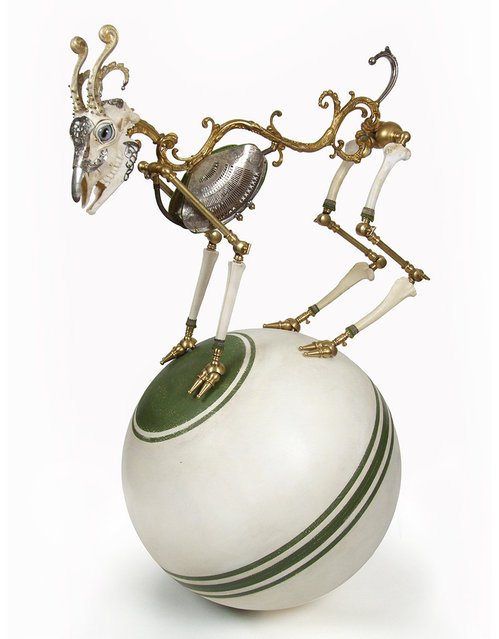
Sculpture By Jessica Joslin

More great and peculiar work from Chicago based sculptor Jessica Joslin. Joslin assembles her hybrid creatures from objects found in obscure junk shops, flea markets, attics, taxidermy supply houses, specialty hardware distributors…or even just walking through the woods. “Miniature machine bolts, springs and couplings comprise anatomical structures. Many of the beasts have hidden movements: a spring loaded beak, snapping jaws, jointed legs and adjustable tails. Some creatures are free-standing but have mechanisms to allow for movement or multiple positions.”
Details
03 Nov 2013 14:28:00
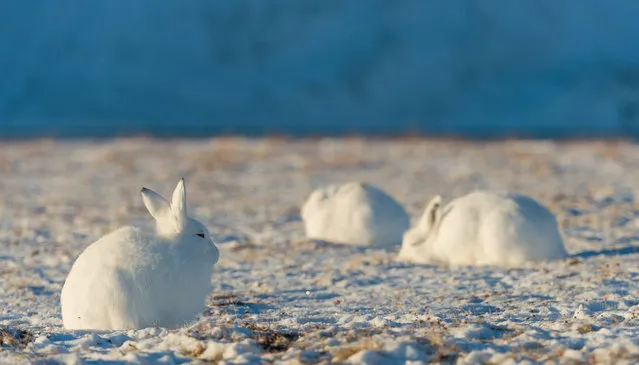
Arctic Hare

The arctic hare, or polar rabbit, is a species of hare which is adapted largely to polar and mountainous habitats. The arctic hare survives with a thick coat of fur and usually digs holes in the ground or under snow to keep warm and sleep. Arctic hares look like rabbits but have shorter ears, are taller when standing, and, unlike rabbits, can thrive in cold climates. They can travel together with many other hares, sometimes huddling with dozens or more, but are usually found alone, taking, in some cases, more than one partner. The arctic hare can run up to 60 kilometres per hour (40 mph). Its predators include the arctic wolf, arctic fox, and ermine.
Details
17 Mar 2014 13:56:00
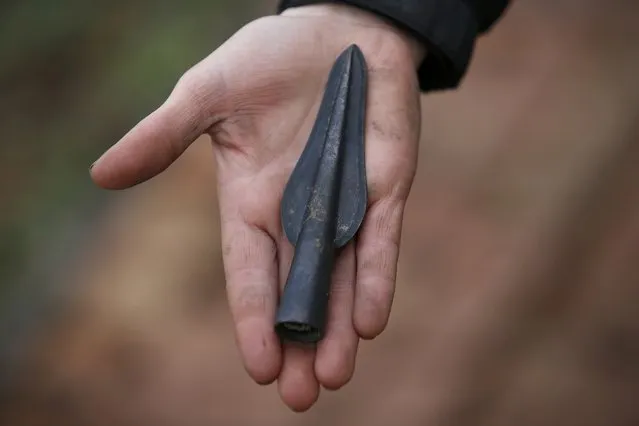
An arrow-head discovered in 2006 by Archaeologists of the University of Cambridge Archaeological Unit, is displayed by one of the team uncovering Bronze Age wooden houses, preserved in silt, from a quarry near Peterborough, Britain, January 12, 2016. (Photo by Peter Nicholls/Reuters)

An arrow-head discovered in 2006 by Archaeologists of the University of Cambridge Archaeological Unit, is displayed by one of the team uncovering Bronze Age wooden houses, preserved in silt, from a quarry near Peterborough, Britain, January 12, 2016. Archaeologists said on Tuesday they had discovered what were believed to be the best-preserved Bronze Age dwellings ever found in Britain, providing an extraordinary insight into prehistoric life from 3,000 years ago. (Photo by Peter Nicholls/Reuters)
Details
14 Jan 2016 08:00:00