Loading...
Done
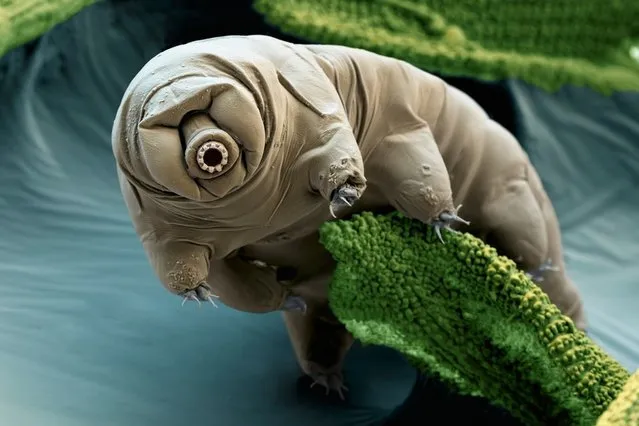
Tardigrades (commonly known as waterbears or moss piglets). (Photo by SPL/East News)

“Tardigrades (commonly known as waterbears or moss piglets) are small, water-dwelling, segmented animals with eight legs. Tardigrades were first discovered in 1773 by Johann August Ephraim Goeze, who called them kleiner Wasserbär, meaning “little water bear” in German. The name Tardigrada means “slow walker” and was given by Lazzaro Spallanzani in 1777. The name water bear comes from the way they walk, reminiscent of a bear's gait. The biggest adults may reach a body length of 1.5 millimetres (0.059 in), the smallest below 0.1 mm. Freshly hatched tardigrades may be smaller than 0.05 mm”. – Wikipedia. Photo: Tardigrades. (Photo by SPL/East News)
Details
26 Sep 2012 09:55:00
purim

An Israeli girl in costume, celebrates the Jewish festival of Purim on March 5, 2004, in Tel Aviv, Israel. The Festival commemorates the rescue of Jews from genocide in ancient Persia.
Details
18 Mar 2011 08:09:00


French tennis champion Suzanne Lenglen (1899–1938) high-kicking during a doubles match at the Wimbledon Lawn Tennis Championships. (Photo by Kirby/Topical Press/Getty Images). 1924
Details
14 Jun 2011 10:02:00
A harp seal pup

“The harp seal or saddleback seal is a species of earless seal native to the northernmost Atlantic Ocean and adjacent parts of the Arctic Ocean. Newborn pups weigh around 11 kilograms (24 lb) and are 80–85 centimetres (31–33 in) long. After birth, the mother only feeds that pup. During the 12 day nursing period, the mother does not eat, losing up to 3 kilograms (7 lb) per day. Harp seal milk contains up to 48% fat, so pups gain over 2.2 kilograms (4.9 lb) per day. During this time, the juvenile's “greycoat” grows in beneath the white neonatal coat, and it weighs 80 pounds (36 kg)”. – Wikipedia

Photo: A harp seal pup lies on an ice floe in the Gulf of Saint Lawrence March 24, 2008 in Charlottetown, Canada. (Photo by Joe Raedle/Getty Images)
Details
19 Sep 2011 15:49:00
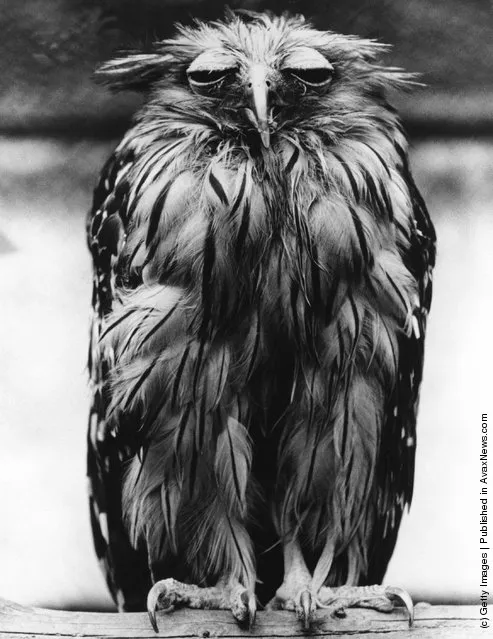
1973: A tired-looking Javan Fish Owl

A tired-looking Javan Fish Owl. (Photo by Fox Photos/Getty Images). 5th December 1973
Details
13 Oct 2011 11:33:00
Tour guides wearing traditional Chinese dress practice smiling by biting chopsticks at Qingming Grand-River Park in Kaifeng, central China's Henan Province on March 2, 2017, aiming to provide better service for visitors. (Photo by IPA Asia via ZUMA Wire)

Tour guides wearing traditional Chinese dress practice smiling by biting chopsticks at Qingming Grand-River Park in Kaifeng, central China's Henan Province on March 2, 2017, aiming to provide better service for visitors. (Photo by IPA Asia via ZUMA Wire)
Details
03 Mar 2017 11:03:00
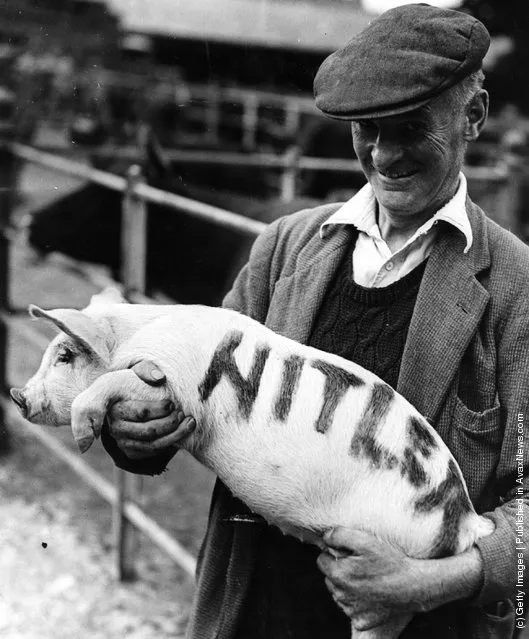
This greedy piglet was isolated from the rest of its litter by the farmer who named it Hitler after it tried to grab all the food at feeding time, 1942

This greedy piglet was isolated from the rest of its litter by the farmer who named it Hitler after it tried to grab all the food at feeding time. (Photo by R J Lewis/Getty Images). 1942
Details
08 Mar 2012 12:02:00
Clay "caganers" representing Spanish Prime Minister Mariano Rajoy (2nd L), Podemos's candidate Pablo Iglesias (R), Socialist Party (PSOE) leader Pedro Sanchez (2nd R) and Ciudadanos party leader Albert Rivera (L) are seen on display at the Santa Llucia Christmas market in central Barcelona, Spain, December 16, 2015. Catalans hide "caganers" or defecators, in Christmas Nativity scenes to let friends hunt for them during Christmas celebrations. The "caganers", which symbolise defecation and fertilization of the earth, are believed to bring prosperity and luck for the coming year. (Photo by Albert Gea/Reuters)

Clay "caganers" representing Spanish Prime Minister Mariano Rajoy (2nd L), Podemos's candidate Pablo Iglesias (R), Socialist Party (PSOE) leader Pedro Sanchez (2nd R) and Ciudadanos party leader Albert Rivera (L) are seen on display at the Santa Llucia Christmas market in central Barcelona, Spain, December 16, 2015. Catalans hide “caganers” or defecators, in Christmas Nativity scenes to let friends hunt for them during Christmas celebrations. The “caganers”, which symbolise defecation and fertilization of the earth, are believed to bring prosperity and luck for the coming year. (Photo by Albert Gea/Reuters)
Details
18 Dec 2015 08:00:00