Loading...
Done
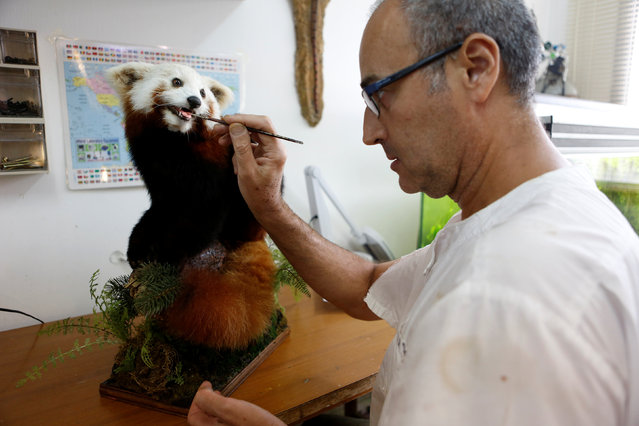
Igor Gavrilov, the main taxidermist of the Zoological centre at Tel Aviv University, works on a taxidermied animal, part of a collection which will be housed at the Steinhardt Museum of Natural History, a new Israeli natural history museum set to open next year in Tel Aviv, Israel June 8, 2016. Legions of insects, sea creatures and ancient fossils are lining up in a new museum shaped liked a giant Noah's Ark, telling the story of a crucial evolutionary byway across Israel. Experts say all humans and other animals had to pass through Israel on their first journey out of Africa into Europe and Asia. (Photo by Nir Elias/Reuters)

Igor Gavrilov, the main taxidermist of the Zoological centre at Tel Aviv University, works on a taxidermied animal, part of a collection which will be housed at the Steinhardt Museum of Natural History, a new Israeli natural history museum set to open next year in Tel Aviv, Israel June 8, 2016. Legions of insects, sea creatures and ancient fossils are lining up in a new museum shaped liked a giant Noah's Ark, telling the story of a crucial evolutionary byway across Israel. (Photo by Nir Elias/Reuters)
Details
25 Aug 2016 09:42:00
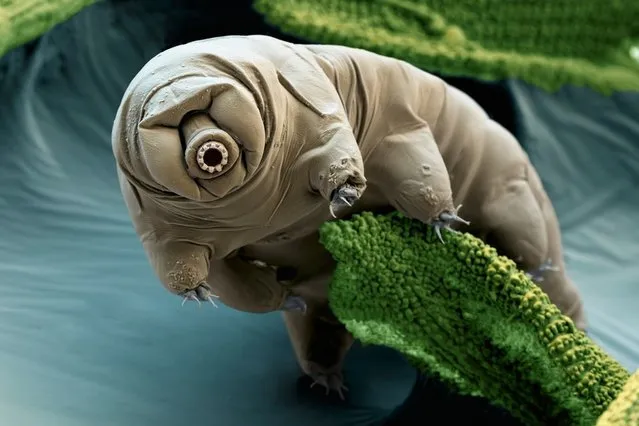
Tardigrades (commonly known as waterbears or moss piglets). (Photo by SPL/East News)

“Tardigrades (commonly known as waterbears or moss piglets) are small, water-dwelling, segmented animals with eight legs. Tardigrades were first discovered in 1773 by Johann August Ephraim Goeze, who called them kleiner Wasserbär, meaning “little water bear” in German. The name Tardigrada means “slow walker” and was given by Lazzaro Spallanzani in 1777. The name water bear comes from the way they walk, reminiscent of a bear's gait. The biggest adults may reach a body length of 1.5 millimetres (0.059 in), the smallest below 0.1 mm. Freshly hatched tardigrades may be smaller than 0.05 mm”. – Wikipedia. Photo: Tardigrades. (Photo by SPL/East News)
Details
26 Sep 2012 09:55:00
National police transport an anti-government protester detainee during a protest against Nicolas Maduro's government in Caracas March 13, 2014. Venezuela's state prosecutor said on Thursday the death toll from a month of violent protests had risen to 28, after the nation's top court ordered opposition mayors to dismantle barricades set up by street protesters. (Photo by Carlos Garcia Rawlins/Reuters)

National police transport an anti-government protester detainee during a protest against Nicolas Maduro's government in Caracas March 13, 2014. Venezuela's state prosecutor said on Thursday the death toll from a month of violent protests had risen to 28, after the nation's top court ordered opposition mayors to dismantle barricades set up by street protesters. State prosecutor Luisa Ortega Diaz, speaking on the sidelines of the U.N. Human Rights Council in Geneva, also said 1,293 detainees had been released and 104 remained in custody accused of serious crimes during the anti-government demonstrations. (Photo by Carlos Garcia Rawlins/Reuters)
Details
15 Mar 2014 10:46:00
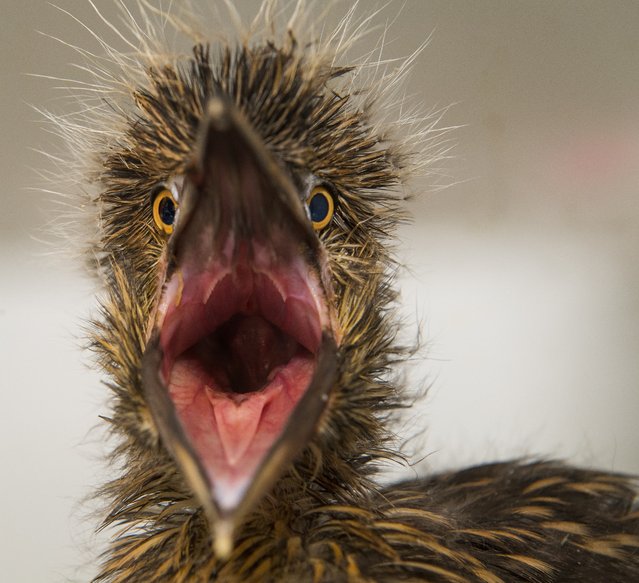
A baby Black-crowned Night Heron squawks in its incubator while being cared for at City Wildlife rescue and rehabilitation center in Washington, DC on May 31, 2017. The heron is one of several that have been brought to CW by the staff at The National Zoo over the past few years. The heron is a native bird and has made an established rookery inside the zoo grounds over a hundred years ago.  Every year at this time, some of the chicks get pushed or fall out of the nest and require human care.  Because the birds are native and not part of the Smithsonian collection, they partnered with CW to rehabilitate the herons for re-release back to the flock inside Zoo. They're reintroduced back to their flock so that they can migrate together in the Fall. The Black-crowned heron usually migrates from the DC area down to southeast North Carolina, some going as far as Jacksonville, FL in winter. The Black-crowned heron is the species of greatest conservation need in the District of Columbia because their numbers are in such rapid decline due to habitat loss. (Photo Linda Davidson/The Washington Post)

A baby Black-crowned Night Heron squawks in its incubator while being cared for at City Wildlife rescue and rehabilitation center in Washington, DC on May 31, 2017. The heron is one of several that have been brought to CW by the staff at The National Zoo over the past few years. (Photo Linda Davidson/The Washington Post)
Details
04 Jun 2017 08:04:00
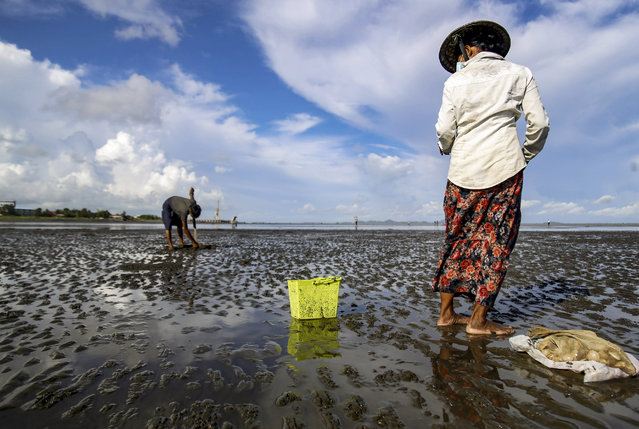
People search for shells on a beach in Sittwe, Rakhine State, Myanmar, 17 September 2020. International Coastal Cleanup Day is observed annually on the third Saturday of September and will occur on 19 September this year. The day was established to encourage global efforts to clean up garbage on beaches and coastal areas and raise awareness on protecting the world's oceans and waterways. According to a report released by the US-based nonprofit environmental advocacy group Ocean Conservancy on 08 September 2020, plastic food packaging topped the list of most common items found in beach trash. Close to five million food wrappers were collected in a single day during the International Coastal Cleanup Day in 2019. An approximate 11 million metric tons of plastic enters the ocean every year according to a 2016 analysis, affecting more than 800 marine species and causing contamination to human food chains and drinking water. (Photo by Nyunt Win/EPA/EFE/Rex Features/Shutterstock)

People search for shells on a beach in Sittwe, Rakhine State, Myanmar, 17 September 2020. International Coastal Cleanup Day is observed annually on the third Saturday of September and will occur on 19 September this year. (Photo by Nyunt Win/EPA/EFE/Rex Features/Shutterstock)
Details
24 Oct 2020 00:05:00
Senji Nakajima sleeps with his Love Doll “Saori” at Love Hotel on June 4, 2016 in Nagano, Japan. Senji Nakajima, 61 years old, lives with his life-size 'love doll' named “Saori” in his apartment in Tokyo, Japan. Nakajima, married with two children, who lives away from home for work, first started his life with Saori six years ago. At first, he used to imagine as if the doll was his first girl friend, and used it only for sexual purposes to fill the loneliness, but months later, he started to find Saori actually has an original personality. “She never betrays, not after only money. I'm tired of modern rational humans. They are heartless”, Nakajima says, “for me, she is more than a doll. Not just a silicon rubber. She needs much help, but still is my perfect partner who shares precious moments with me and enriches my life”. (Photo by Taro Karibe/Getty Images)

Senji Nakajima sleeps with his Love Doll “Saori” at Love Hotel on June 4, 2016 in Nagano, Japan. Senji Nakajima, 61 years old, lives with his life-size “love doll” named “Saori” in his apartment in Tokyo, Japan. Nakajima, married with two children, who lives away from home for work, first started his life with Saori six years ago. (Photo by Taro Karibe/Getty Images)
Details
07 Aug 2016 09:21:00
Hamar women dance before a bull jumping ceremony in Ethiopia's southern Omo Valley region near Turmi on September 19, 2016. The Hamar are a Nilotic ethnic group in Ethiopia. The construction of the Gibe III dam, the third largest hydroelectric plant in Africa, and large areas of very “thirsty” cotton and sugar plantations and factories along the Omo river are impacting heavily on the lives of tribes living in the Omo Valley who depend on the river for their survival and way of life. Human rights groups fear for the future of the tribes if they are forced to scatter, give up traditional ways through loss of land or ability to keep cattle as globalisation and development increases. (Photo by Carl De Souza/AFP Photo)

Hamar women dance before a bull jumping ceremony in Ethiopia's southern Omo Valley region near Turmi on September 19, 2016. The Hamar are a Nilotic ethnic group in Ethiopia. The construction of the Gibe III dam, the third largest hydroelectric plant in Africa, and large areas of very “thirsty” cotton and sugar plantations and factories along the Omo river are impacting heavily on the lives of tribes living in the Omo Valley who depend on the river for their survival and way of life. (Photo by Carl De Souza/AFP Photo)
Details
02 Oct 2016 08:45:00
Ukrainian artist Dariya Marchenko works on a portrait of Russian President Vladimir Putin named “The Face of War” which is made out of 5,000 cartridges brought from the frontline in eastern Ukraine, in Kiev, July 23, 2015. The portrait will be presented along with a novel which will tell personal stories of six people involved in this project including Daria's own story and stories of people who helped her to collect shells from the frontline. (Photo by Gleb Garanich/Reuters)

Ukrainian artist Dariya Marchenko works on a portrait of Russian President Vladimir Putin named “The Face of War” which is made out of 5,000 cartridges brought from the frontline in eastern Ukraine, in Kiev, July 23, 2015. The portrait will be presented along with a novel which will tell personal stories of six people involved in this project including Daria's own story and stories of people who helped her to collect shells from the frontline. Daria Marchenko calls her art approach philosophic symbolism where every element has its hidden meaning. In her works cartridges mean human's life that was brutally ended. (Photo by Gleb Garanich/Reuters)
Details
28 Jul 2015 12:44:00