Loading...
Done
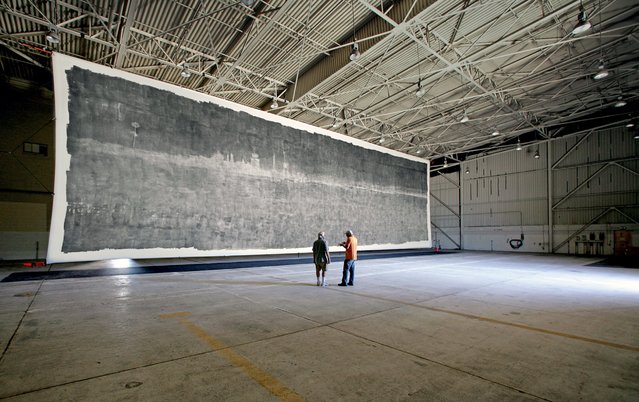
World’s Largest Pinhole Camera Takes World’s Largest Photo. (Photo by Caters News)

The Great Picture” is a black and white panoramic print of Marine Corps Air Station El Toro, an old military outpost. The print measures 111 feet wide by 32 feet high on seamless white muslin cloth. (Photo by Caters News)
Details
18 May 2014 10:03:00
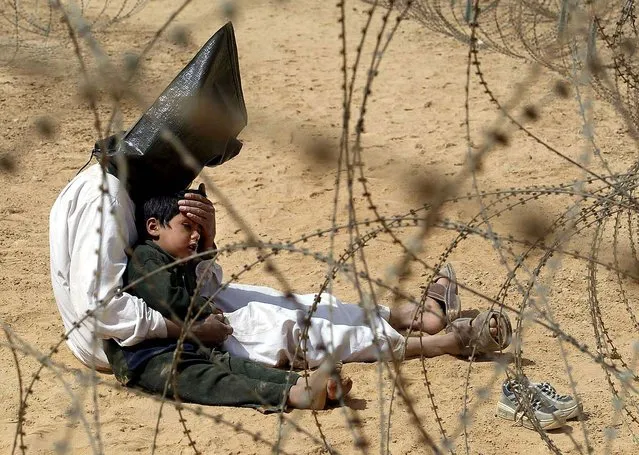
An Iraqi man comforts his 4-year-old son at a regroupment center for POWs of the 101st Airborne Division near An Najaf, Iraq

An Iraqi man comforts his 4-year-old son at a regroupment center for POWs of the 101st Airborne Division near An Najaf, Iraq, March 31, 2003. The man was seized in An Najaf with his son and the U.S. military did not want to separate them. (Photo by Jean-Marc Bouju/Associated Press)
Details
18 Jul 2012 06:22:00


An Israeli soldier salutes as she attends a military cemetery ahead of the start of Remembrance Day at the graves of killed comrades on May 8, 2011 in Jerusalem, Israel. The 64th anniversary of the creation of Israel in 1948 has fallen on the Monday as determined by the Hebrew calendar and is preceded by the annual memorial recognising Israel's fallen soldiers. (Photo by Uriel Sinai/Getty Images)
Details
09 May 2011 11:21:00
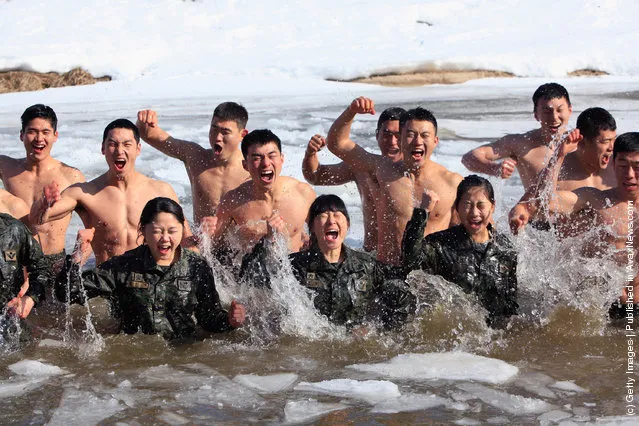
South Korean Special Forces Participate In Winter Training Exercises

South Korean special warfare command soldiers participate in winter military training exercise on January 11, 2012 in Pyeongchang-gun, South Korea. The South Korean troops train in temperatures below -20 degrees celsius to defend the country against any possible attacks from North Korea. (Photo by Chung Sung-Jun/Getty Images)
Details
12 Jan 2012 12:28:00
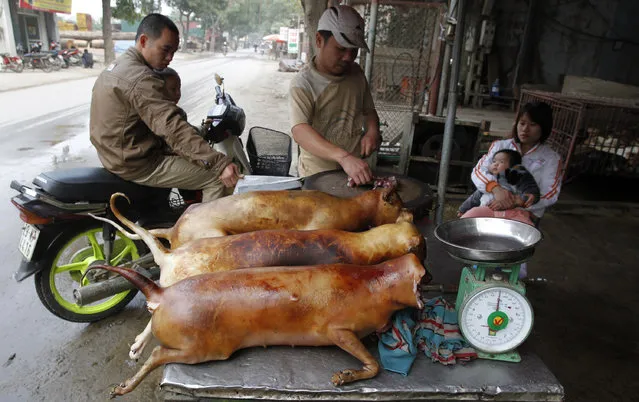
A vendor (C) cuts slaughtered dogs for sale at his roadside stall in Duong Noi village, outside Hanoi December 16, 2011. While animal rights activists have condemned eating dog meat as cruel treatment of the animals, it is still an accepted popular delicacy for some Vietnamese, as well in some other Asian countries. (Photo by Reuters/Kham)

A vendor (C) cuts slaughtered dogs for sale at his roadside stall in Duong Noi village, outside Hanoi December 16, 2011. While animal rights activists have condemned eating dog meat as cruel treatment of the animals, it is still an accepted popular delicacy for some Vietnamese, as well in some other Asian countries. Duong Noi is well-known as a dog-meat village, where hundreds of dogs are killed each day for sale as popular traditional food. Dog-eating as a custom is rooted in Vietnam and was developed as a result of poverty. One kilogram of dog meat costs about 130,000 dongs ($6.2). (Photo by Reuters/Kham)
Details
16 Jul 2013 11:40:00
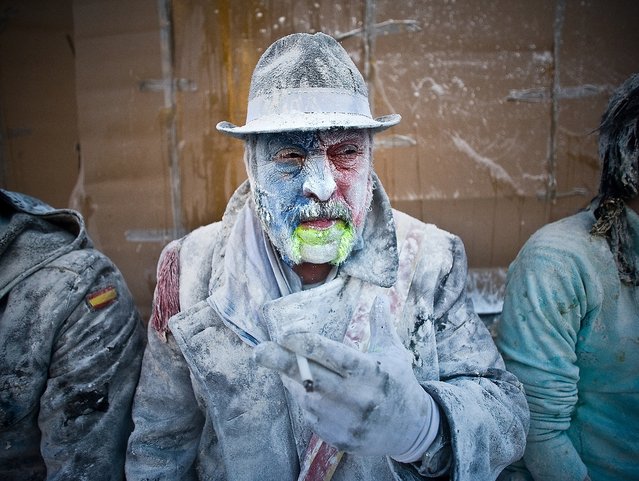
A Reveller smokes during the battle of “Enfarinats”, a flour fight in celebration of the Els Enfarinats festival. (Photo by David Ramos)

It’s a classic tale of dictatorship gone wrong and the fight for freedom. Like in any good battle, there’s fire, albeit from firecrackers, but the ammunition in this one is – flour. It takes place in a Hemingway-esque Spanish village. The battle of “Enfarinats” in celebration of the Els Enfarinats festival, rages on on December 28, 2012 in Ibi, Spain. Citizens of Ibi annually celebrate the festival with a fight using flour, eggs and firecrackers. The battle takes place between two groups, a group of married men called “Els Enfarinats” who take the control of the village for one day pronouncing a number of ridiculous laws and fining the citizens that infringe them and a group called “La Oposicio” who try to restore order. At the end of the day the money collected from the fines is donated to charitable causes in the village. The festival has been celebrated since 1981 after the town of Ibi recovered the tradition but the origins remain unknown.

Photo: A Reveller smokes during the battle of “Enfarinats”, a flour fight in celebration of the Els Enfarinats festival. (Photo by David Ramos)
Details
30 Dec 2012 10:28:00
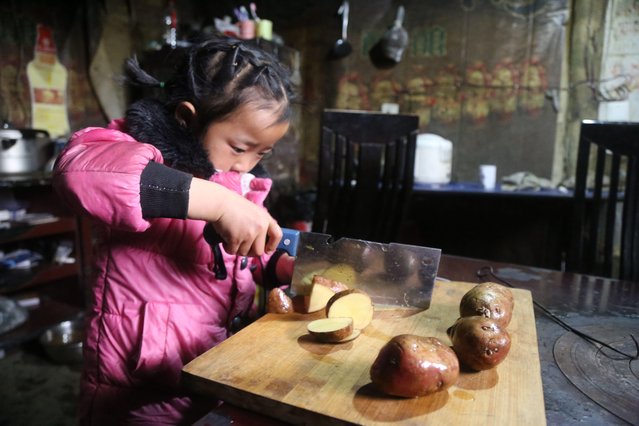
5-year-old Chinese girl Wang Anna prepares meals for her grandmother and great-grandmother at home in Zhuyuan village, Guizhou province, China on March 3, 2017. (Photo by Imaginechina/Rex Features/Shutterstock)

5-year-old Chinese girl Wang Anna prepares meals for her grandmother and great-grandmother at home in Zhuyuan village, Guizhou province, China on March 3, 2017. Chinese girl called Wang Anna, 5, takes care of her ill grandmother and 92-year-old great-grandmother on her own every day in a mountainous village in Zhima town, Zunyi city, southwest China's Guizhou province. Her father went to jail before she was born and her mother remarried after gave birth to her. Although she is just five years old, she started to shoulder the responsibility to look after ill grandmother and elderly great-grandmother. (Photo by Imaginechina/Rex Features/Shutterstock)
Details
09 Mar 2017 00:05:00
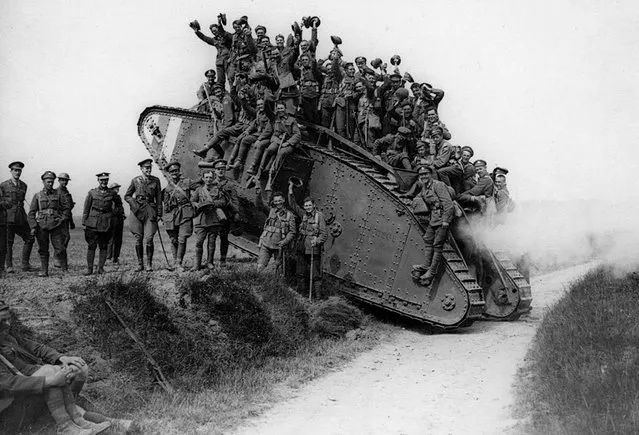
These black-and-white photos are taken from the new book “Armoured Warfare in the First World War 1916 – 1918” by Anthony Tucker-Jones and published by Pen & Sword Military. “Interestingly the British, French and Germans took completely different approaches with varying results”. The British military produced “Little Willie” in Autumn 1915 weighing 18 tonnes, which had a crew of two plus four gunners. “Inspired by a tracked artillery tractor “Little Willie” was referred to as a water tank – hence the name tank – to ensure secrecy”, said Anthony. “This led to the strange looking Mark I with its peculiar rhomboid shape, designed to cross trenches with guns in sponsons on either side. The Germans saw the tank as unchivalrous and were slow to grasp its utility. They favoured the Stormtrooper (specialist soldiers used to infiltrate enemy trenches) and artillery, not the tank”, said Anthony. “However, they didn’t hesitate to make use of captured British tanks. Although the tank helped secure victory and German soldiers dubbed it “Germany’s Downfall” the country was ultimately brought to its knees by the Allies blockade”. Here: British troops hitch a ride on a Mark IV after the massed tank fleet spearheading attack at Cambrai on November 20, 1917. (Photo by Anthony Tucker-Jones/Mediadrumworld.com)

These black-and-white photos are taken from the new book “Armoured Warfare in the First World War 1916 – 1918” by Anthony Tucker-Jones and published by Pen & Sword Military. Here: British troops hitch a ride on a Mark IV after the massed tank fleet spearheading attack at Cambrai on November 20, 1917. (Photo by Anthony Tucker-Jones/Mediadrumworld.com)
Details
23 Feb 2017 00:02:00