Loading...
Done
Chris “Birdman” Andersen poses for Getty Images photographer Mike Ehrmann during the Miami Heat's Media Day at AmericanAirlines Arena, on September 30, 2013. (Photo by Gary Coronado/The Palm Beach Post)

Chris “Birdman” Andersen poses for Getty Images photographer Mike Ehrmann during the Miami Heat's Media Day at AmericanAirlines Arena, on September 30, 2013. (Photo by Gary Coronado/The Palm Beach Post)

P.S. All pictures are presented in high resolution. To see Hi-Res images – just TWICE click on any picture. In other words, click small picture – opens the BIG picture. Click BIG picture – opens VERY BIG picture (if available; this principle works anywhere on the site AvaxNews)
Details
05 Oct 2013 12:25:00
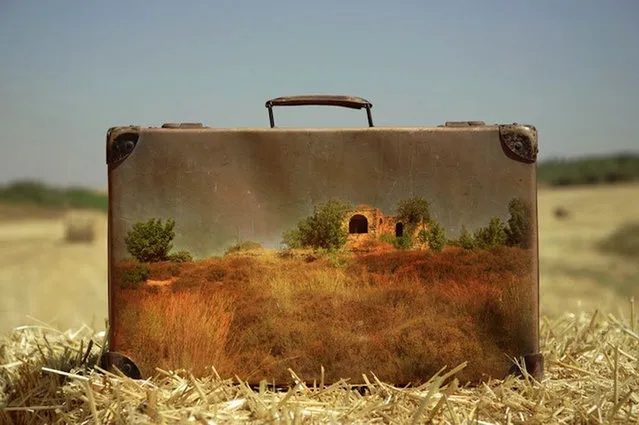
Memory Suitcase By Yuval Yairi

Memory Suitcases is a thought-provoking series by Israeli artist Yuval Yairi that uses old, worn suitcases as canvases for nostalgic landscapes. Like scenes out of one's memory, the propped up traveling cases feature a range of sepia-toned settings. The series presents the objects as though they are relics of a civilization from yesteryear, each with their own story to tell.
There's something both heartbreaking and sentimental about the images. It appears to tell a number of stories of leaving one lifestyle for another. The suitcases hold within them a picture show of memories from a life-altering journey. Like a number of his other works, Memory Suitcases "mimics the natural process of memory."
Details
22 Nov 2013 12:55:00
Photograph shows a puppy holding a kitten, 1914. (Photo by Harry Whittier Frees/Library of Congress)

“Harry Whittier Frees (1879–1953) was an American photographer who created novelty postcards and children's books based on his photographs of animals. He dressed the animals and posed them in human situations with props, often with captions; these can be seen as progenitors of modern lolcats”. – Wikipedia. Photo: “The nurse”. Photograph shows a puppy holding a kitten, 1914. (Photo by Harry Whittier Frees/Library of Congress)

P.S. All pictures are presented in high resolution. To see Hi-Res images – just TWICE click on any picture. In other words, click small picture – opens the BIG picture. Click BIG picture – opens VERY BIG picture (if available; this principle works anywhere on the site AvaxNews).
Details
28 Mar 2014 11:20:00
Tridacna Gigas, or Giant Clams

“The giant clam, Tridacna gigas (known as pā’ua in Cook Islands Māori), is the largest living bivalve mollusc. T. gigas is one of the most endangered clam species. It was mentioned as early as 1825 in scientific reports. One of a number of large clam species native to the shallow coral reefs of the South Pacific and Indian oceans, they can weigh more than 200 kilograms (440 lb) measure as much as 120 cm (47 in) across, and have an average lifespan in the wild of 100 years or more”. – Wikipedia

Photo: Tridacna Gigas, or Giant Clams spew water as a traditional fisherman passes by a small sanctuary on January 23, 2004 near Bolinao in the Northern Philippines. The clams, prime builders for coral reefs and providing shelter for spawning fish and other marine life, are exposed by low tides in the sanctuary. Overfishing and pollution throughout the country are not only threatening food security, but are also starting to choke one of the few working clam sanctuaries in the world. (Photo by David Greedy/Getty Images)
Details
01 Oct 2011 13:10:00
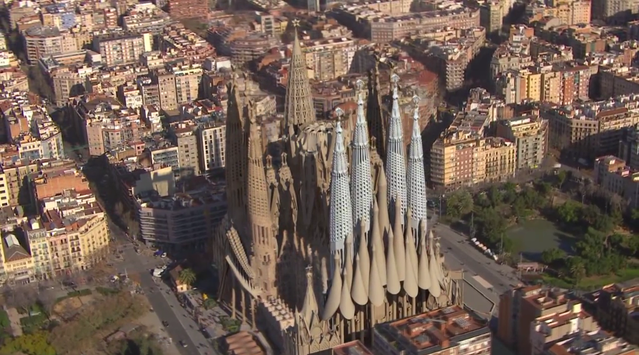
We Build Tomorrow – Sagrada Familia 2026 ( VIDEO )

For more than a century, the Barcelona skyline has been graced (or marred, depending on who’s talking) by the spectacle of the Basilica designed by Anton Gaudi, first started in 1882. If you want to know what it’ll look like when finished, don’t fret — 2026 is right around the corner. Or you can watch this video, released last week on YouTube by Basílica de la Sagrada Família and titled simply “2026 We Build Tomorrow,” a 3-D artists’ rendering of the building stages through completion.
(If 144 years sounds like a long time to finish a cathedral, keep in mind that there were decades that they didn’t work on it — and that Notre Dame de Paris took 182 years, although the 13th century Parisians didn’t have diesel-powered industrial cranes.) Now, if only the video could show us what the admission and hours will be in 2026 (and how to avoid the inevitable long lines).
Details
11 Jan 2014 10:59:00
Museum assistant and former Soviet soldier, Sheikh Abdullah looks at a display in the Manzar-e Jahad, or Jihad Museum, which depicts the Soviet invasion of 1979 and the Afghan resistance, in Herat, on February 15, 2014. (Photo by Aref Karimi/AFP Photo via The Atlantic)

Museum assistant and former Soviet soldier, Sheikh Abdullah looks at a display in the Manzar-e Jahad, or Jihad Museum, which depicts the Soviet invasion of 1979 and the Afghan resistance, in Herat, on February 15, 2014. Sheikh Abdullah, who was a Soviet intelligence officer by the name of Khakimov Bakhrodin, was captured after being injured in battle with the Mujahideen. Abdullah stayed with his captors, converted to Islam and was renamed Abdullah. He never returned to his former homeland and now works at the Jihad Museum. (Photo by Aref Karimi/AFP Photo via The Atlantic)
Details
10 Mar 2014 09:08:00
A glass building mirrors the sky in Singapore as the sun goes down over the city. (Photo by Fong Qi Wei/Thoughtful Photography)

Intrigued by photographing time, Singapore-based photographer Fong Qi Wei created single, composite pictures from a sequence of images spanning 2-4 hours. He concentrated on capturing sunrises and sunsets as they evolved over different landscapes, seascapes, and cityscapes. He then digitally stitched the images together to get a snapshot of time passing over the scene for his series “Time is a Dimension”. “Most paintings and photographs are an instance of time”, Wei explained in his artist’s statement. “That’s not the way the world works. We experience a sequence of time, and that’s why a video is somehow more compelling than a freeze frame”. (Photo by Fong Qi Wei/Thoughtful Photography)
Details
19 Aug 2014 10:28:00
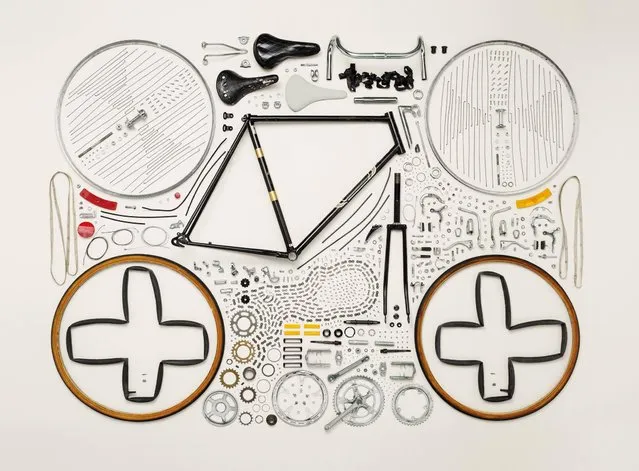
Deconstructed Objects By Todd McLellan

It is simply staggering how complicated some items really are. We never think about it, but some items that we use every day consist of hundreds of parts meticulously put together and working perfectly. Todd McLellan is a photographer who based his newest book “Things Come Apart” on the complexity of various old and new tech. By carefully taking apart various items and arranging all of the parts in perfect order, Todd has allowed us not only to look inside various appliances, but also to appreciate the astounding complexity of these items. Just like the human mind, we are so used to seeing and talking with people that we forget just how complicated their minds really are. It would be great if we could “take apart” the human mind in order to gain some insight into the person’s thoughts and desires. However, very few people are capable of doing it, while the rest will remain blind to the obvious. (Photo by Todd McLellan)
Details
15 Nov 2014 12:30:00