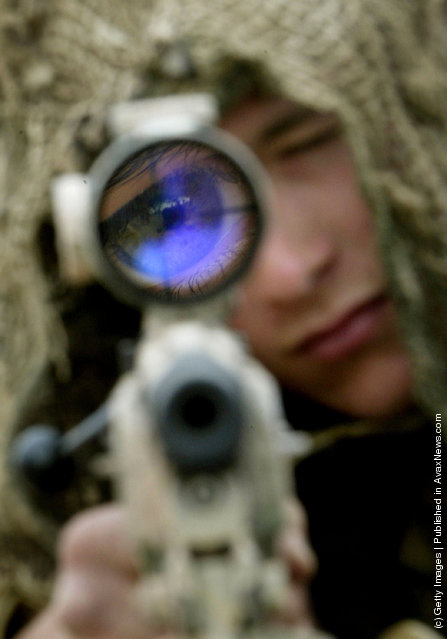
A British soldier from 3 Commando Brigade looks through the sight of his sniper rifle at Camp Gibraltar February 24, 2003 near Kuwait City, Kuwait. (Photo by Ian Waldie/Getty Images)
Residents (R to L) Luiza, Janubie, Leiticia and Lucas sit beneath an overpass near their houses in an impoverished area in the unpacified Complexo da Mare slum complex, one of the largest “favela” complexes in Rio, on March 18, 2014 in Rio de Janeiro, Brazil. (Photo by Mario Tama/Getty Images)
The Belgian photographer Anton Kusters spent two years photographing the Yakuza, Japan’s most notorious gang. He returned with some amazing images that he made into a book called “Odo Yakuza Tokyo”. (Odo means “the way of the cherry blossom” and is the credo of the Yakuza family he followed. Photo: An erotic danser picks up fake 2-dollar bills during a private dance with a Yakuza customer in a strip tease bar in Kabukicho, a bar which is controlled by the ODO family – 2010. (Photo and caption by Anton Kusters)
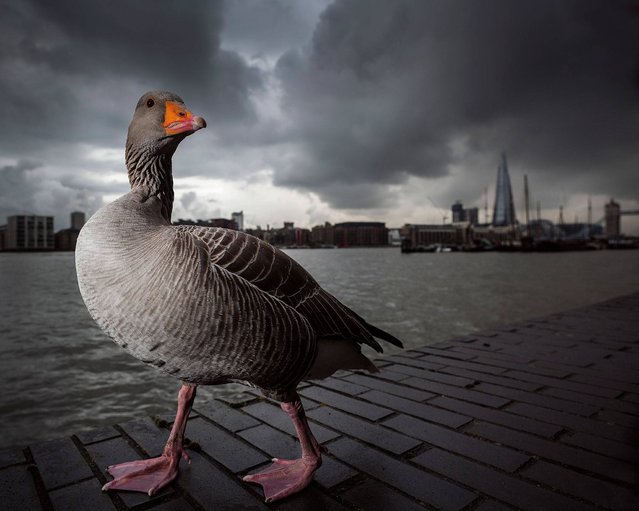
The British Wildlife Photography Awards winners have been revealed, with Lee Acaster from Suffolk taking home the top prize for his shot of a Graylag Goose in London. Acaster, who received £5,000, photographed the animal against an ominous London skyline, with The Shard clearly visible in the background. Here: “Urban Tourist (Graylag Goose)”. Urban category and overall winner. (Photo by Lee Acaster/British Wildlife Photography Awards 2014)
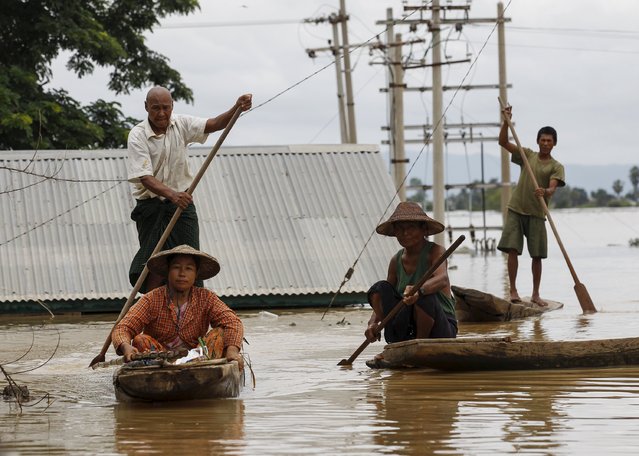
People row their canoes on a flooded street at a village in Kawlin township, Sagaing division, Myanmar, July 21, 2015. Heavy rains caused flooding over 20,000 acres of rice field and in about a hundred villages, killing at least eight people, according to local media. (Photo by Soe Zeya Tun/Reuters)
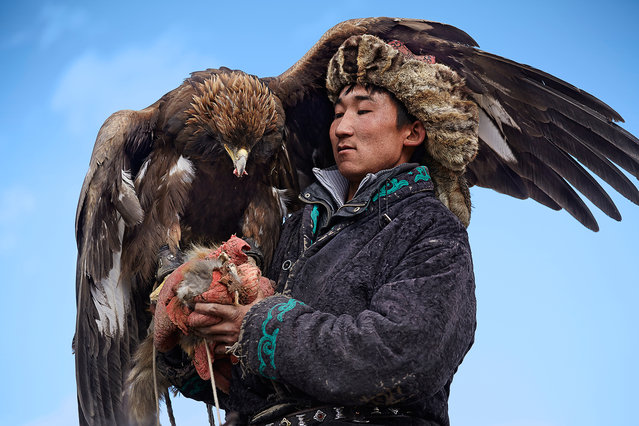
In one of the planet’s most desolate and harsh terrains, the Altai Mountains which run from Siberia in Russia down to Mongolia’s Gobi Desert, hunting with eagles is currently only practiced by a handful of Kyrgyz and Kazakhs. This form of falconry, the practice of hunting with the aid of birds of prey, can be traced back as far as 4,000 years in Central Asia. Here: after a successful hunt, a proud hunter rewards his eagle by feeding it the lungs of the prey, which is considered the most highly prized part of the animal. (Photo by Tariq Zaidi/The Washington Post)
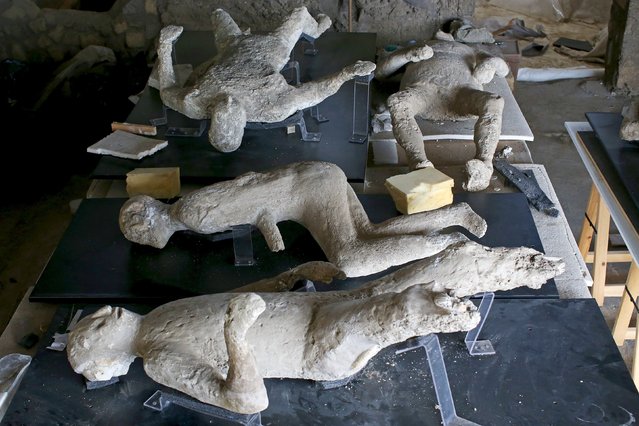
Plaster cast moulds of victims of the Mount Vesuvius eruption lie on a display table in a laboratory at Pompeii October 13, 2015. An expert team made up of archaeologists, radiologists, orthodontists and anthropologists began on September 2015 to use CAT scan technology (computerised axial tomography) to peer inside the plaster cast moulds of Pompeii's victims, in a study that has added more detail to previous findings. A 16-layer scan had to be used in order to penetrate the hardened plaster but the results showed up impressive skeletal remains and near perfect teeth. (Photo by Alessandro Bianchi/Reuters)