Loading...
Done


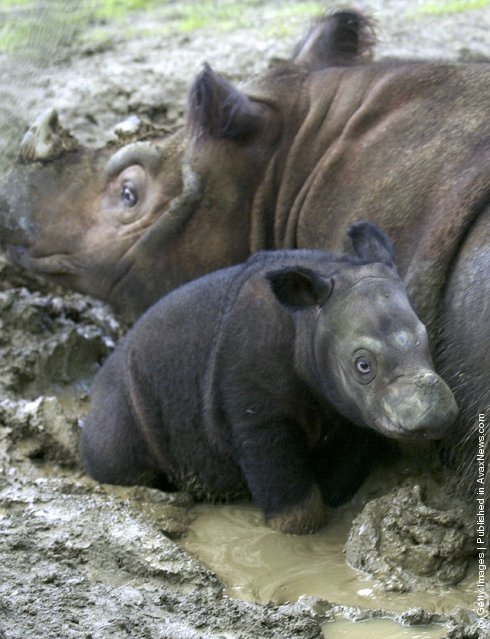
“The Sumatran Rhinoceros (Dicerorhinus sumatrensis) is a member of the family Rhinocerotidae and one of five extant rhinoceroses. It is the only extant species of the genus Dicerorhinus. It is the smallest rhinoceros, standing about 120–145 centimetres (3.9–4.76 ft) high at the shoulder, with a body length of 250 centimetres (8.2 ft) and weight of 500–800 kilograms (1,100–1,800 lb). Like the African species, it has two horns; the larger is the nasal horn, typically 15–25 centimetres (5.9–9.8 in), while the other horn is typically a stub. A coat of reddish-brown hair covers most of the Sumatran Rhino's body”. – Wikipedia

Photo: Emi, a Sumatran rhinoceros lies in the mud with her three-week-old female calf at the Cincinnati Zoo and Botanical Garden August 19, 2004 in Cincinnati, Ohio. Emi made history by becoming the first Sumatran rhino to produce two calves in captivity. (Photo by Mike Simons/Getty Images)
Details
22 Jun 2011 12:37:00


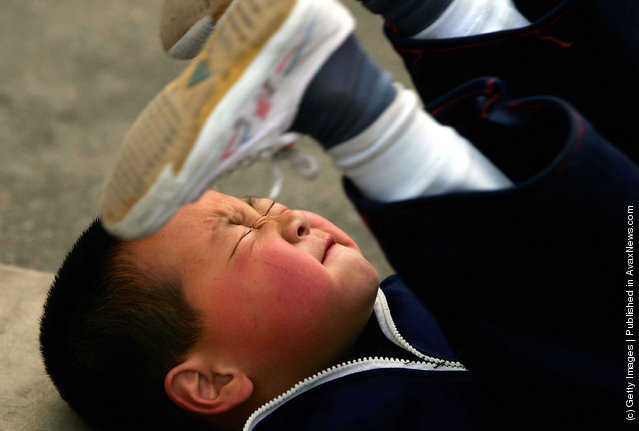
Wang Zeyu, 4, a fee-paying enthusiast of kung fu, practises during a training class at a kung fu school near the Shaolin Temple April 10, 2005 in Dengfeng, Henan Province, China. Zeyu's father sent him to the school from his home in Jiangsu Province, thousands kilometres away from Dengfeng, when he was just 3 years old. And his father must pay 9,800 yuan (US$1195) for one year's tuition at the school, a huge amount for most Chinese. There are more than 80 kung fu schools that line the road from the city of Dengfeng to the Shaolin Temple with hundreds and thousands of young kung-fu lovers from all over the country and beyond studying here. All the schools use the Shaolin name to attract students as the Shaolin Temple is the birthplace of Chinese Kung Fu. (Photo by Cancan Chu/Getty Images)
Details
06 Jul 2011 11:21:00


“The Red River Hog (Potamochoerus porcus), also known as the Bush Pig (but not to be confused with P. larvatus, common name “Bushpig”), is a wild member of the pig family living in Africa, with most of its distribution in the Guinean and Congolian forests. It is rarely seen away from rainforests, and generally prefers areas near rivers or swamps.

Red River Hogs eat grass, berries, roots, insects, molluscs, small vertebrates and carrion. They are capable of causing damage to plantations. Red River Hogs typically live in herds of 6-20 members led by a dominant boar. Sows rear 3-6 piglets at a time.”

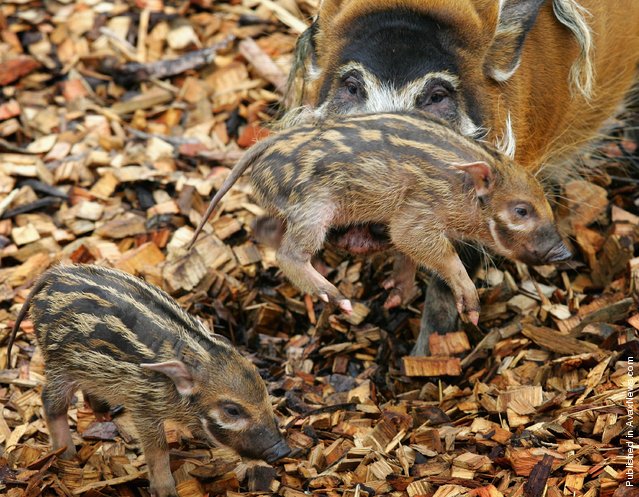
Photo: Two 17 day old red river hoglet twins forage for food next to their mother Bahiti at London Zoo on August 23, 2007 in London, England. Red River hoglets inhabit the forests and swamps of West and Central Africa. The recent additions to the London Zoo pig pen have been eagerly awaited by zoo keepers. (Photo by Chris Jackson/Getty Images)
Details
18 Mar 2011 15:15:00
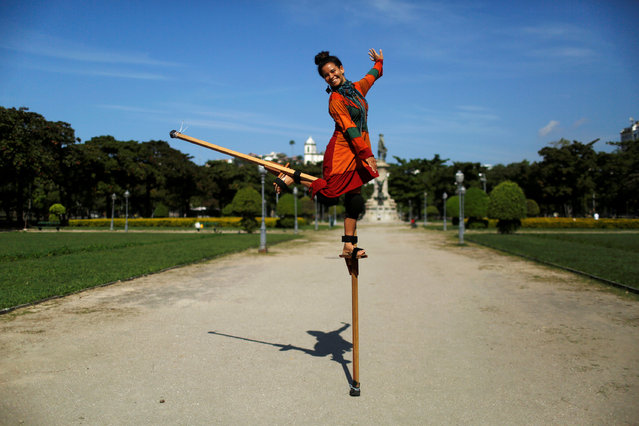
Raquel Poti, a 32-year-old street artist, poses at a park in Rio de Janeiro, Brazil, June 25, 2016. Raquel thinks the Olympics promotes a lifestyle that combines sports, culture and education. She is concerned about the large investment for the event while the population needs improvements in basic services. (Photo by Pilar Olivares/Reuters)

Just a week before Rio de Janeiro hosts South America's first Olympics, city residents expressed mixed feelings about the cost and security of the Games, while holding out hope they will bring joy to a nation facing economic and political crises. The conflicted thoughts mirror a recent survey by the Datafolha polling group showing that half of Brazilians were opposed to holding the Games, while 63 percent think the costs of hosting the event will outweigh benefits. (Photo by Pilar Olivares/Reuters)
Details
03 Aug 2016 11:51:00
“Two Brothers”. We found about 20 lions eating a buffalo. When the male leaved the group we anticipated him to take photos. It is 8AM, light is perfect and the position too. The lion stops and looks down from the hill, another lion is coming up, it stiffens, I think that will be a fight, i'm tense, the camera is OK, the shots previously made perfect. Photo location: Masai Mara, Kenya. (Photo and caption by Massimo Mei/National Geographic Photo Contest)

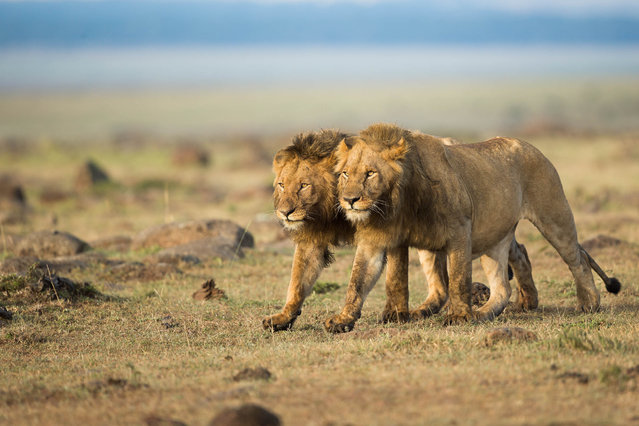
“Two Brothers”. We found about 20 lions eating a buffalo. When the male leaved the group we anticipated him to take photos. It is 8AM, light is perfect and the position too. The lion stops and looks down from the hill, another lion is coming up, it stiffens, I think that will be a fight, i'm tense, the camera is OK, the shots previously made perfect. The two meet, looking directly into their eyes, they sniff, rub against their heads, the tension drops, they start walking with the same step as when they were puppies, they are two brothers. Photo location: Masai Mara, Kenya. (Photo and caption by Massimo Mei/National Geographic Photo Contest)
Details
02 Jul 2014 09:45:00
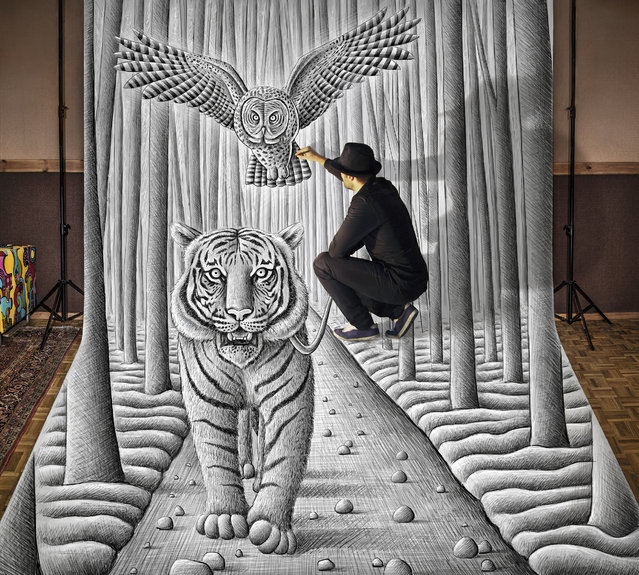
Visual artist Ben Heine at work in his studio while he creates one of his “anamorphic illusions” in Rochefort, Belgium

An arm holding a giant gun appears to explode through a wall, while elsewhere a man walks a tiger on a leash. These breathtaking pencil drawings are the work of 31-year-old artist Ben Heine, who lives and works in Rochefort, Belgium. The “anamorphic illusions”, part of the artist's “Pencil Vs Camera” series, appear slightly distorted unless viewed from the exact same perspective in which they were created. Photo: Visual artist Ben Heine at work in his studio while he creates one of his “anamorphic illusions” in Rochefort, Belgium. (Photo by Ben Heine/Barcroft Media)
Details
23 Mar 2014 11:00:00
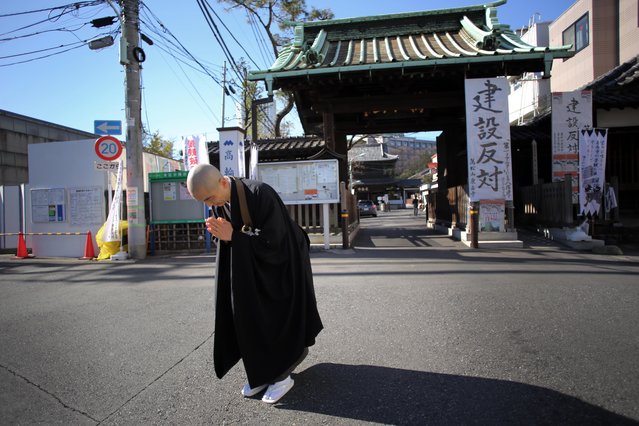
In this January 8, 2015 photo, a monk Kenmyo Muta bows at the condominium construction site and the gate of Sengakuji temple in Tokyo. (Photo by Eugene Hoshiko/AP Photo)

In this January 8, 2015 photo, a monk Kenmyo Muta bows at the condominium construction site and the gate of Sengakuji temple in Tokyo. The “47 ronin” samurai who inspired the long-loved saga of loyalty and honor eulogized in films, books and plays are fighting a new kind of battle in urban Japan. An apartment complex is going up next to the curved tile-roofed Sengakuji temple where the three-century-old graves of the ronin, or masterless samurai, lie. The banner reads: “We only hope to protect landscape of Sengakuji temple”. (Photo by Eugene Hoshiko/AP Photo)
Details
16 Jan 2015 13:01:00
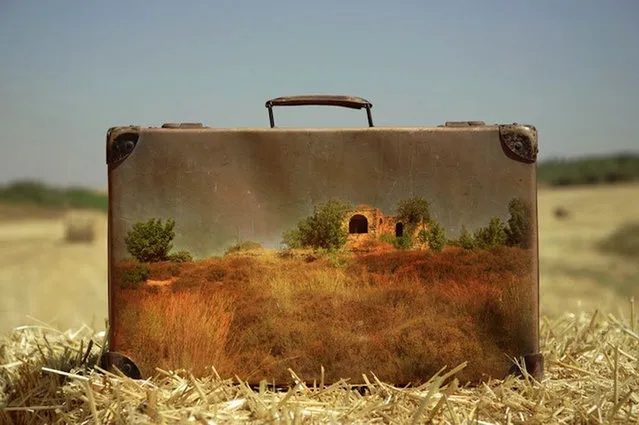
Memory Suitcase By Yuval Yairi

Memory Suitcases is a thought-provoking series by Israeli artist Yuval Yairi that uses old, worn suitcases as canvases for nostalgic landscapes. Like scenes out of one's memory, the propped up traveling cases feature a range of sepia-toned settings. The series presents the objects as though they are relics of a civilization from yesteryear, each with their own story to tell.
There's something both heartbreaking and sentimental about the images. It appears to tell a number of stories of leaving one lifestyle for another. The suitcases hold within them a picture show of memories from a life-altering journey. Like a number of his other works, Memory Suitcases "mimics the natural process of memory."
Details
22 Nov 2013 12:55:00