Loading...
Done
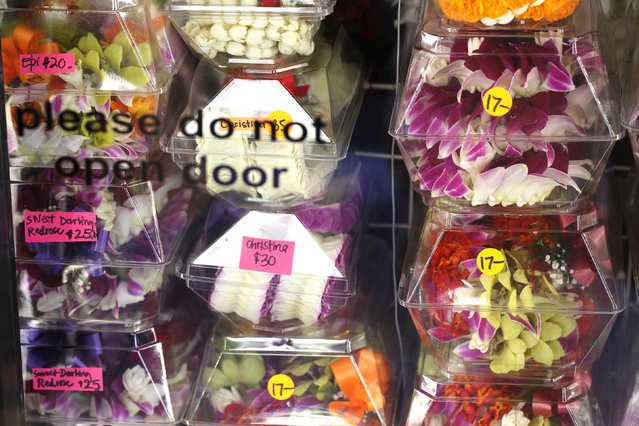
A selection of hand-made leis, traditional Hawaiian necklaces made of flowers and worn mostly on special occasions, fill a cooler at Lin's Lei Shop in the Chinatown district of Honolulu, Hawaii December 22, 2015. Hawaii, whose economy depends heavily on tourism, sees a brief lull in visitors each year in January and February. But in addition to the usual tourist destinations, the state shows a unique overlay of mainland U.S. culture atop tropical beauty year-round. (Photo by Jonathan Ernst/Reuters)

A selection of hand-made leis, traditional Hawaiian necklaces made of flowers and worn mostly on special occasions, fill a cooler at Lin's Lei Shop in the Chinatown district of Honolulu, Hawaii December 22, 2015. Hawaii, whose economy depends heavily on tourism, sees a brief lull in visitors each year in January and February. But in addition to the usual tourist destinations, the state shows a unique overlay of mainland U.S. culture atop tropical beauty year-round. (Photo by Jonathan Ernst/Reuters)
Details
16 Jan 2016 08:00:00
The eruption of Cordon Caulle began on June 4, 2011, located in the Region of Los Rios in Chile. For about 12 months, people and animals became accustomed to living with the daily fall of ash, which also caused problems in the air traffic in South America. The explosions and lightning during first days of the eruption could be seen from hundreds of miles around. This photograph was taken on the second night of eruption from the town of Lago Ranco. (Photo and caption by Francisco Negroni/National Geographic Traveler Photo Contest)

The eruption of Cordon Caulle began on June 4, 2011, located in the Region of Los Rios in Chile. For about 12 months, people and animals became accustomed to living with the daily fall of ash, which also caused problems in the air traffic in South America. The explosions and lightning during first days of the eruption could be seen from hundreds of miles around. This photograph was taken on the second night of eruption from the town of Lago Ranco. (Photo and caption by Francisco Negroni/National Geographic Traveler Photo Contest)

ATTENTION! All pictures are presented in high resolution. To see Hi-Res images – just TWICE click on any picture. In other words, click small picture – opens the BIG picture. Click BIG picture – opens VERY BIG picture.
Details
23 Jun 2013 11:24:00
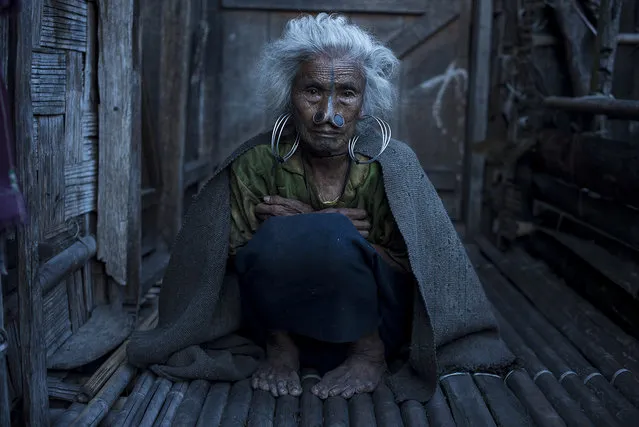
“YagYang”. The Apatani are tribal people living in north east of India in the region of Arunachal Pradesh. Tattooing and stuffing of large nose plugs is the particularity of these women. YagYang 75 years old, her husband passed away few months ago and she feels very alone, during my visit I was very fond of this woman and I wanted to spend some more time with her, so I asked her which was her favorite dish. Photo location: India. (Photo and caption by Passarini Mattia/National Geographic Photo Contest)

“YagYang”. The Apatani are tribal people living in north east of India in the region of Arunachal Pradesh. Tattooing and stuffing of large nose plugs is the particularity of these women. YagYang 75 years old, her husband passed away few months ago and she feels very alone, during my visit I was very fond of this woman and I wanted to spend some more time with her, so I asked her which was her favorite dish. The next day i returned with the fresh fish, as she mentioned, and when she saw me she was very happy and welcomed me with a big smile. Photo location: India. (Photo and caption by Passarini Mattia/National Geographic Photo Contest)
Details
05 Nov 2014 11:55:00
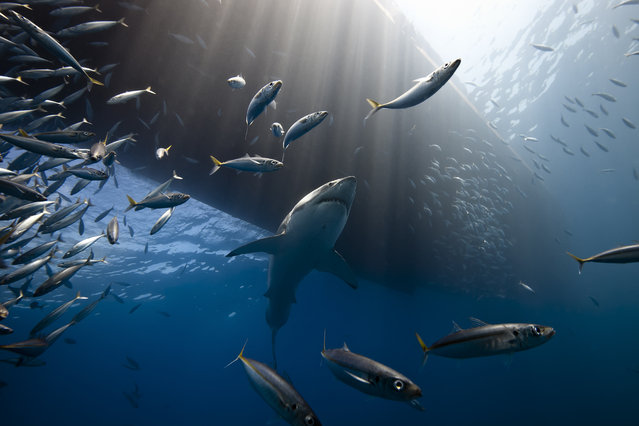
“Great White Shark of Guadalupe Island”. A great white shark very quiet under the boat and a lot of fish. The sun ray lighting the head of the shark. Location: Guadalupe Island, Mexico. (Photo and caption by Marc Henauer/National Geographic Traveler Photo Contest)

“Great White Shark of Guadalupe Island”. A great white shark very quiet under the boat and a lot of fish. The sun ray lighting the head of the shark. Location: Guadalupe Island, Mexico. (Photo and caption by Marc Henauer/National Geographic Traveler Photo Contest)

ATTENTION! All pictures are presented in high resolution. To see Hi-Res images – just TWICE click on any picture. In other words, click small picture – opens the BIG picture. Click BIG picture – opens VERY BIG picture.
Details
04 Jul 2013 09:49:00
This picture taken on June 1, 2019 shows Alex Gao trying to balance a book on his head during an etiquette and manners class in central Shanghai. (Photo by Hector Retamal/AFP Photo)

This picture taken on June 1, 2019 shows Alex Gao trying to balance a book on his head during an etiquette and manners class in central Shanghai. Against a soundtrack of classical music, children learn social skills, dining manners and deportment in the class, which costs $390 for four hours of practical instruction per student. (Photo by Hector Retamal/AFP Photo)
Details
02 Jul 2019 00:01:00
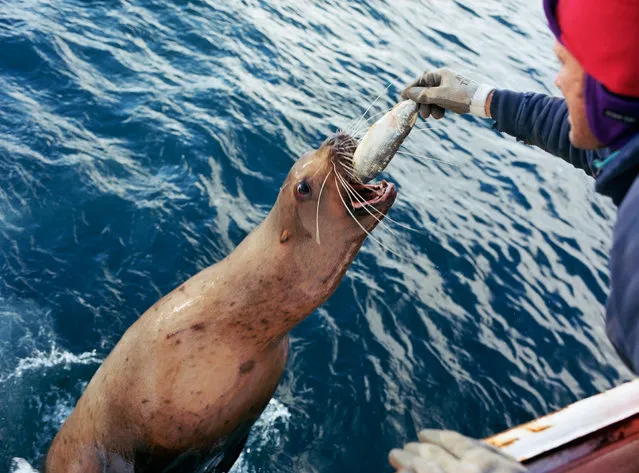
Before heading up to Alaska, the ship loads up with 3 months worth of food. Even so, it's hardly necessary. The ship's cook is constantly steaming fresh crab legs and seafood caught during the day. The hard labour of fishing requires a diet heavy in fat, protein, and omega-3s. Here, a sea lion gets a bite of the grub. (Photo by Corey Arnold)

In 2002 photographer Corey Arnold left behind a poor economy in San Francisco and headed up to Alaska to try his luck at his longtime passion of fishing. Arnold, who had worked summers during college on a salmon boat in Alaska, signed onto the f/v Rollo, a crabbing boat that fishes in the dangerous Bering Sea. While working long, strenuous hours on the Rollo, Arnold often stole away with the captain’s permission to grab his camera and photograph the crew and the ship. Arnold eventually put together “Fish Work: Bering Sea”, a documentation of his seven adventurous and dicey crab seasons aboard the Rollo. (Photo by Corey Arnold)
Details
20 Aug 2014 10:05:00
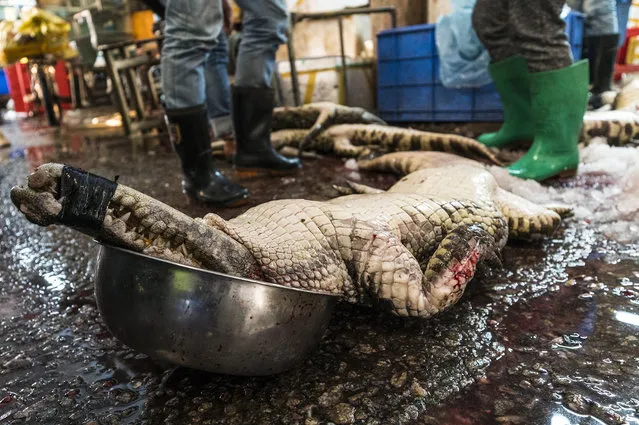
A dead crocodile is seen on Huangsha Seafood Market in Guangzhou, Guandong Province, China, 22 January 2018. Tsukiji Market of China or Huangsha Seafood Market is biggest one in Southern China and one of the biggest in China, as there are literally hundreds of different varieties of fish and seafood scattered throughout the market. Since the proximity of the fish market is so close to the Zhujiang River, it's quite easy for the large fishing vessels and fishermen to unload their fresh catch right at the market, which ensures that the fish and seafood remain fresh. Fish and other seafood are coming there from all around the globe. Seafood Market is full of different kinds of live fish, live shellfish, and live seafood on display in crystal clear tanks and it's common to see 5-star chefs, retailers and expats to source for fresh and high-quality seafood supplies for reasonable prices. While it is a wholesale fish market, since many Guangzhou restaurants and businesses come to purchase their seafood here, the public is welcome to come and even purchase. Many local Chinese have the vendors slice up fresh salmon fillets to take home or carry seafood into one of the nearby specialty restaurants, where they will cook if for them and serve it with vegetables and other side dishes of their choice. One of the biggest attractions for both, tourists and buyers, on market are crocodiles, which are brought there alive in wooden cases with taped jaws so they can?t accidentally bite. They are from crocodile farms from Guangdong, China and from Vietnam. Crocodile meat is popular in most Asian countries and it is consider as delicate one. Crocodiles weight from 10 to 25 kg and bigger ones are about 2 years old. They cost about 70 RMB (8.90 EURO) when bout as whole, or if you buy as parts most expensive and appreciated parts are paws 120 RMB (15.26 EURO) per kg, and tail 100 RMB (12.72 EURO) per kg. (Photo by Aleksandar Plavevski/EPA/EFE)

A dead crocodile is seen on Huangsha Seafood Market in Guangzhou, Guandong Province, China, 22 January 2018. Tsukiji Market of China or Huangsha Seafood Market is biggest one in Southern China and one of the biggest in China, as there are literally hundreds of different varieties of fish and seafood scattered throughout the market. (Photo by Aleksandar Plavevski/EPA/EFE)
Details
17 Apr 2020 00:05:00
Remarkable Cossack Songs

“Cossacks are a group of predominantly East Slavic people who originally were members of democratic, semi-military communities in Ukraine and Southern Russia. They inhabited sparsely populated areas and islands in the lower Dnieper and Don basins, and played an important role in the historical development of both Ukraine and Russia”. – Wikipedia

Photo: Кубанский казачий хор (Kuban Cossack chorus) - Розпрягайте, хлопцi, коней (Unharness The Horses, Guys!) – Ukrainian
Details
23 Oct 2012 14:20:00