Loading...
Done
A woman poses for a friend next to blossoming trees in the A.V. Fomin Botanical Garden, in Kyiv, Ukraine, Wednesday, April 10, 2024. (Photo by Vadim Ghirda/AP Photo)

A woman poses for a friend next to blossoming trees in the A.V. Fomin Botanical Garden, in Kyiv, Ukraine, Wednesday, April 10, 2024. (Photo by Vadim Ghirda/AP Photo)
Details
07 May 2024 03:50:00
Colourful pictures all round as people pose on April 7, 2025 in the bright rows of tulips at the family-run Norfolk Tulips near King’s Lynn, UK made famous due to being used to recreate the Emerald City in the Wicked film. (Photo by Bav Media)

Colourful pictures all round as people pose on April 7, 2025 in the bright rows of tulips at the family-run Norfolk Tulips near King’s Lynn, UK made famous due to being used to recreate the Emerald City in the Wicked film. (Photo by Bav Media)
Details
18 Jul 2025 02:47:00
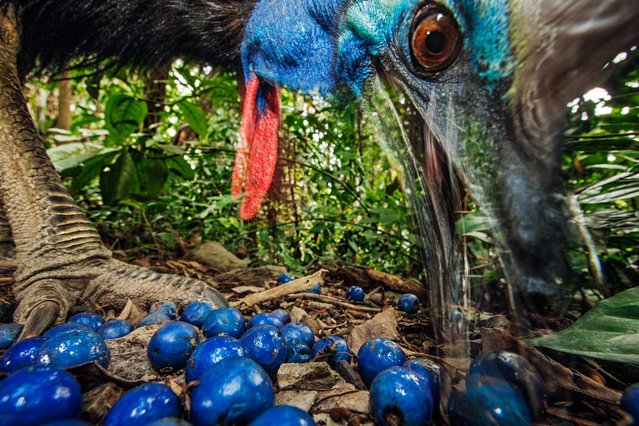
“Cassowaries are large, flightless birds related to emus and (more distantly) to ostriches, rheas, and kiwis”, writes Olivia Judson in the September issue of National Geographic magazine. (Photo by Christian Ziegler/National Geographic)

“Cassowaries are large, flightless birds related to emus and (more distantly) to ostriches, rheas, and kiwis”, writes Olivia Judson in the September issue of National Geographic magazine. How large? People-size: Adult males stand well over five foot five and top 110 pounds. Females are even taller, and can weigh more than 160 pounds. Dangerous when roused, they’re shy and peaceable when left alone. But even birds this big and tough are prey to habitat loss. The dense New Guinea and Australia rain forests where they live have dwindled. Today cassowaries might number 1,500 to 2,000. And because they help shape those same forests – by moving seeds from one place to another – “if they vanish”, Judson writes, “the structure of the forest would gradually change” too. (Photo by Christian Ziegler/National Geographic)
Details
06 Jan 2014 12:21:00
Two women wearing nun outfits drink beer while watching the 2014 Tim Hortons Brier curling championships in Kamloops, British Columbia in this March 8, 2014 file photo. (Photo and caption by Ben Nelms/Reuters)

Two women wearing nun outfits drink beer while watching the 2014 Tim Hortons Brier curling championships in Kamloops, British Columbia in this March 8, 2014 file photo. Although some people might conclude that a curling event could produce a dull atmosphere, it is actually far from it. Some of the most energetic and loyal fans are committed to showing their colours at tournaments around the world. There was a lull in the games that were being held on this day and I remember spotting these nuns sitting in their seats earlier. Although them just sitting there didn't produce a picture, I kept my eye on them for the entire match. As soon as I spotted them with beer in their hands, I slowly turned my camera towards them and waited for them to take a drink. One of the challenges of shooting this image was to not have everyone notice me taking the photo. I had a longer lens on and was right in the middle of the rink. I slowly turned my lens, not to make my intentions too obvious, and waited until they drank from their beers together. (Photo and caption by Ben Nelms/Reuters)
Details
27 Nov 2014 14:39:00
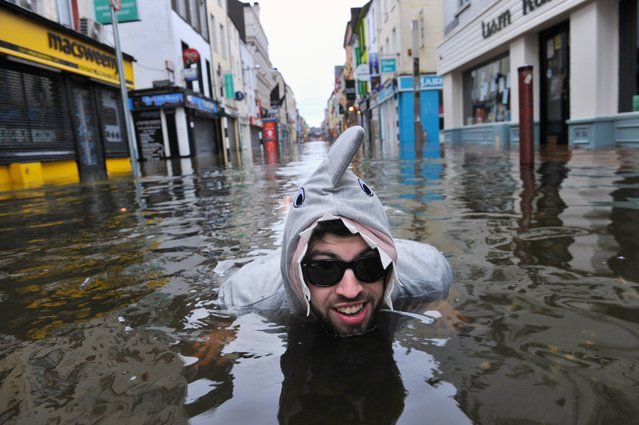
Early morning shark Sean McKeon pictured during severe flooding Oliver Plunkett street, Cork city, on February 3, 2014. (Photo by Daragh McSweeney/Provision)

Early morning shark Sean McKeon pictured during severe flooding Oliver Plunkett street, Cork city, on February 3, 2014. (Photo by Daragh McSweeney/Provision)
Details
08 Feb 2014 15:29:00
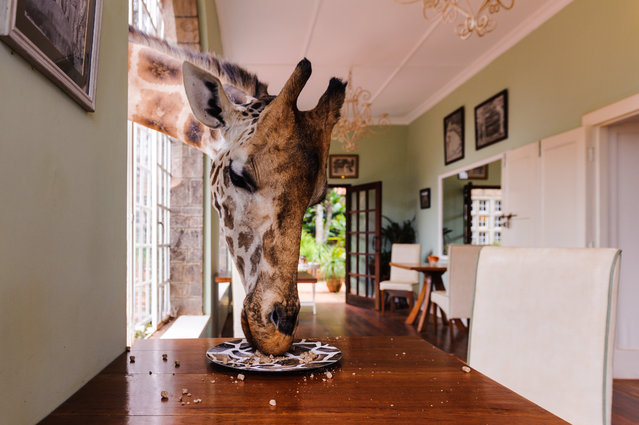
“Don't Leave Any Food On Your Plate”. The giraffes at Nairobi's Giraffe Manor are totally at home with humans. They will eat out of your hand, or even off your plate. Photo location: Giraffe Manor, Nairobi, Kenya. (Photo and caption by Gavin Werbeloff/National Geographic Photo Contest)

“Don't Leave Any Food On Your Plate”. The giraffes at Nairobi's Giraffe Manor are totally at home with humans. They will eat out of your hand, or even off your plate. Photo location: Giraffe Manor, Nairobi, Kenya. (Photo and caption by Gavin Werbeloff/National Geographic Photo Contest)
Details
20 Jun 2014 10:23:00
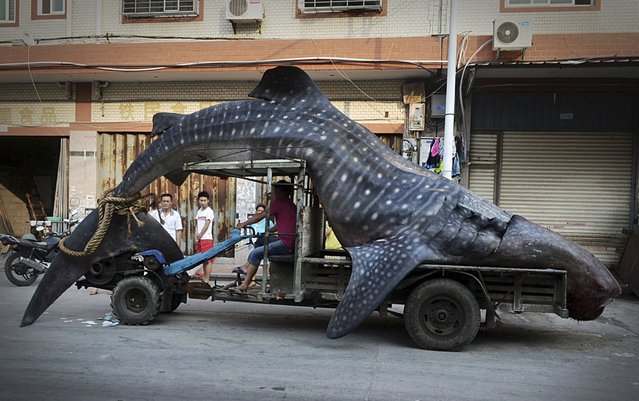
A fisherman transports a dead whale shark after it was caught in fishermen's net, in Yangzhi county, Fujian province August 1, 2014. According to local media, the whale shark is five-metre-long and weighs over 2 tonnes. (Photo by Reuters/Stringer)

A fisherman transports a dead whale shark after it was caught in fishermen's net, in Yangzhi county, Fujian province August 1, 2014. According to local media, the whale shark is five-metre-long and weighs over 2 tonnes. (Photo by Reuters/Stringer)
Details
05 Aug 2014 12:15:00
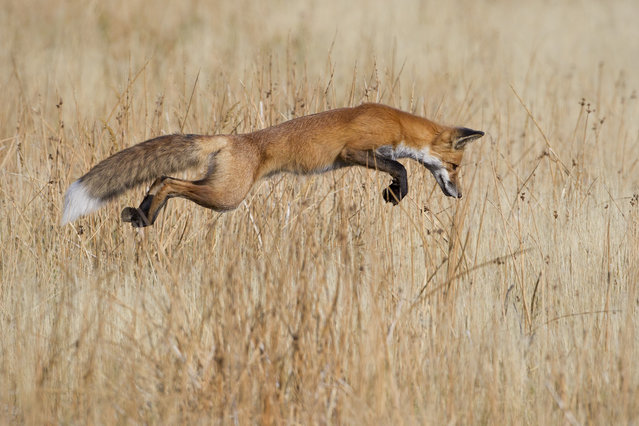
Canada: “Lucky pounce”. (Photo by Connor Stefanison/Wildlife Photographer of the Year 2013)

The winners of The London’s Natural History Museum's prestigious Wildlife Photographer of the Year for 2013 have finally been unveiled. Selected from almost 43,000 entries from 96 countries, the winners offer a glimpse of the stunning array of natural beauty on our planet. Photo: Canada: “Lucky pounce”. “Anticipating the pounce – that was the hardest part”, says Connor, who had come to Yellowstone National Park, Wyoming, USA, in search of wildlife as much as the spectacular landscape. He had found this fox, his first ever, on his last day in the park. It was so absorbed in hunting that Connor had plenty of time to get out of the car and settle behind a rock. It quartered the grassland, back and forth, and then started staring intently at a patch of ground, giving Connor just enough warning of the action to come. When it sprung up, Connor got his shot. And when it landed, the fox got his mouse. (Photo by Connor Stefanison/Wildlife Photographer of the Year 2013)

Details
17 Oct 2013 08:12:00