Loading...
Done
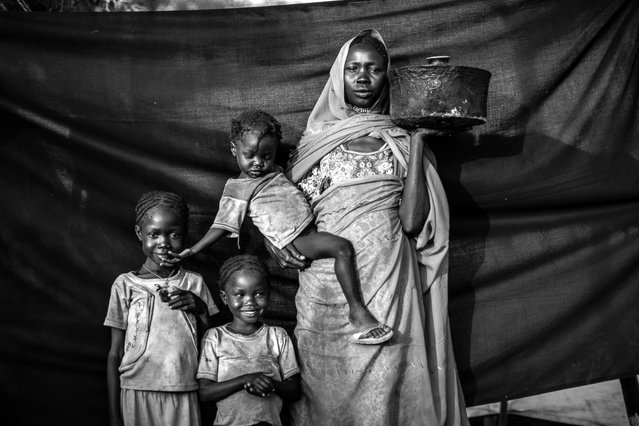
Magbola Alhadi, 20, and her three children pose for a portrait in Jamam refugee camp in Maban County, South Sudan on August 11th, 2012. Magboola and her family weathered aerial bombing raids for several months, but decided it was time to leave their village of Bofe the night that soldiers arrived and opened fire. (Photo by Brian Sokol/Panos Pictures)

Magbola Alhadi, 20, and her three children pose for a portrait in Jamam refugee camp in Maban County, South Sudan on August 11th, 2012. Magboola and her family weathered aerial bombing raids for several months, but decided it was time to leave their village of Bofe the night that soldiers arrived and opened fire. With her three children, she travelled for 12 days from Bofe to the town of El Fudj, on the South Sudanese border. The most important thing that Magboola was able to bring with her is the saucepan she holds in this photograph. It wasn't the largest pot that she had in Bofe, but it was small enough she could travel with it, yet big enough to cook sorghum for herself and her three daughters (from left: Aduna Omar, 6, Halima Omar, 4, and Arfa Omar, 2) during their journey. (Photo by Brian Sokol/Panos Pictures)
Details
18 Sep 2015 15:04:00
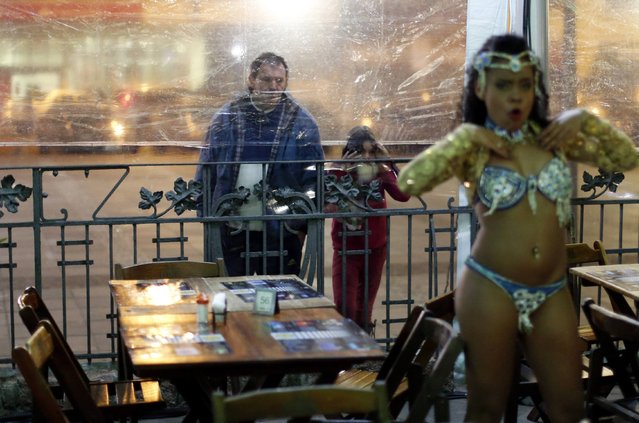
People watch from outside as a dancer performs inside a bar in Porto Alegre June 21, 2014. In a project called “On The Sidelines” Reuters photographers share pictures showing their own quirky and creative view of the 2014 World Cup in Brazil. (Photo by Marko Djurica/Reuters)

As national soccer teams and the photographers who have been covering them start to trickle home from the Brazil World Cup, it’s time to revisit the “On the Sidelines” project. This Reuters Pictures project was billed as a chance for photographers to share “their own quirky and creative view of the World Cup”. Photo: People watch from outside as a dancer performs inside a bar in Porto Alegre June 21, 2014. In a project called “On The Sidelines” Reuters photographers share pictures showing their own quirky and creative view of the 2014 World Cup in Brazil. (Photo by Marko Djurica/Reuters)
Details
09 Jul 2014 13:04:00
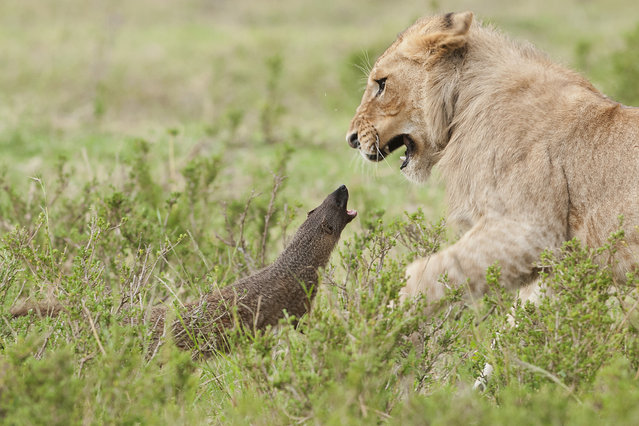
A mongoose growls at a startled lion on September 10, 2011 in Maasai Mara, Kenya. Four lions were left with their tails between their legs when a mongoose bravely took on the predators. Despite being under two feet tall, the aggressive mongoose growled at the felines and even bit one on the nose. (Photo by Jerome Guillaumot/Barcroft Media)

A mongoose growls at a startled lion on September 10, 2011 in Maasai Mara, Kenya. Four lions were left with their tails between their legs when a mongoose bravely took on the predators. Despite being under two feet tall, the aggressive mongoose growled at the felines and even bit one on the nose. The shocking fight, which was photographed in 2011 but has just been released, began in the Masaai Mara National Park, Kenya, when photographer Jerome Guillaumot came across four young lions surrounding the terrified marsh mongoose. The lions chased the mongoose into a hole in the ground but the small animal reemerged to fight the predators once again before running for cover. (Photo by Jerome Guillaumot/Barcroft Media)
Details
03 Sep 2014 10:33:00
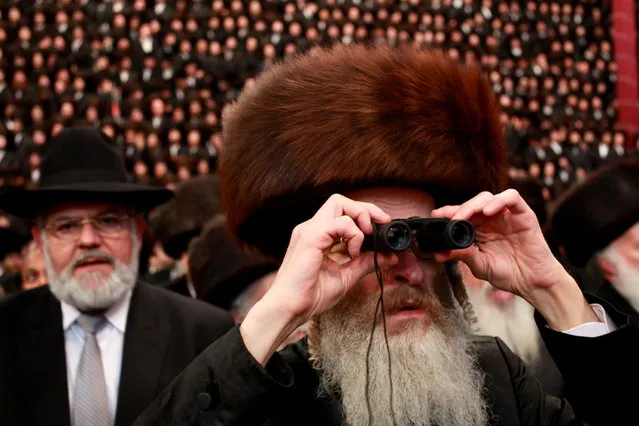
Ultra-orthodox Jewish wedding in Israel. Tens of thousands of Ultra-Orthodox Jews of the Belz Hasidic dynasty gather at the wedding ceremony of Rabbi Shalom Rokach in Kiryat Belz, in Jerusalem, on May 22, 2013. Around 25,000 ultra-orthodox Jews took part, making it one of the biggest weddings of the past few years. (Photo by Gil Cohen)

“Coming back home at 5am sunrise, I was just beginning to digest the grand event I was lucky to witness and cover: the wedding of the grandson of one of the most influential spiritual leaders in Israel’s ultra-Orthodox community...”. – Ronen Zvulun via Reuters. Photo: Ultra-orthodox Jewish wedding in Israel. Tens of thousands of Ultra-Orthodox Jews of the Belz Hasidic dynasty gather at the wedding ceremony of Rabbi Shalom Rokach in Kiryat Belz, in Jerusalem, on May 21, 2013. Around 25,000 ultra-orthodox Jews took part, making it one of the biggest weddings of the past few years. (Photo by Gil Cohen)
Details
24 May 2013 08:02:00


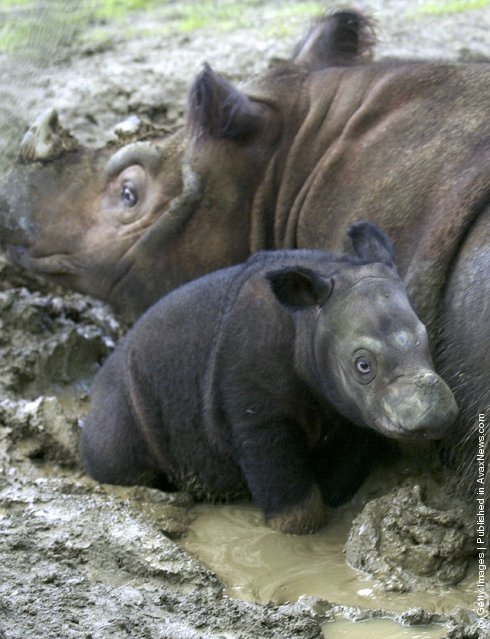
“The Sumatran Rhinoceros (Dicerorhinus sumatrensis) is a member of the family Rhinocerotidae and one of five extant rhinoceroses. It is the only extant species of the genus Dicerorhinus. It is the smallest rhinoceros, standing about 120–145 centimetres (3.9–4.76 ft) high at the shoulder, with a body length of 250 centimetres (8.2 ft) and weight of 500–800 kilograms (1,100–1,800 lb). Like the African species, it has two horns; the larger is the nasal horn, typically 15–25 centimetres (5.9–9.8 in), while the other horn is typically a stub. A coat of reddish-brown hair covers most of the Sumatran Rhino's body”. – Wikipedia

Photo: Emi, a Sumatran rhinoceros lies in the mud with her three-week-old female calf at the Cincinnati Zoo and Botanical Garden August 19, 2004 in Cincinnati, Ohio. Emi made history by becoming the first Sumatran rhino to produce two calves in captivity. (Photo by Mike Simons/Getty Images)
Details
22 Jun 2011 12:37:00


“Mario Armando Lavandeira, Jr. (born March 23, 1978), better known as Perez Hilton (a play on “Paris Hilton”), is an American blogger and television personality. His blog, Perezhilton.com (formerly PageSixSixSix.com), is known for posts covering gossip items about musicians, actors and celebrities. He is also known for posting tabloid photographs over which he has added his own captions or “doodles”. His blog has garnered negative attention for its attitude, its active “outing” of alleged closeted celebrities and its role in the increasing coverage of celebrities in all forms of media.” – Wikipedia

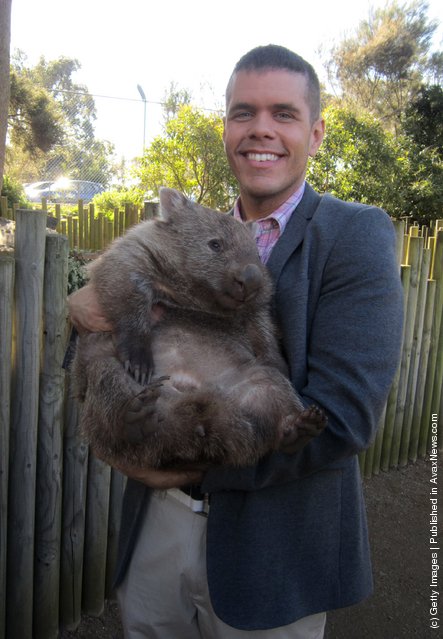
Photo: Blogger Perez Hilton poses with a wombat during a visit to Taronga Zoo on June 13, 2011 in Sydney, Australia. (Photo by Perezhilton.com via Getty Images)
Details
14 Jul 2011 09:44:00
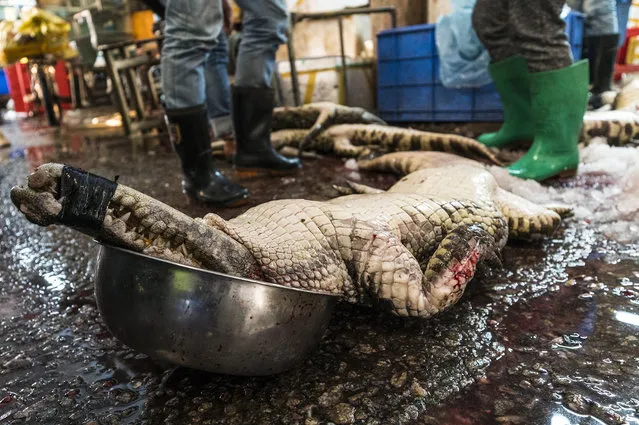
A dead crocodile is seen on Huangsha Seafood Market in Guangzhou, Guandong Province, China, 22 January 2018. Tsukiji Market of China or Huangsha Seafood Market is biggest one in Southern China and one of the biggest in China, as there are literally hundreds of different varieties of fish and seafood scattered throughout the market. Since the proximity of the fish market is so close to the Zhujiang River, it's quite easy for the large fishing vessels and fishermen to unload their fresh catch right at the market, which ensures that the fish and seafood remain fresh. Fish and other seafood are coming there from all around the globe. Seafood Market is full of different kinds of live fish, live shellfish, and live seafood on display in crystal clear tanks and it's common to see 5-star chefs, retailers and expats to source for fresh and high-quality seafood supplies for reasonable prices. While it is a wholesale fish market, since many Guangzhou restaurants and businesses come to purchase their seafood here, the public is welcome to come and even purchase. Many local Chinese have the vendors slice up fresh salmon fillets to take home or carry seafood into one of the nearby specialty restaurants, where they will cook if for them and serve it with vegetables and other side dishes of their choice. One of the biggest attractions for both, tourists and buyers, on market are crocodiles, which are brought there alive in wooden cases with taped jaws so they can?t accidentally bite. They are from crocodile farms from Guangdong, China and from Vietnam. Crocodile meat is popular in most Asian countries and it is consider as delicate one. Crocodiles weight from 10 to 25 kg and bigger ones are about 2 years old. They cost about 70 RMB (8.90 EURO) when bout as whole, or if you buy as parts most expensive and appreciated parts are paws 120 RMB (15.26 EURO) per kg, and tail 100 RMB (12.72 EURO) per kg. (Photo by Aleksandar Plavevski/EPA/EFE)

A dead crocodile is seen on Huangsha Seafood Market in Guangzhou, Guandong Province, China, 22 January 2018. Tsukiji Market of China or Huangsha Seafood Market is biggest one in Southern China and one of the biggest in China, as there are literally hundreds of different varieties of fish and seafood scattered throughout the market. (Photo by Aleksandar Plavevski/EPA/EFE)
Details
17 Apr 2020 00:05:00
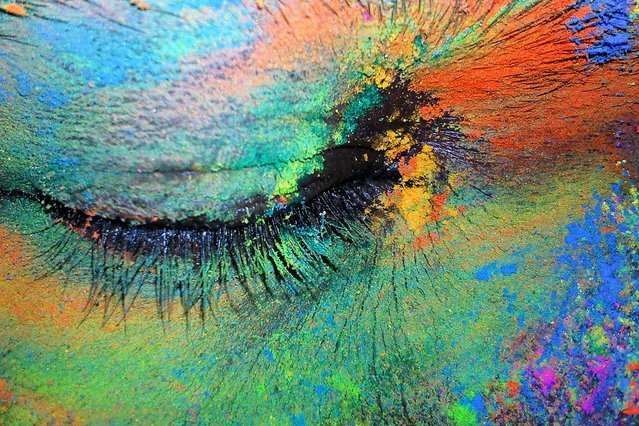
This close-up image – of a Holi Festival celebrant in Vrindivan, India, coated in neon-colored powder – was submitted to National Geographic’s Your Shot in the last week of March. On April 1 we published it on our Daily News site, along with seven other bright scenes captured during the Hindu spring Festival of Colors. (Photo by Tinto Alencherry/National Geographic)

This close-up image – of a Holi Festival celebrant in Vrindivan, India, coated in neon-colored powder – was submitted to National Geographic’s Your Shot in the last week of March. On April 1 we published it on our Daily News site, along with seven other bright scenes captured during the Hindu spring Festival of Colors. (Photo by Tinto Alencherry/National Geographic)
Details
06 Jan 2014 12:30:00