Loading...
Done
An activist of the anti-G8 forum 'Block G8' shows his middle finger to a police helicopter passing overhead

An activist of the anti-G8 forum “Block G8” shows his middle finger to a police helicopter passing overhead June 07, 2007 at Bollhagen, near Heiligendamm, Germany. (Photo by Carsten Koall/Getty Images)
Details
27 Dec 2011 15:40:00
Dancers perform during the Opening Ceremony of the Rio 2016 Olympic Games at Maracana Stadium on August 5, 2016 in Rio de Janeiro, Brazil. (Photo by Jamie Squire/Getty Images)

Dancers perform during the Opening Ceremony of the Rio 2016 Olympic Games at Maracana Stadium on August 5, 2016 in Rio de Janeiro, Brazil. (Photo by Jamie Squire/Getty Images)
Details
06 Aug 2016 13:40:00
Festival-goers wash on Shipyard Island, the venue of the 24th Sziget (Island) Festival in Northern Budapest, Hungary, 15 August 2016. (Photo by Szabó Gábor/Origo.hu)

Festival-goers wash on Shipyard Island, the venue of the 24th Sziget (Island) Festival in Northern Budapest, Hungary, 15 August 2016. The venue, one of the biggest cultural events of Europe, offers art exhibitions, theatrical and circus performances and above all music concerts from 10 to 17 August. (Photo by Szabó Gábor/Origo.hu)
Details
17 Aug 2016 11:36:00
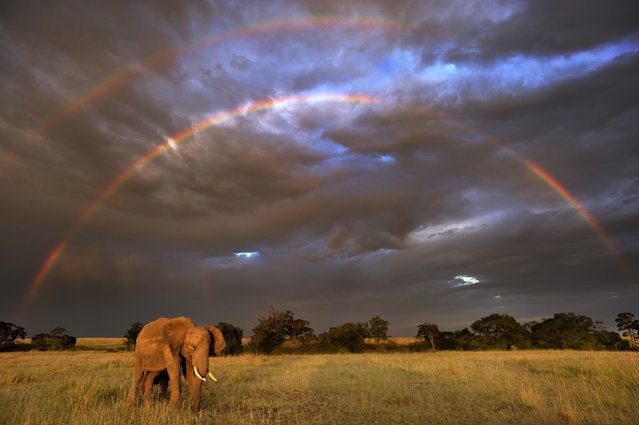
This photo provided by Netflix/naturepl.com and WWF-International shows an African Elephant (Loxodonta africana) in front of double rainbow, in Masai Mara, Kenya, included in the Netflix natural history series, “Our Planet”, in collaboration with Silverback Films and WWF. The eight-part series debuts in 2019. (Photo by Andy Rouse/Naturepl.com/WWF-International/Netflix via AP Photo)

This photo provided by Netflix/naturepl.com and WWF-International shows an African Elephant (Loxodonta africana) in front of double rainbow, in Masai Mara, Kenya, included in the Netflix natural history series, “Our Planet”, in collaboration with Silverback Films and WWF. The eight-part series debuts in 2019. (Photo by Andy Rouse/Naturepl/WWF-International/Netflix via AP Photo)
Details
09 Oct 2015 08:05:00
A couple hugs while standing near a Christmas tree made out of plastic bins and plastic hampers outside the Museum of History in Monterrey, Mexico, December 4, 2015. (Photo by Daniel Becerril/Reuters)

A couple hugs while standing near a Christmas tree made out of plastic bins and plastic hampers outside the Museum of History in Monterrey, Mexico, December 4, 2015. The humble Christmas tree has a rich history, from evergreen trees used to symbolise eternal life in Ancient Egypt to tree worship among pagan Europeans. The modern version has its origins in Germany, where the song “O Tannenbaum” is still a festive favourite. Today the traditional tree with lights and decorations appears in cities including Washington, Moscow and Beirut. Alternative constructions range from recycled rubbish in Mexico City to old window frames in Rakvere, Estonia. Whatever the shape or size, the message is the same: Merry Christmas. (Photo by Neil Hall/Reuters)

Details
23 Dec 2015 08:01:00
Tourists watch the Christmas Day sunrise behind Diamond Head from Waikiki Beach in Honolulu, Friday, December 25, 2015. (Photo by J. David Ake/AP Photo)

Tourists watch the Christmas Day sunrise behind Diamond Head from Waikiki Beach in Honolulu, Friday, December 25, 2015. (Photo by J. David Ake/AP Photo)
Details
26 Dec 2015 11:31:00
A pangolin carries its baby at a Bali zoo, Indonesia, Thursday, June 19, 2014. The pangolin baby was born on May 31. (Photo by Firdia Lisnawati/AP Photo)

A pangolin carries its baby at a Bali zoo, Indonesia, Thursday, June 19, 2014. The pangolin baby was born on May 31. (Photo by Firdia Lisnawati/AP Photo)
Details
21 Jun 2014 13:11:00
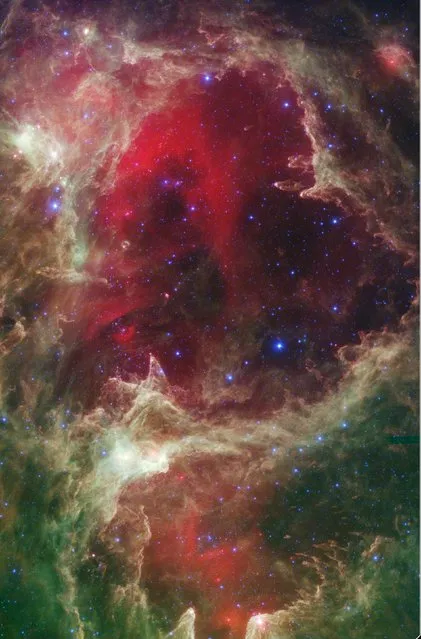
An infrared portrait from NASA's Spitzer Space Telescope which shows generations of stars is seen in this undated NASA handout image released February 14, 2013. In this wispy star-forming region, called W5, the oldest stars can be seen as blue dots in the centers of the two hollow cavities (other blue dots are background and foreground stars not associated with the region). Red shows heated dust that pervades the region's cavities, while green highlights dense clouds. (Photo by NASA/Reuters/JPL-Caltech/Harvard-Smithsonian/Handout)

An infrared portrait from NASA's Spitzer Space Telescope which shows generations of stars is seen in this undated NASA handout image released February 14, 2013. In this wispy star-forming region, called W5, the oldest stars can be seen as blue dots in the centers of the two hollow cavities (other blue dots are background and foreground stars not associated with the region). Red shows heated dust that pervades the region's cavities, while green highlights dense clouds. (Photo by NASA/Reuters/JPL-Caltech/Harvard-Smithsonian/Handout)
Details
03 Mar 2013 08:44:00