Loading...
Done
In this February 7, 2014 file photo, Matt Figi hugs and tickles his once severely-ill seven year old daughter Charlotte, as they walk together inside a greenhouse for a special strain of medical marijuana known as Charlotte's Web, which was named after the girl early in her treatment for crippling severe epilepsy, in the mountains west of Colorado Springs, Colo. (Photo by Brennan Linsley/AP Photo)

In this February 7, 2014 file photo, Matt Figi hugs and tickles his once severely-ill seven year old daughter Charlotte, as they walk together inside a greenhouse for a special strain of medical marijuana known as Charlotte's Web, which was named after the girl early in her treatment for crippling severe epilepsy, in the mountains west of Colorado Springs, Colo. Colorado is poised to award more than $8 million for medical marijuana research, a step toward addressing complaints that little is known about pot's medical potential. Among the research projects poised for approval on Wednesday, December 17, 2014, are one for pediatric epilepsy patients, and another for children with brain tumors. (Photo by Brennan Linsley/AP Photo)
Details
29 Dec 2014 13:12:00
A woman wearing a protective mask is seen behind a girl dressed in a Plague Doctor Mask in Western-Ukrainian city of Lviv, Ukraine, 22 March 2020. Ukrainian Designer Anastasia Markovska sewed protective masks looking like Plague Doctor Masks, the traditional costume of Venice Carnival, for herself and her friends due to the ongoing pandemic of the COVID-19 disease caused by the SARS-CoV-2 coronavirus. In Ukraine had been 47 laboratory-confirmed cases of COVID-19, including three deaths and one recovery as Ukraine's Health Ministry announced. (Photo by Pavlo Palamarchuk/EPA/EFE)

A woman wearing a protective mask is seen behind a girl dressed in a Plague Doctor Mask in Western-Ukrainian city of Lviv, Ukraine, 22 March 2020. Ukrainian Designer Anastasia Markovska sewed protective masks looking like Plague Doctor Masks, the traditional costume of Venice Carnival, for herself and her friends due to the ongoing pandemic of the COVID-19 disease caused by the SARS-CoV-2 coronavirus. In Ukraine had been 47 laboratory-confirmed cases of COVID-19, including three deaths and one recovery as Ukraine's Health Ministry announced. (Photo by Pavlo Palamarchuk/EPA/EFE)
Details
02 May 2020 00:05:00
In this July 9, 2016 file photo, girls jump from a diving platform into the Geneva Lake and enjoy sunny and warm weather, in Villeneuve, Switzerland. After nearly 90 years, women can legally swim topless in Geneva’s lake and Rhone River without running the risk of a fine. Geneva’s regional council has voted to modify a 1929 ordinance that banned women from swimming topless in the city’s main natural waterways, though the change doesn’t apply to public swimming pools or swimming totally naked. Nicolas Bolle, an official with Geneva’s security department, on Thursday, April 6, 2017 confirmed the council’s action a day earlier. (Photo by Jean-Christophe Bott/Keystone via AP Photo)

In this July 9, 2016 file photo, girls jump from a diving platform into the Geneva Lake and enjoy sunny and warm weather, in Villeneuve, Switzerland. After nearly 90 years, women can legally swim topless in Geneva’s lake and Rhone River without running the risk of a fine. Geneva’s regional council has voted to modify a 1929 ordinance that banned women from swimming topless in the city’s main natural waterways, though the change doesn’t apply to public swimming pools or swimming totally naked. Nicolas Bolle, an official with Geneva’s security department, on Thursday, April 6, 2017 confirmed the council’s action a day earlier. (Photo by Jean-Christophe Bott/Keystone via AP Photo)
Details
08 Apr 2017 09:39:00
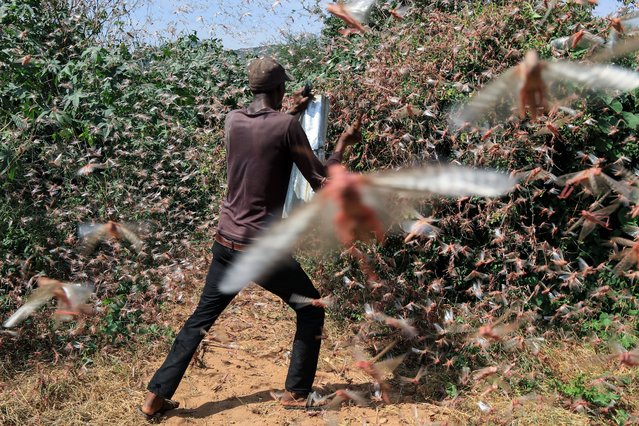
A man uses iron sheet to make noises, as a way of trying to disperse desert locusts that had invaded their farms during the second wave invasion in Kakongo village, in Nuu-Mwingi East, in Kitui, Kenya, 06 February 2021. The second wave invasion of the desert locusts in the country comes at a time where most famers are expecting to harvest their farm produce in the country. According to the United Nations Food and Agriculture Organization (FAO), on 04 February, warned numerous immature desert locust swarms persist in southern Ethiopia and Kenya. Some of the swarms are in community areas and therefore cannot be treated. In Kenya, immature swarms continue to spread westwards across northern and central counties where there are currently about 20 small swarms present, mostly about 50 hectares in size, it said. (Photo by Daniel Irungu/EPA/EFE)

A man uses iron sheet to make noises, as a way of trying to disperse desert locusts that had invaded their farms during the second wave invasion in Kakongo village, in Nuu-Mwingi East, in Kitui, Kenya, 06 February 2021. The second wave invasion of the desert locusts in the country comes at a time where most famers are expecting to harvest their farm produce in the country. (Photo by Daniel Irungu/EPA/EFE)
Details
25 Feb 2021 08:17:00
Palestinian barber Ramadan Odwan styles and straightens the hair of a customer with fire at his salon in Rafah, in the southern Gaza Strip February 2, 2017. In Ramadan Odwan's barbershop in Gaza, hair isn't just blow-dried, it's blowtorch-dried. “People have gone crazy about it, many people are curious to go through the experience and they are not afraid”, he told Reuters. “People here love adventures”. Odwan, 37, is not the first stylist in the world to use flame to straighten hair, but his craft is unique in the Gaza Strip. In his salon in the southern Gaza town of Rafah, Odwan applied what he described as a protective liquid coating to a customer's hair – he declined to disclose its contents – before aiming for the head and pressing the button on a small blowtorch. “I control how long I apply fire, I keep it on and off for 10 seconds or 15 seconds. It is completely safe and I have not encountered any accident since I started it two months ago”, Odwan added. Odwan charges 20 shekels ($5.20) for a haircut and fire-straightening. A barber for the past 18 years, he said part of the reason he uses the technique is to show that Palestinian barbers are as “professional as those out there around the world”. (Photo by Ibraheem Abu Mustafa/Reuters)

Palestinian barber Ramadan Odwan styles and straightens the hair of a customer with fire at his salon in Rafah, in the southern Gaza Strip February 2, 2017. In Ramadan Odwan's barbershop in Gaza, hair isn't just blow-dried, it's blowtorch-dried. “People have gone crazy about it, many people are curious to go through the experience and they are not afraid”, he told Reuters. “People here love adventures”. (Photo by Ibraheem Abu Mustafa/Reuters)
Details
11 Feb 2017 00:05:00
Female North Korean soldiers patrol along the banks of Yalu River, near the North Korean town of Sinuiju, opposite the Chinese border city of Dandong, April 11, 2013. South Korea and the United States were on high alert for a North Korean missile launch on Thursday as the hermit kingdom turned its attention to celebrating its ruling Kim dynasty and appeared to tone down rhetoric of impending war. (Photo by Jacky Chen/Reuters)

Female North Korean soldiers patrol along the banks of Yalu River, near the North Korean town of Sinuiju, opposite the Chinese border city of Dandong, April 11, 2013. South Korea and the United States were on high alert for a North Korean missile launch on Thursday as the hermit kingdom turned its attention to celebrating its ruling Kim dynasty and appeared to tone down rhetoric of impending war. (Photo by Jacky Chen/Reuters)

P.S. All pictures are presented in high resolution. To see Hi-Res images – just TWICE click on any picture. In other words, click small picture – opens the BIG picture. Click BIG picture – opens VERY BIG picture (if available; this principle works anywhere on the site AvaxNews)
Details
13 Apr 2013 14:48:00
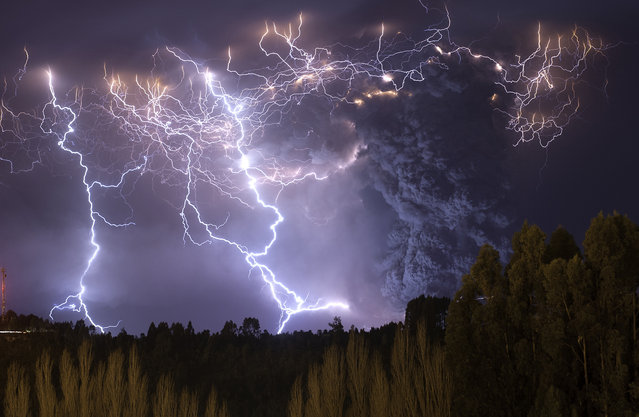
The eruption of Cordon Caulle began on June 4, 2011, located in the Region of Los Rios in Chile. For about 12 months, people and animals became accustomed to living with the daily fall of ash, which also caused problems in the air traffic in South America. The explosions and lightning during first days of the eruption could be seen from hundreds of miles around. This photograph was taken on the second night of eruption from the town of Lago Ranco. (Photo and caption by Francisco Negroni/National Geographic Traveler Photo Contest)

The eruption of Cordon Caulle began on June 4, 2011, located in the Region of Los Rios in Chile. For about 12 months, people and animals became accustomed to living with the daily fall of ash, which also caused problems in the air traffic in South America. The explosions and lightning during first days of the eruption could be seen from hundreds of miles around. This photograph was taken on the second night of eruption from the town of Lago Ranco. (Photo and caption by Francisco Negroni/National Geographic Traveler Photo Contest)

ATTENTION! All pictures are presented in high resolution. To see Hi-Res images – just TWICE click on any picture. In other words, click small picture – opens the BIG picture. Click BIG picture – opens VERY BIG picture.
Details
23 Jun 2013 11:24:00
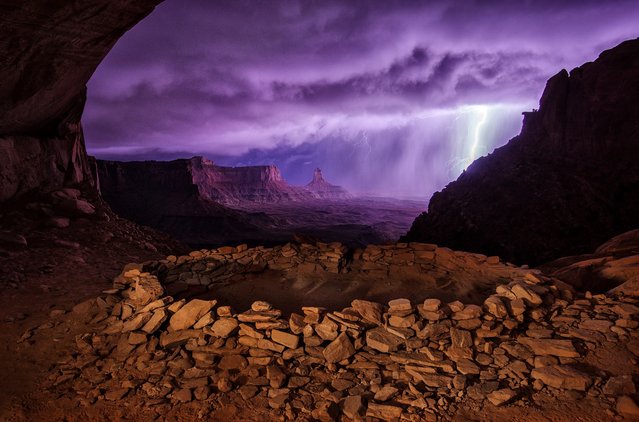
Second Place Winner: “Thunderstorm at False Kiva”. I hiked out to these ruins at night hoping to photograph them with the Milky Way, but instead a thunderstorm rolled through, creating this dramatic image. – Max Seigal. (Photo and caption by Max Seigal/National Geographic Traveler Photo Contest)

Second Place Winner: “Thunderstorm at False Kiva”. I hiked out to these ruins at night hoping to photograph them with the Milky Way, but instead a thunderstorm rolled through, creating this dramatic image. – Max Seigal. National Geographic Traveler Director of Photography Dan Westergren, one of this year's judges, shares his thoughts on the second place winner: “This photo combines two different scenes into one: the small kiva in a cliff dwelling and the grand vista of Canyonlands National Park across the valley. I really like the two different color palettes – warm inside and purple outside. This two-for-one scene was caused by the lightning storm outside the dwelling, which lit up the landscape like it was a huge electronic flash. Looking at this picture I can imagine what a wonderful sight it must have been for the ancient people who lived here. It doesn't seem too amazing now in our modern world, but might have been mind-blowing for the prehistoric residents”. Location: Utah. (Photo and caption by Max Seigal/National Geographic Traveler Photo Contest)
Details
02 Aug 2013 06:16:00