Loading...
Done


“The Trabant is a car that was produced by former East German auto maker VEB Sachsenring Automobilwerke Zwickau in Zwickau, Sachsen. It was the most common vehicle in East Germany, and was also exported to countries both inside and outside the communist bloc. The main selling points was that it had room for four adults and luggage in a compact, light and durable shell and that it was fast (when introduced) and durable. With its mediocre performance, smoky two-stroke engine, and production shortages, the Trabant is often cited as an example of the disadvantages of centralized planning; on the other hand, it is regarded with derisive affection as a symbol of the failed former East Germany and of the fall of communism (in former West Germany, as many East Germans streamed into West Berlin and West Germany in their Trabants after the opening of the Berlin Wall in 1989). It was in production without any significant changes for nearly 30 years with 3,096,099 Trabants produced in total”. – Wikipedia

Photo: Enthusiasts weared in uniforms of the former eastern german army trive in a military Trabant car as fans and owners of East German-era Trabant cars gather at the 2011 International Trabantfahrer Treffen (International Trabant Drivers Meeting) on June 26, 2011 in Zwickau, Germany. The Trabant, also known as the Trabi, was among the main cars produced in communist East Germany and built by VEB Sachsenring Automobilwerke in Zwickau for 30 years until 1989. Today the car has cult status for many followers and one company, IndiKar, is even seeking to revive the brand in a modern, electric version. (Photo by Carsten Koall/Getty Images)
Details
27 Jun 2011 12:21:00
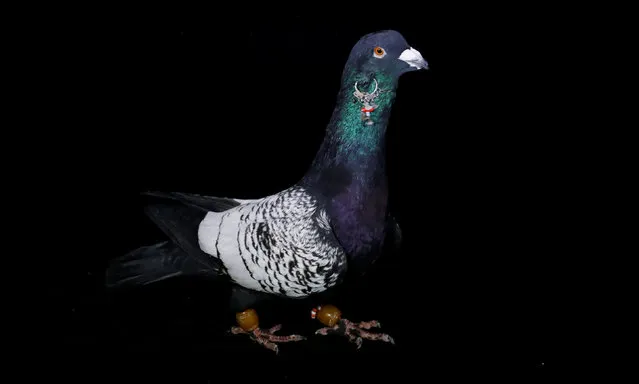
A pigeon, known as Siyah Kinifirli, with an approximate market value of 1000 Turkish Lira ($263), bred by 23-year-old Ismail Ozbek, is pictured in Sanliurfa, Turkey, December 23, 2016. As night-time approaches in Sanliurfa, southeastern Turkey, most of the alleyways of the city's old bazaar are emptying out of buyers and vendors, except for one. The bustle of daytime trading has died down, but on this little street, a stream of men carry cardboard boxes filled with pigeons to a cluster of three teahouses. Here, they sell the birds at Sanliurfa's famed auctions to a dedicated band of pigeon keepers and breeders, a pastime that has been thriving for hundreds of years across the region and over the nearby border into war-torn Syria. In a country where the minimum wage is about 1,400 Liras ($367) a month, enthusiasts regularly easily spend hundreds of dollars for one bird. “I once sold a pair of pigeons for 35,000 Turkish Lira”, says auctioneer Imam Dildas. “This is a passion, a hobby you cannot quit. I've been known to sell the fridge and my wife's gold bracelets to pay for pigeons”. (Photo by Umit Bektas/Reuters)

A pigeon, known as Siyah Kinifirli, with an approximate market value of 1000 Turkish Lira ($263), bred by 23-year-old Ismail Ozbek, is pictured in Sanliurfa, Turkey, December 23, 2016. As night-time approaches in Sanliurfa, southeastern Turkey, most of the alleyways of the city's old bazaar are emptying out of buyers and vendors, except for one. (Photo by Umit Bektas/Reuters)
Details
17 Jan 2017 12:05:00
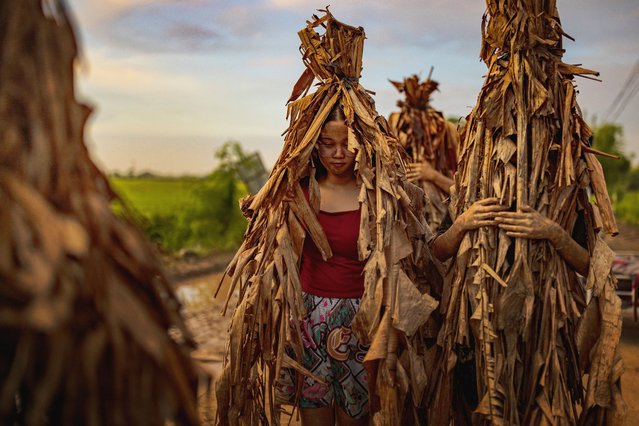
Devotees of the small farming village of Bibiclat celebrate the Feast of Saint John the Baptist while covered in banana leaves and mud on June 24, 2025 in Aliaga, Philippines. Known as the “Taong Putik” (mud people), the ritual happens yearly in this small farming village as their own version of expressing their faith and celebrating the feast of Saint John the Baptist whom the survivors of the Japanese occupation in 1944 in their area prayed to for rain to save their fellow villagers. A marker near the church entrance of the village tells a story of a heavy torrential rain that happened that day that forced the Japanese military to call off the execution of 14 villagers. The Philippines is the only predominantly Catholic country in Southeast Asia after more than 300 years of Spanish rule. (Photo by Ezra Acayan/Getty Images)

Devotees of the small farming village of Bibiclat celebrate the Feast of Saint John the Baptist while covered in banana leaves and mud on June 24, 2025 in Aliaga, Philippines. Known as the “Taong Putik” (mud people), the ritual happens yearly in this small farming village as their own version of expressing their faith and celebrating the feast of Saint John the Baptist whom the survivors of the Japanese occupation in 1944 in their area prayed to for rain to save their fellow villagers. (Photo by Ezra Acayan/Getty Images)
Details
29 Aug 2025 03:18:00
Models present creations of fashion brand motonari ono during Tokyo Fantashion at a shopping district in Tokyo, Japan, August 16, 2015. (Photo by Yuya Shino/Reuters)

Models present creations of fashion brand motonari ono during Tokyo Fantashion at a shopping district in Tokyo, Japan, August 16, 2015. Tokyo Fantashion is a one-day showcase event of up-and-coming fashion trends, organised by Tokyo Creators, a group of 20 new brands. (Photo by Yuya Shino/Reuters)
Details
17 Aug 2015 10:36:00
A protester stands against Turkish soldiers during clashes near Silivri, where a hearing on people charged with attempting to overthrow Prime Minister Tayyip Erdogan's Islamist-rooted government is due to take place August 5, 2013. (Photo by Murad Sezer/Reuters)

A protester stands against Turkish soldiers during clashes near Silivri, where a hearing on people charged with attempting to overthrow Prime Minister Tayyip Erdogan's Islamist-rooted government is due to take place August 5, 2013. A Turkish court on Monday sentenced a former military commander to life in prison and dozens of others including opposition members of parliament to long terms for plotting against the government, in a case that has exposed deep divisions in the country. Retired military chief of staff General Ilker Basbug was sentenced to life for his role in the “Ergenekon” conspiracy to overthrow the government of Erdogan. (Photo by Murad Sezer/Reuters)

P.S. All pictures are presented in high resolution. To see Hi-Res images – just TWICE click on any picture. In other words, click small picture – opens the BIG picture. Click BIG picture – opens VERY BIG picture (if available; this principle works anywhere on the site AvaxNews)
Details
10 Aug 2013 13:51:00
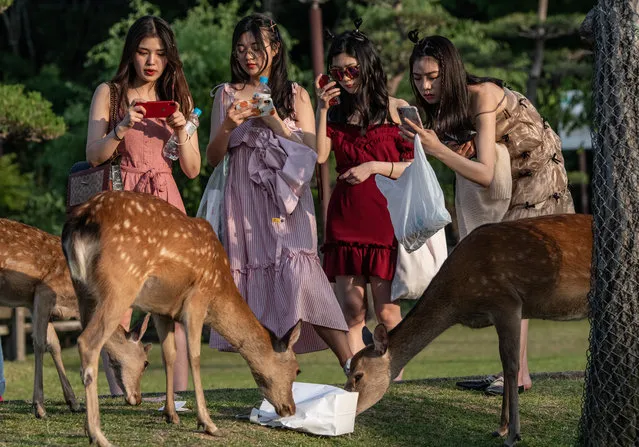
Tourists take photographs as a wild sika deer eats a bag on June 6, 2019 in Nara, Japan. Nara's free-roaming deer have become a huge attraction for tourists. However, an autopsy on a deer that was recently found dead near one of the city's famous temples discovered 3.2kg of plastic in its stomach and caused concern at the effect of tourism as Japan struggles to cope with a huge increase in domestic and international tourists. Alongside a growing Japanese tendency to holiday domestically, a record 31 million people visited the country in 2018 up 8.7 percent from the previous year, with many people now worrying about the environmental impact caused by such large visitor numbers. (Photo by Carl Court/Getty Images)

Tourists take photographs as a wild sika deer eats a bag on June 6, 2019 in Nara, Japan. Nara's free-roaming deer have become a huge attraction for tourists. However, an autopsy on a deer that was recently found dead near one of the city's famous temples discovered 3.2kg of plastic in its stomach and caused concern at the effect of tourism as Japan struggles to cope with a huge increase in domestic and international tourists. (Photo by Carl Court/Getty Images)
Details
19 Jun 2019 00:03:00
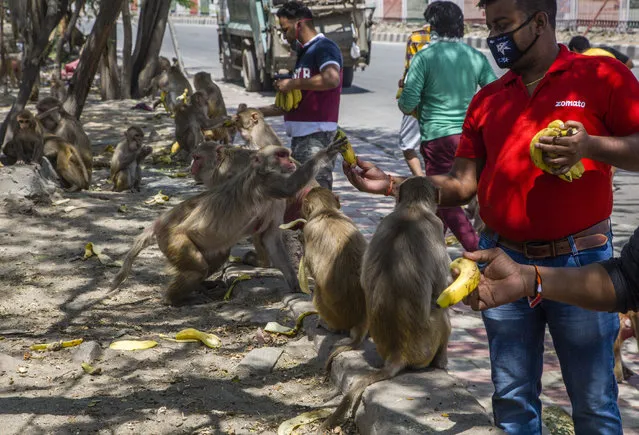
Men give bananas to monkeys gathered on the side of the road as India remains under an unprecedented lockdown over the highly contagious coronavirus (COVID-19) on April 08, 2020 in New Delhi, India. Wild animals, including monkeys, are roaming human settlements in India as people are staying indoors due to the 21-day lockdown. With India's 1.3 billion population and tens of millions of cars off the roads, wildlife is moving towards areas inhabited by humans. Wild animals in many countries have been seen roaming streets. A study says some 60 percent of the new diseases found around the globe every year are zoonotic, meaning they originate in animals and are passed on to humans. COVID-19 is a zoonotic disease that is suspected to have come from the wet markets of Wuhan, China. (Photo by Yawar Nazir/Getty Images)

Men give bananas to monkeys gathered on the side of the road as India remains under an unprecedented lockdown over the highly contagious coronavirus (COVID-19) on April 08, 2020 in New Delhi, India. Wild animals, including monkeys, are roaming human settlements in India as people are staying indoors due to the 21-day lockdown. (Photo by Yawar Nazir/Getty Images)
Details
12 Apr 2020 00:05:00
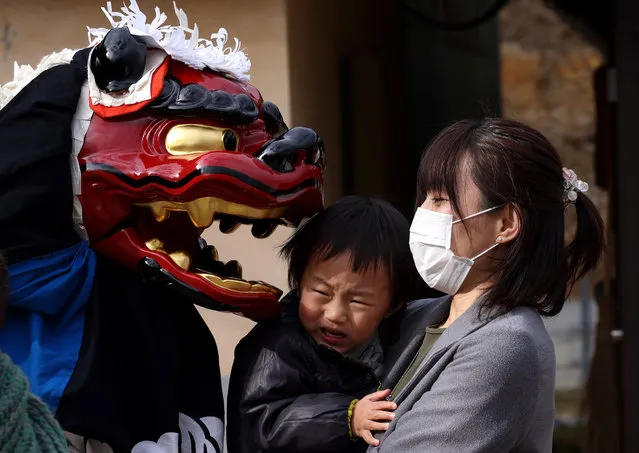
A performer wearing a lion mask performs the Ise Daikagura lion dance at the remote village of Yamanawa on February 08, 2021 in Ryuo, Japan. Ise Daikagura is a group of traditional Lion Dance performers who pray in front of farmers houses and businesses for good grain harvests and disease-free lives. Performers play sacred music using drums and flutes with two lion mask dancers. A lion mask is considered a symbol of God, who enters the house and performs in front of the Shinto God, a statue placed inside the house, mostly in the kitchen. These prayers are called “Kamodo Barai”. After the prayers, they are gifted with money, rice, sake and Japanese sweets from the householders. A group can travel for more than one hundred days to thousands of households and businesses throughout rural-villages in western Japan, and pray to those who are unable to visit the country’s most sacred shrine, the Grand Ise Shrine in Mie Prefecture. The group started its performance in the Edo era between 1603 to 1868 according to Japanese history. The Japanese government designated it as an important folk cultural national property in 1981. (Photo by Buddhika Weerasinghe/Getty Images)

A performer wearing a lion mask performs the Ise Daikagura lion dance at the remote village of Yamanawa on February 08, 2021 in Ryuo, Japan. Ise Daikagura is a group of traditional Lion Dance performers who pray in front of farmers houses and businesses for good grain harvests and disease-free lives. (Photo by Buddhika Weerasinghe/Getty Images)
Details
18 Feb 2021 09:27:00