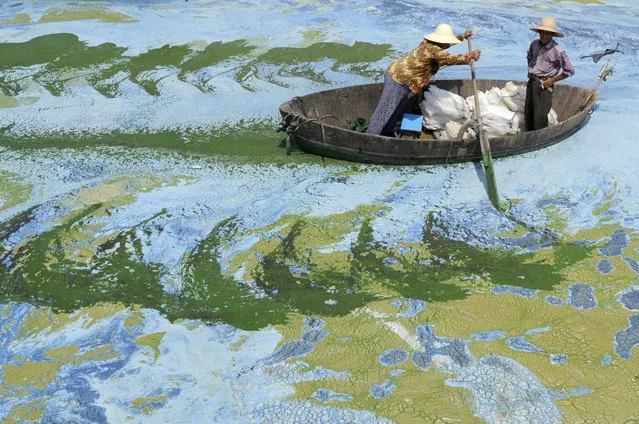
Growing cities, overuse of fertilizers and factory wastewater have degraded China's water supplies to the extent that half the nation's rivers and lakes are severely polluted. China aims to spend $850 billion to improve filthy water supplies over the next decade, but even such huge outlays may do little to reverse damage caused by decades of pollution and overuse in Beijing's push for rapid economic growth. Photo: Fishermen row a boat in the algae-filled Chaohu Lake in Hefei, Anhui province, June 19, 2009. (Photo by Jianan Yu/Reuters)
A young Chinese girl dressed in Christmas costume, hugs a pedestrian on a street to celebrate Christmas in Nanjing city, east China's Jiangsu province, 23 December 2015. (Photo by Imaginechina/Splash News)
A tourist catches snowflakes on her tongue during snow fall in Times Square, Midtown, New York, on January 3, 2013. A major snowstorm producing blizzard-like conditions hammered the northeastern United States on Friday, causing more than 1,000 U.S. flight delays and cancellations, paralyzing road travel, and closing schools and government offices. (Photo by Darren Ornitz/Reuters)
A robot named “Robovie-II”, developed by Japanese robotics research institution ATR, moves around at a grocery store during a shopping assisting experiment by utilizing the robot in an ubiquitous network technology platform in Kyoto, western Japan January 6, 2010. (Photo by Yuriko Nakao/Reuters)
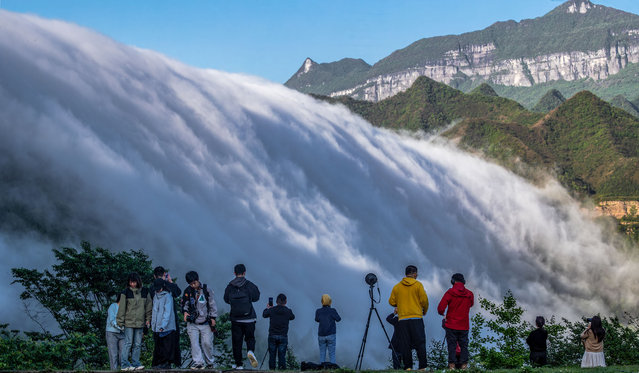
Water vapour cascades down the Gold Buddha Mountain after a rainfall, drawing large crowds of visitors, on May 13, 2024 in Chongqing, China. (Photo by Qu Mingbin/VCG via Getty Images)