Loading...
Done
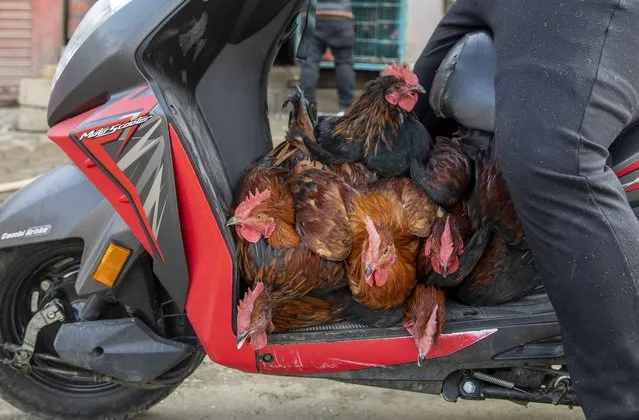
A man transports chicken on a motorscooter to the chicken market in Kathmandu, Nepal, 07 February 2023. Cases of bird flu, or avian influenza, infections have been confirmed in three places in the Kathmandu Valley, according to the Ministry of Agriculture and Livestock Development (MoALD), causing a drop in sales of chicken in the valley after the spread of the flu news. (Photo by Narendra Shrestha/EPA)

A man transports chicken on a motorscooter to the chicken market in Kathmandu, Nepal, 07 February 2023. Cases of bird flu, or avian influenza, infections have been confirmed in three places in the Kathmandu Valley, according to the Ministry of Agriculture and Livestock Development (MoALD), causing a drop in sales of chicken in the valley after the spread of the flu news. (Photo by Narendra Shrestha/EPA)
Details
18 Feb 2023 06:14:00
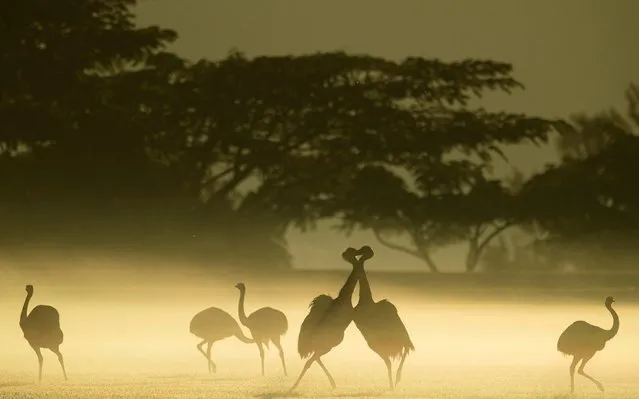
View of a group of ostriches, in the gardens of the Palacio do Alvorada, in Brasilia, Brazil, 02 June 2020. The ostrich is the largest and heaviest bird in the world. When the chicks hatch they are between 25 and 30 cm tall, weighing about 900 grams. (Photo by Joedson Alves/EPA/EFE/Rex Features/Shutterstock)

View of a group of ostriches, in the gardens of the Palacio do Alvorada, in Brasilia, Brazil, 02 June 2020. The ostrich is the largest and heaviest bird in the world. When the chicks hatch they are between 25 and 30 cm tall, weighing about 900 grams. (Photo by Joedson Alves/EPA/EFE/Rex Features/Shutterstock)
Details
08 Jun 2020 00:03:00
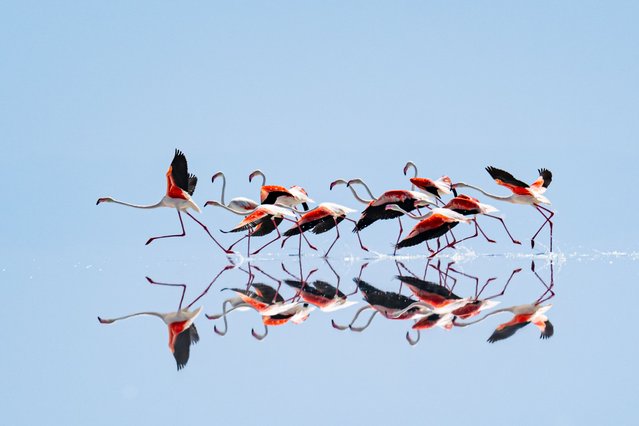
Flamingos preparing to take flight are reflected on Lake Tuz, which hosts thousands of flamingos every year, in Ankara, Turkiye, on June 24, 2025. This year, the lake has seen a decline in flamingo numbers due to drought, prompting the birds to shift their migration route to other wetlands across Turkiye. (Photo by Harun Ozalp/Anadolu via Getty Images)

Flamingos preparing to take flight are reflected on Lake Tuz, which hosts thousands of flamingos every year, in Ankara, Turkiye, on June 24, 2025. This year, the lake has seen a decline in flamingo numbers due to drought, prompting the birds to shift their migration route to other wetlands across Turkiye. (Photo by Harun Ozalp/Anadolu via Getty Images)
Details
31 Jul 2025 02:48:00
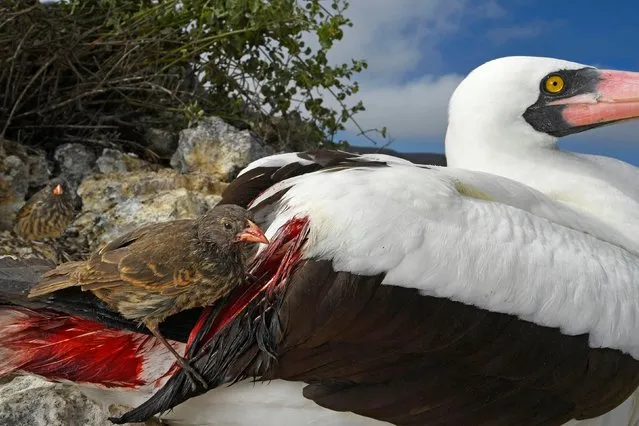
Bloodthirsty by Thomas P Peschak, Germany/South Africa — winner, Behaviour: birds. When rations run short on Wolf Island, in the remote northern Galápagos, the sharp-beaked ground finches become vampires. Their sitting targets are Nazca boobies and other large birds. The finches rely on a scant diet of seeds and insects, which regularly dries up, so they drink blood to survive. ‘I’ve seen more than half a dozen finches drinking from a single Nazca booby,’ says Tom. Rather than leave their nests the boobies tolerate the vampires, and the blood loss doesn’t seem to cause permanent harm. (Photo by Thomas P Peschak/2018 Wildlife Photographer of the Year)

Bloodthirsty by Thomas P. Peschak, Germany/South Africa — winner, Behaviour: birds. When rations run short on Wolf Island, in the remote northern Galápagos, the sharp-beaked ground finches become vampires. Their sitting targets are Nazca boobies and other large birds. The finches rely on a scant diet of seeds and insects, which regularly dries up, so they drink blood to survive. ‘I’ve seen more than half a dozen finches drinking from a single Nazca booby,’ says Tom. Rather than leave their nests the boobies tolerate the vampires, and the blood loss doesn’t seem to cause permanent harm. (Photo by Thomas P. Peschak/2018 Wildlife Photographer of the Year)
Details
19 Oct 2018 00:05:00
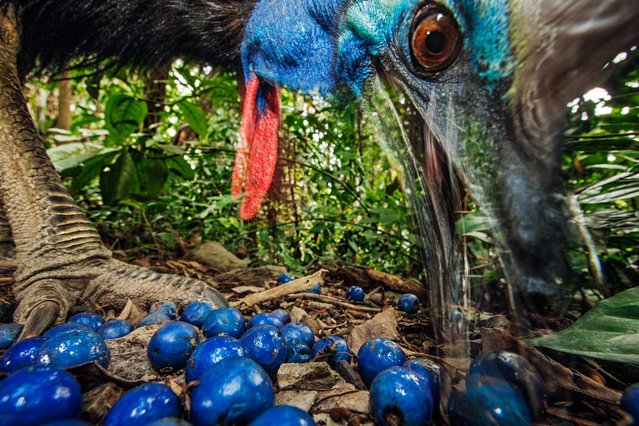
“Cassowaries are large, flightless birds related to emus and (more distantly) to ostriches, rheas, and kiwis”, writes Olivia Judson in the September issue of National Geographic magazine. (Photo by Christian Ziegler/National Geographic)

“Cassowaries are large, flightless birds related to emus and (more distantly) to ostriches, rheas, and kiwis”, writes Olivia Judson in the September issue of National Geographic magazine. How large? People-size: Adult males stand well over five foot five and top 110 pounds. Females are even taller, and can weigh more than 160 pounds. Dangerous when roused, they’re shy and peaceable when left alone. But even birds this big and tough are prey to habitat loss. The dense New Guinea and Australia rain forests where they live have dwindled. Today cassowaries might number 1,500 to 2,000. And because they help shape those same forests – by moving seeds from one place to another – “if they vanish”, Judson writes, “the structure of the forest would gradually change” too. (Photo by Christian Ziegler/National Geographic)
Details
06 Jan 2014 12:21:00


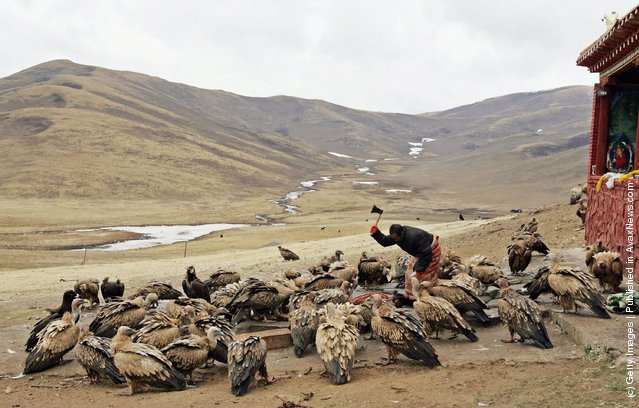
“Sky burial or ritual dissection was once a common funerary practice in Tibet wherein a human corpse is cut in specific locations and placed on a mountaintop, exposing it to the elements or the mahabhuta and animals – especially to birds of prey. The location of the sky burial preparation and place of execution are understood in the Vajrayana traditions as charnel grounds. In Tibet the practice is known as jhator, which literally means, «giving alms to the birds»”. – Wikipedia

Photo: A burial master chops bones of a body to feed vultures during a celestial burial ceremony on April 19, 2006 in Dari County of Guoluo Prefecture, Qinghai Province, northwest China. Celestial burial is a traditional funeral of Tibetan people, which began in the 7th century. (Photo by China Photos/Getty Images)
Details
18 Jun 2011 12:12:00
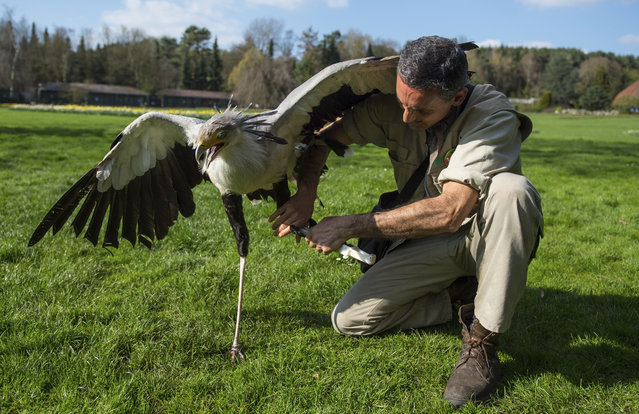
In this April 4, 2017 photo keeper German Alonso straps a leg prothesis to on the left leg of secretarybird Soeckchen (Sagittarius seprentarius) at the bird park in Walsrode, northern Germany. The prothesis was made in a 3D-printer after his left leg was amputated. (Photo by Philipp Schulze/DPA via AP Photo)

In this April 4, 2017 photo keeper German Alonso straps a leg prothesis to on the left leg of secretarybird Soeckchen (Sagittarius seprentarius) at the bird park in Walsrode, northern Germany. The prothesis was made in a 3D-printer after his left leg was amputated. (Photo by Philipp Schulze/DPA via AP Photo)
Details
11 Apr 2017 09:53:00
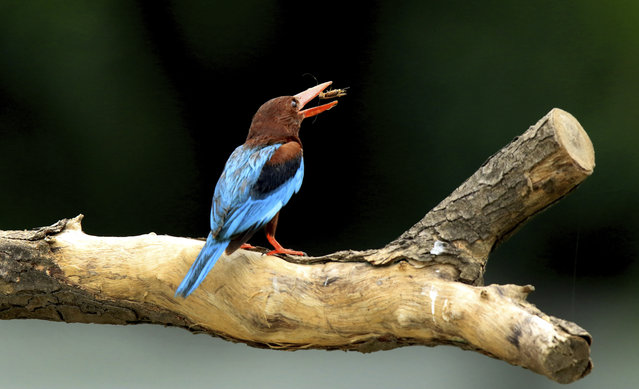
A common kingfisher sits on a branch of a tree after catching an insect in Allahabad, India, Sunday, July 9, 2017. The common kingfisher is a highly territorial bird that has to eat nearly sixty percent of its bodyweight every day. (Photo by Rajesh Kumar Singh/AP Photo)

A common kingfisher sits on a branch of a tree after catching an insect in Allahabad, India, Sunday, July 9, 2017. The common kingfisher is a highly territorial bird that has to eat nearly sixty percent of its bodyweight every day. (Photo by Rajesh Kumar Singh/AP Photo)
Details
16 Jul 2017 07:52:00