Loading...
Done
Kyaiktiyo, Burma, 1978. The Golden Rock at Shwe Pyi Daw (the Golden Country), the Buddhist holy place. Hiroji Kubota writes: “I was desperate to keep a distance from America for a while; luckily, I found Burma and its gentle and compassionate people. In the spring of 1978, on the top of the hill where I took this photo, I had two Leica bodies: the one with Tri-X and the other with Kodachrome 64. Soon after, I realised that the colour one looked very colourful and was more powerful. That was my decisive moment, to become a colour photographer”. (Photo by Hiroji Kubota/Magnum Photos)

Kyaiktiyo, Burma, 1978. The Golden Rock at Shwe Pyi Daw (the Golden Country), the Buddhist holy place. Hiroji Kubota writes: “I was desperate to keep a distance from America for a while; luckily, I found Burma and its gentle and compassionate people. In the spring of 1978, on the top of the hill where I took this photo, I had two Leica bodies: the one with Tri-X and the other with Kodachrome 64. Soon after, I realised that the colour one looked very colourful and was more powerful. That was my decisive moment, to become a colour photographer”. (Photo by Hiroji Kubota/Magnum Photos)
Details
10 Jun 2016 13:30:00
Zhao Deli waves as he pilots his self-made “flying scooter” in Dongguan, Guangdong Province, China, 12 August 2018 (issued 16 August 2018). Inspired by a cartoon he watched as a child, Zhao Deli sold off his apartment in pursuit of his dream of building a flying scooter. (Photo by Aleksandar Plavevski/EPA/EFE)

Zhao Deli waves as he pilots his self-made “flying scooter” in Dongguan, Guangdong Province, China, 12 August 2018 (issued 16 August 2018). Inspired by a cartoon he watched as a child, Zhao Deli sold off his apartment in pursuit of his dream of building a flying scooter. (Photo by Aleksandar Plavevski/EPA/EFE)
Details
06 Sep 2018 00:05:00
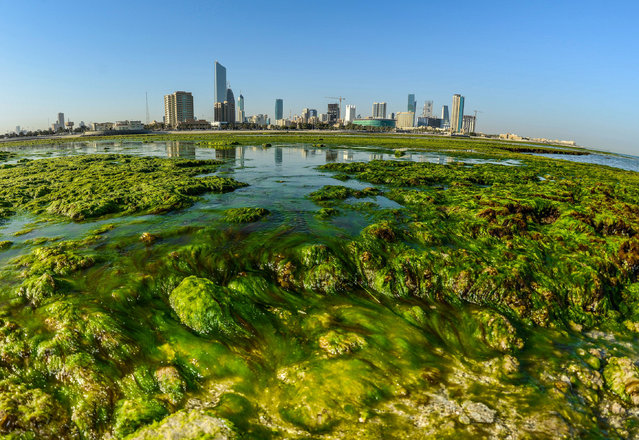
Green algae sits on a beach in Kuwait City, Kuwait, 28 February 2017. The formation of green algae is a normal phenomenon that occurs every year at the shores of Kuwait. (Photo by Raed Qutena/EPA)

Green algae sits on a beach in Kuwait City, Kuwait, 28 February 2017. The formation of green algae is a normal phenomenon that occurs every year at the shores of Kuwait. (Photo by Raed Qutena/EPA)
Details
01 Mar 2017 10:50:00
A protester dressed as a clown holds an umbrella over a Swiss police officer on a motorbike during a May Day demonstration in Zurich, Switzerland on May 1, 2017. (Photo by Arnd Wiegmann/Reuters)

A protester dressed as a clown holds an umbrella over a Swiss police officer on a motorbike during a May Day demonstration in Zurich, Switzerland on May 1, 2017. (Photo by Arnd Wiegmann/Reuters)
Details
02 May 2017 09:36:00
Anton Unitsyn, Russia. Shortlist, Professional , Daily Life. Parkour jumpers on their daily training. On the background – one of the main Solvychegodsk sights – Blagoveshchensky Cathedral. This church is among 3 churches, that survived soviet times. At the begining of 20th century there were 13 churches in Solvichegodsk. After breakdown of the communism, Solvichegodsk as many small towns in russia is stuck in it's past. Despite everything, people in Solvichegodsk still belive in their positive future, and wait for wind of change. (Photo by Anton Unitsyn/Sony World Photography Awards)

Anton Unitsyn, Russia. Shortlist, Professional , Daily Life. Parkour jumpers on their daily training. On the background – one of the main Solvychegodsk sights – Blagoveshchensky Cathedral. This church is among 3 churches, that survived soviet times. At the begining of 20th century there were 13 churches in Solvichegodsk. After breakdown of the communism, Solvichegodsk as many small towns in russia is stuck in it's past. Despite everything, people in Solvichegodsk still belive in their positive future, and wait for wind of change. (Photo by Anton Unitsyn/Sony World Photography Awards)
Details
25 Feb 2016 12:16:00
On August 31, 2012, a long filament of solar material that had been hovering in the sun's atmosphere, the corona, erupted out into space at 4:36 p.m. EDT. The coronal mass ejection, or CME, traveled at over 900 miles per second. The CME did not travel directly toward Earth, but did connect with Earth's magnetic environment, or magnetosphere, causing aurora to appear on the night of Monday, September 3. (Photo by NASA/GSFC/SDO)

On August 31, 2012, a long filament of solar material that had been hovering in the sun's atmosphere, the corona, erupted out into space at 4:36 p.m. EDT. The coronal mass ejection, or CME, traveled at over 900 miles per second. The CME did not travel directly toward Earth, but did connect with Earth's magnetic environment, or magnetosphere, causing aurora to appear on the night of Monday, September 3. (Photo by NASA/GSFC/SDO via The Atlantic)
Details
14 Sep 2012 09:01:00
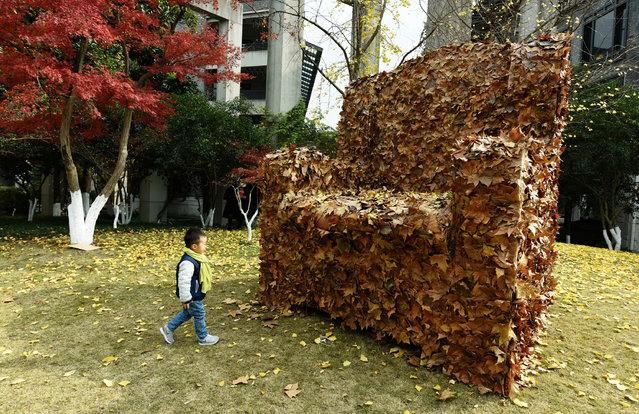
A child walks to an installation made from fallen leaves by college students, in shape of a sofa, to call for people's attention to environment protection, in Hangzhou, Zhejiang province, China, December 6, 2016. (Photo by Reuters/China Daily)

A child walks to an installation made from fallen leaves by college students, in shape of a sofa, to call for people's attention to environment protection, in Hangzhou, Zhejiang province, China, December 6, 2016. (Photo by Reuters/China Daily)
Details
07 Dec 2016 12:36:00
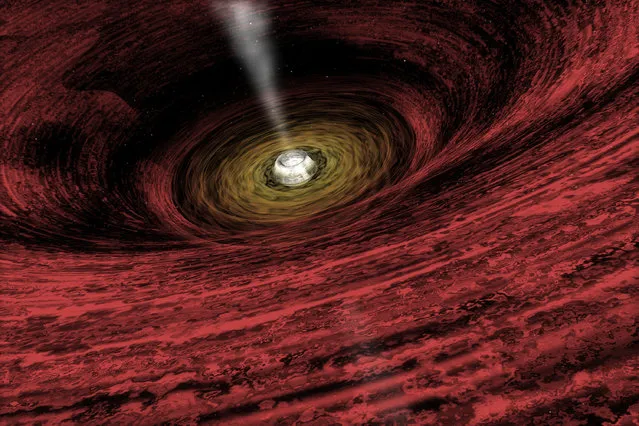
An artist's impression of a growing supermassive black hole located in the early Universe is seen in this NASA handout illustration released on June 15, 2011. Using the deepest X-ray image ever taken, astronomers found the first direct evidence that massive black holes were common in the early universe. This discovery from NASA's Chandra X-Ray Observatory shows that very young black holes grew more aggressively than previously thought, in tandem with the growth of their host galaxies. (Photo by Reuters/NASA/Chandra X-Ray Observatory/A.Hobart)

An artist's impression of a growing supermassive black hole located in the early Universe is seen in this NASA handout illustration released on June 15, 2011. Using the deepest X-ray image ever taken, astronomers found the first direct evidence that massive black holes were common in the early universe. This discovery from NASA's Chandra X-Ray Observatory shows that very young black holes grew more aggressively than previously thought, in tandem with the growth of their host galaxies. (Photo by Reuters/NASA/Chandra X-Ray Observatory/A.Hobart)
Details
11 Feb 2016 12:57:00