Loading...
Done
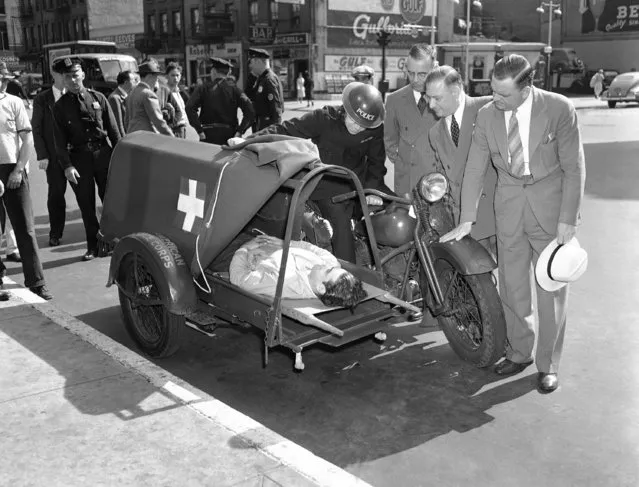
Developed for the British American Ambulance Corps, this new motorcycle ambulance is capable of speeding wounded soldiers 90 miles an hour from the front lines to field hospitals. Its springs are synchronized with the patient?s heartbeat to avoid increasing fever when traveling over various Terrain. Viewing it in New York  August 27, 1941, are left to right: constable Herbert Scott of England, driver; William E. Detlor, whose firm developed the vehicle; M. W. Stand, inspector-general of Civilian Defense, and Maj. Edward Riekert, also. (Photo by AP Photo)

Developed for the British American Ambulance Corps, this new motorcycle ambulance is capable of speeding wounded soldiers 90 miles an hour from the front lines to field hospitals. Its springs are synchronized with the patient's heartbeat to avoid increasing fever when traveling over various Terrain. Viewing it in New York August 27, 1941, are left to right: constable Herbert Scott of England, driver; William E. Detlor, whose firm developed the vehicle; M. W. Stand, inspector-general of Civilian Defense, and Maj. Edward Riekert, also. (Photo by AP Photo)
Details
28 Aug 2015 11:51:00
In this January 12, 2016 photo, an abandoned boat lies on the dried up lake bed of Lake Poopo, on the outskirts of Untavi, Bolivia. Drought caused by the recurrent El Nino meteorological phenomenon is considered the main driver of the lake's demise. Along with glacial melting, authorities say another factor is the diversion of water from Poopo's tributaries, mostly for mining but also for agriculture. (Photo by Juan Karita/AP Photo)

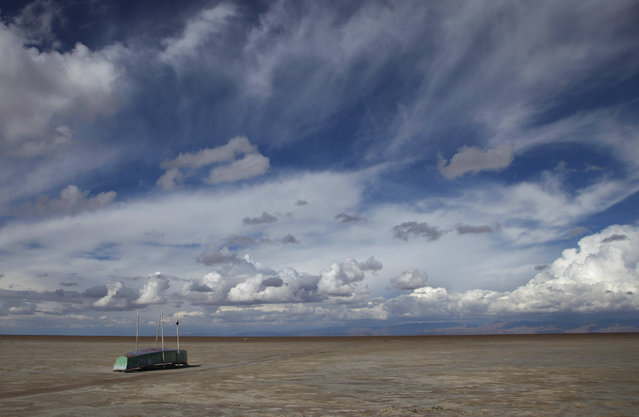
In this January 12, 2016 photo, an abandoned boat lies on the dried up lake bed of Lake Poopo, on the outskirts of Untavi, Bolivia. Drought caused by the recurrent El Nino meteorological phenomenon is considered the main driver of the lake's demise. Along with glacial melting, authorities say another factor is the diversion of water from Poopo's tributaries, mostly for mining but also for agriculture. (Photo by Juan Karita/AP Photo)
Details
21 Jan 2016 12:33:00
In this image provided by Maine State Police, emergency crews work to remove a tractor-trailer hauling 15 million bees to be used in pollinating the state's blueberry crops after it overturned on Interstate-95, Thursday evening, May 10, 2024, in Clinton, Maine. The driver was taken to a hospital and most of the bees were contained, officials said. (Photo by Maine State Police via AP Photo)

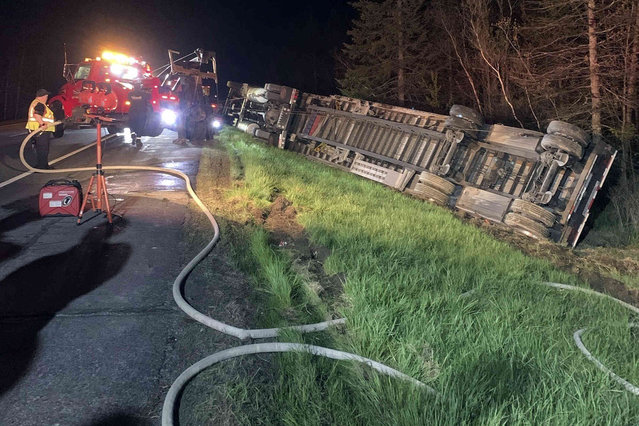
In this image provided by Maine State Police, emergency crews work to remove a tractor-trailer hauling 15 million bees to be used in pollinating the state's blueberry crops after it overturned on Interstate-95, Thursday evening, May 10, 2024, in Clinton, Maine. The driver was taken to a hospital and most of the bees were contained, officials said. (Photo by Maine State Police via AP Photo)
Details
22 Aug 2024 03:29:00
Alaa, an ambulance driver, feeds cats in Masaken Hanano in Aleppo, September 24, 2014. Alaa buys about $4 of meat everyday to feed about 150 abandoned cats in Masaken Hanano, a neigbourhood in Aleppo that has been abandoned because of shelling from forces loyal to Syria's president Bashar Al-Assad on it. Alaa said that he has been feeding and taking care of the cats for over 2 months. (Photo by Hosam Katan/Reuters)

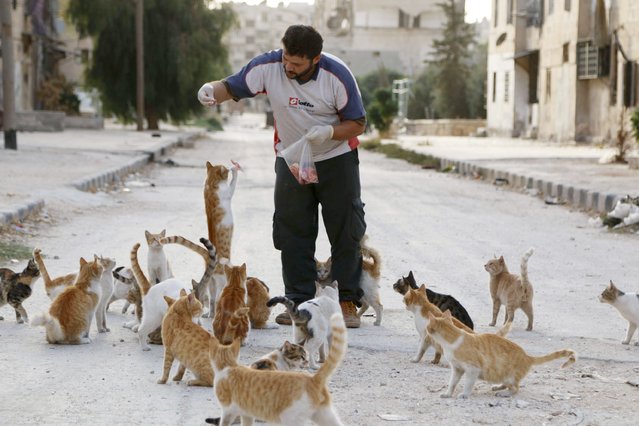
Alaa, an ambulance driver, feeds cats in Masaken Hanano in Aleppo, September 24, 2014. Alaa buys about $4 of meat everyday to feed about 150 abandoned cats in Masaken Hanano, a neigbourhood in Aleppo that has been abandoned because of shelling from forces loyal to Syria's president Bashar Al-Assad on it. Alaa said that he has been feeding and taking care of the cats for over 2 months. (Photo by Hosam Katan/Reuters)
Details
25 Sep 2014 13:29:00
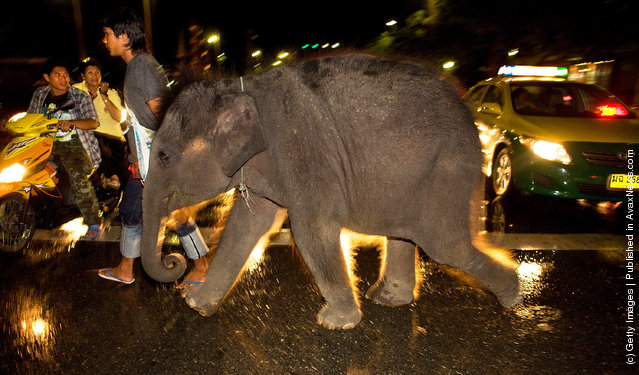
Urban Elephants Roam The Streets of Bangkok

A mahout (elephant driver) walks a baby elephant across the city streets at night September 27, 2008 in Bangkok, Thailand. (Photo Paula Bronstein/Getty Images)
Details
12 Oct 2011 12:19:00
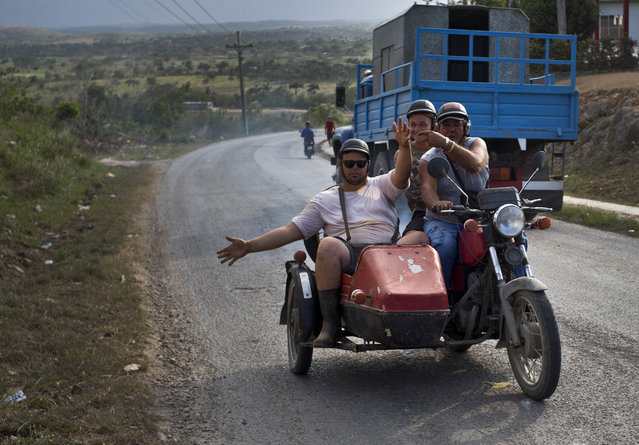
In this April 13, 2018 photo, motorcycle taxi driver Ricardo Medina, 60, transports vegetable vender Rigoberto Herrera Mendez, left, and coconut vendor Osvaldo Ochoa in Campo Florido, east of Havana, Cuba. The three men expressed hope that new government leadership will improve things, saying the country cannot move backwards. “We survive life with our work”, said Medina. (Photo by Ramon Espinosa/AP Photo)

In this April 13, 2018 photo, motorcycle taxi driver Ricardo Medina, 60, transports vegetable vender Rigoberto Herrera Mendez, left, and coconut vendor Osvaldo Ochoa in Campo Florido, east of Havana, Cuba. The three men expressed hope that new government leadership will improve things, saying the country cannot move backwards. “We survive life with our work”, said Medina. (Photo by Ramon Espinosa/AP Photo)
Details
01 May 2018 00:01:00
A moto-taxi driver takes two passengers past a burning barricade set up by people protesting fuel shortages in Port-au-Prince, Haiti, Monday, September 16, 2019. Haiti was at a standstill Monday with no public transportation available and closed banks, government offices, and schools amid street protests due to a fuel crisis. (Photo by Dieu Nalio Chery/AP Photo)

A moto-taxi driver takes two passengers past a burning barricade set up by people protesting fuel shortages in Port-au-Prince, Haiti, Monday, September 16, 2019. Haiti was at a standstill Monday with no public transportation available and closed banks, government offices, and schools amid street protests due to a fuel crisis. (Photo by Dieu Nalio Chery/AP Photo)
Details
27 Sep 2019 00:03:00
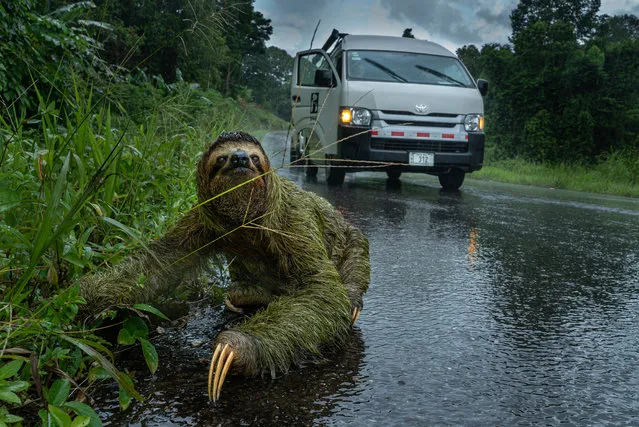
People and Nature category winner: Why did the sloth cross the road? by Andrew Whitworth (Osa Conservation and University of Glasgow), taken in Osa Peninsula, Costa Rica. “I was driving out from the Osa Peninsula, located on the southern Pacific coast of Costa Rica on a dark, stormy day. This female three-toed sloth (Bradypus variegatus) had luckily just about made it across the road, and the drivers of the Toyota on this occasion had spotted her in good time”. (Photo by Andrew Whitworth/2019 British Ecological Society Photography Competition)

People and Nature category winner: Why did the sloth cross the road? by Andrew Whitworth (Osa Conservation and University of Glasgow), taken in Osa Peninsula, Costa Rica. “I was driving out from the Osa Peninsula, located on the southern Pacific coast of Costa Rica on a dark, stormy day. This female three-toed sloth (Bradypus variegatus) had luckily just about made it across the road, and the drivers of the Toyota on this occasion had spotted her in good time”. (Photo by Andrew Whitworth/2019 British Ecological Society Photography Competition)
Details
30 Nov 2019 00:05:00