Loading...
Done


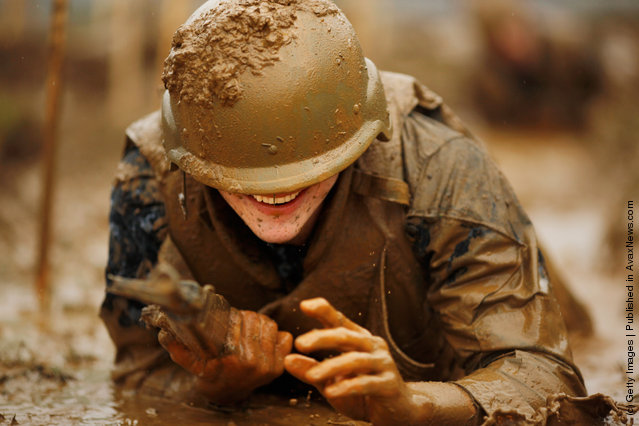
A member of the United States Naval Academy freshman class wears body armor, helmet and carries a rifle through a mud-filled ditch as part of the “Wet and Sandy” challenge during the rigorous Sea Trials May 17, 2011 in Annapolis, MD. Under strict safety supervision, about 900 freshmen, or “Plebes”, faced 14 hours of 32 rigorous physical and mental challenges during the trials, a daylong, action-oriented event modeled after the Marine Corps 54-hour Crucible and the Navy's Battle Stations. (Photo by Chip Somodevilla/Getty Images)
Details
18 May 2011 07:51:00
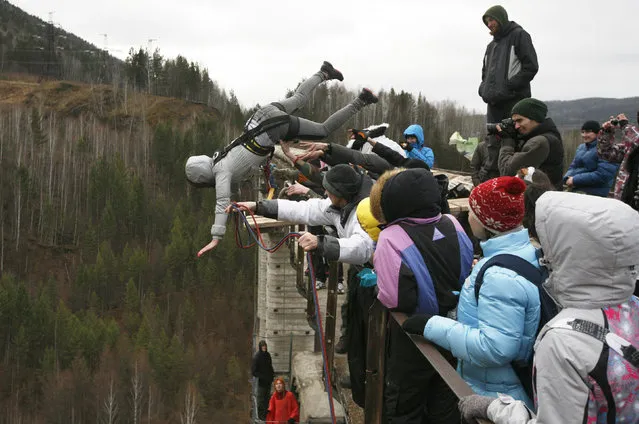
A member of the “Exit Point” amateur rope-jumping group jumps from a 44-metre high (144-ft) waterpipe bridge in the Siberian Taiga area outside Krasnoyarsk, November 3, 2013. (Photo by Ilya Naymushin/Reuters)

A member of the “Exit Point” amateur rope-jumping group jumps from a 44-metre high (144-ft) waterpipe bridge in the Siberian Taiga area outside Krasnoyarsk, November 3, 2013. Fans of rope-jumping, a kind of extreme sport involving a jump from a high point using an advanced leverage system combining mountaineering and rope safety equipment, marked the end of the group's jumping season and recent Halloween festivities. (Photo by Ilya Naymushin/Reuters)
Details
21 Apr 2014 09:57:00
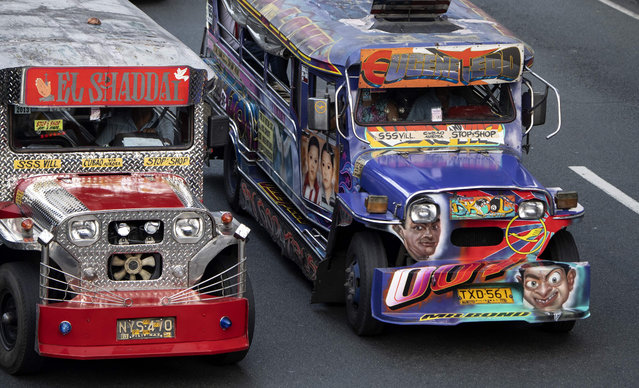
This picture taken on January 17, 2019 shows jeepneys during rush hour in Manila, Philippines. (Photo by Noel Celis/AFP Photo)

This picture taken on January 17, 2019 shows jeepneys during rush hour in Manila, Philippines. Hand-painting custom decor on jeepneys adorned with images of everything from Batman to babies, as well as disco lights and chrome wheels, have for decades provided cheap transport for millions. But pollution and safety concerns have led to a modernisation programme, with jeepneys 15 years or older to be taken off the streets by 2020. (Photo by Noel Celis/AFP Photo)
Details
30 Jan 2019 00:03:00
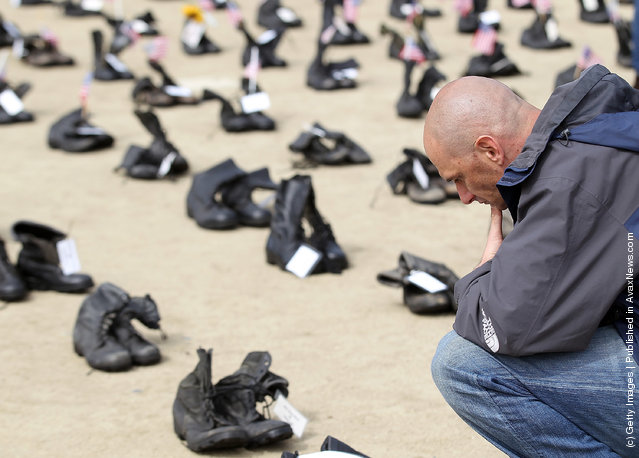
A man pauses as he looks at rows of combat boots that are part of the Eyes Wide Open exhibit in front of San Francisco City Hall

“Eyes Wide Open is an exhibit created by the American Friends Service Committee observing the American soldiers and marines that have died in the Iraq War. It contains a pair of combat boots to represent every American soldier and marine that has died in the war, as well as shoes representing Iraqi civilians who have lost their lives during the invasion and occupation”. – Wikipedia

Photo: A man pauses as he looks at rows of combat boots that are part of the "Eyes Wide Open" exhibit in front of San Francisco City Hall on March 19, 2012 in San Francisco, California. The Eyes Wide Open exhibition includes a pair of boots for every one of the 481 California servicemen and women who died in the Iraq war. (Photo by Justin Sullivan/Getty Images)
Details
20 Mar 2012 11:17:00
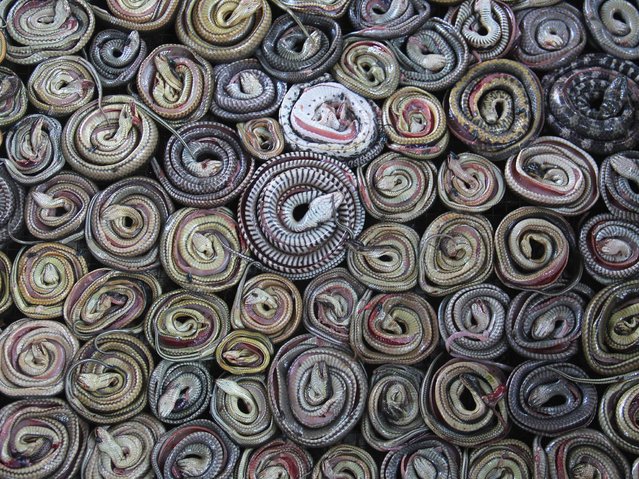
Snakes are collected and rolled before putting into the oven on March 2, 2014 in the village of Kertasura, Cirebon, Indonesia. (Photo by Nurcholis Anhari Lubis/Getty Images)

Snakes are collected and rolled before putting into the oven on March 2, 2014 in the village of Kertasura, Cirebon, Indonesia. At slaughter house snake skins measuring in the hundreds of metres, are sold to bag factories in the West and Central Java provinces on a monthly basis. From snake skin was manufactured into bags, shoes, wallets and belts. The price of a bag made from snake skin costs between 150,000 rupiah ($15 USD) and 300,000 rupiah ($30 USD), depending on its size. When snake skins reach Western fashion houses their price can increase dramatically and sell for up to $4,000 USD. (Photo by Nurcholis Anhari Lubis/Getty Images)
Details
05 Mar 2014 07:31:00
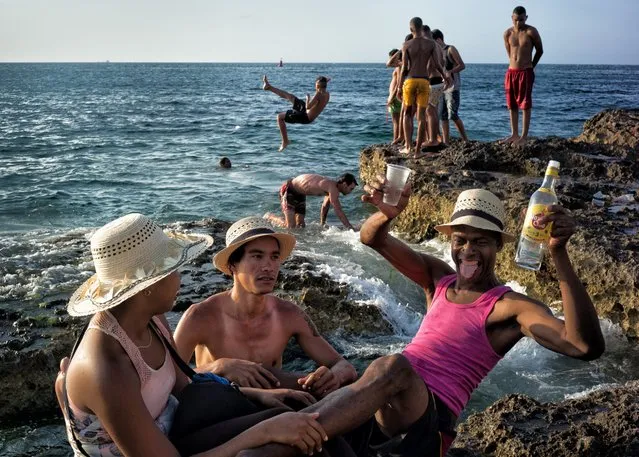
Saguy says that while portraits of Fidel Castro are still found everywhere, they coexist with plenty of foreign brands on subtle display: from Apple logo decals affixed to 1950s Chevys to young people wearing Adidas T-shirts and Converse shoes. Here: Several groups of locals relax on the Malecon in Old Havana, Cuba May 1, 2016. Some chat and drink rum while others dive into the warm Caribbean Sea. (Photo by Dotan Saguy)

Photographer Dotan Saguy visited Cuba expecting to find resentment toward Americans, but he says that, instead, “Every Cuban I met was warm and welcoming despite me being an American”. Here: Several groups of locals relax on the Malecon in Old Havana, Cuba May 1, 2016. Some chat and drink rum while others dive into the warm Caribbean Sea. (Photo by Dotan Saguy)
Details
27 May 2016 12:50:00
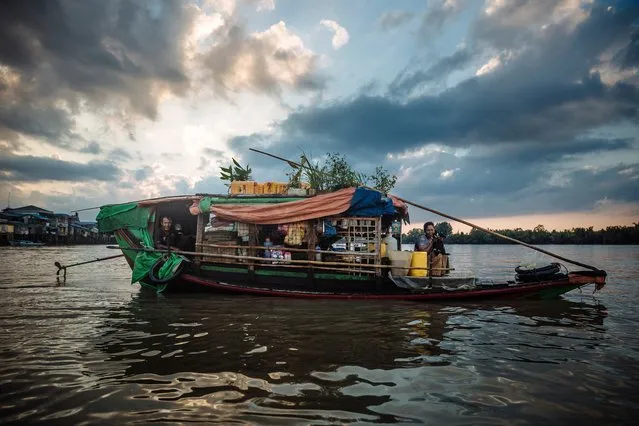
Tin and Naing win live on a small boat which they sail throughout the Delta region in Myanmar. The former gardeners once had a home on land but it was destroyed when a powerful cyclone ravaged the area in 2008. Since then, the couple have not been able to afford to rebuild their home, so they live on the boat from which they sell fish paste to make a living. (Photo by Muse Mohammed/IOM)

The ferocity of crises worldwide is forcing a record number of people to flee their homes, seeking some form of safety within their own country or across international borders. There are 65.3 million displaced people worldwide, including 21.3 million refugees. Most have lost their homes to armed conflict or natural disasters but other factors, such as extreme poverty and climate change, also drive displacement. The International Organisation for Migration commissioned photojournalist Muse Mohammed to document the plight of the displaced. (Photo by Muse Mohammed/IOM)
Details
02 Jan 2017 12:04:00
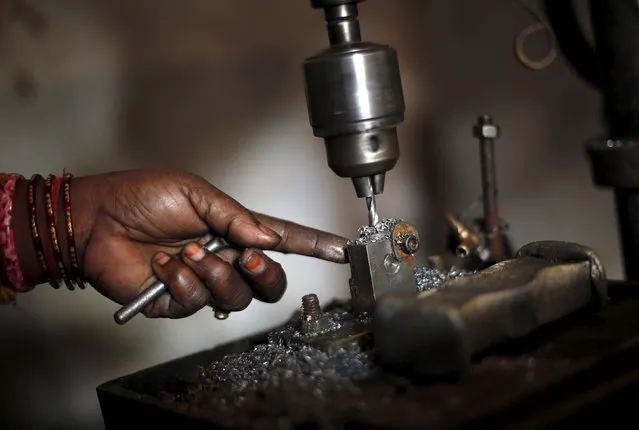
A worker makes auto parts on a machine inside a workshop in Faridabad, India, December 24, 2015. (Photo by Adnan Abidi/Reuters)

A worker makes auto parts on a machine inside a workshop in Faridabad, India, December 24, 2015. Car makers such as Maruti Suzuki India and Hyundai Motor see huge growth in India, set to become the world's third-largest auto market by 2020 as millions buy their first new car. Price tags can be as low as $3,000 for a new Tata Motors Nano mini-car. India is also becoming a low-cost export hub for global car makers such as General Motors and Ford Motor. As the sector expands, some of the work is sub-contracted out to small factories operating on paper-thin margins, where poor contract workers often have little or no access to safety equipment or health benefits. (Photo by Adnan Abidi/Reuters)
Details
23 Jan 2016 13:31:00