Loading...
Done
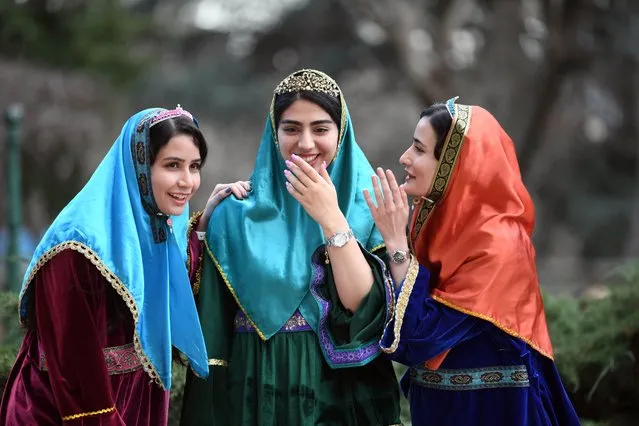
Girls talk outside the Niavaran Palace in northern Tehran, capital of Iran, March 26, 2024. People visited the Niavaran Palace during the new year vacation of Nowruz, which falls on March 20 this year. (Photo by Xinhua News Agency/Rex Features/Shutterstock)

Girls talk outside the Niavaran Palace in northern Tehran, capital of Iran, March 26, 2024. People visited the Niavaran Palace during the new year vacation of Nowruz, which falls on March 20 this year. (Photo by Xinhua News Agency/Rex Features/Shutterstock)
Details
23 Apr 2024 05:02:00
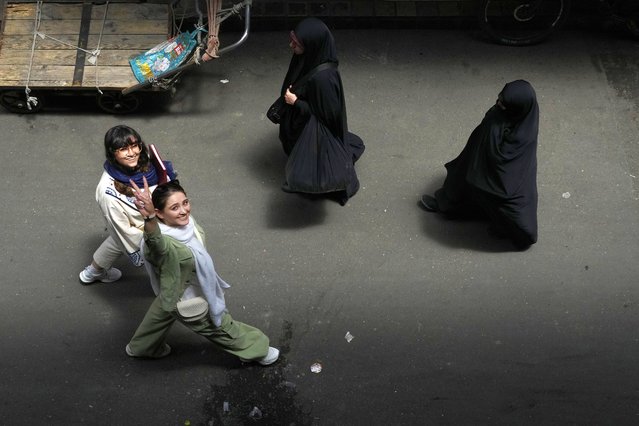
An Iranian woman without wearing her mandatory Islamic headscarf flashes a victory sign as two head-to-toe veiled women walk at the old main bazaar of Tehran, Iran, Thursday, June 13, 2024. (Photo by Vahid Salemi/AP Photo)

An Iranian woman without wearing her mandatory Islamic headscarf flashes a victory sign as two head-to-toe veiled women walk at the old main bazaar of Tehran, Iran, Thursday, June 13, 2024. (Photo by Vahid Salemi/AP Photo)
Details
24 Jul 2024 05:36:00
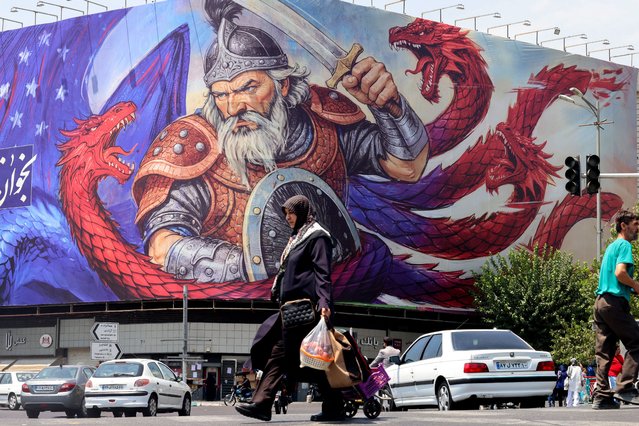
A woman walks depicting a scene from the Iranian national epic poem “Shahnameh” in Tehran on August 5, 2025. (Photo by Atta Kenare/AFP Photo)

A woman walks depicting a scene from the Iranian national epic poem “Shahnameh” in Tehran on August 5, 2025. (Photo by Atta Kenare/AFP Photo)
Details
16 Aug 2025 03:14:00
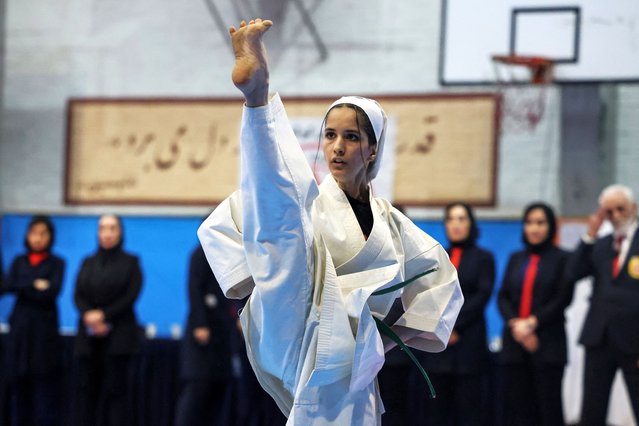
An Iranian athlete warms up prior to the start of the women's karate competition, made-up of clubs and teams from around the Tehran province, in Tehran on November 6, 2025. Some 230 participants, including 5-year-old girls, took part in the competition, with team's deriving only from the Tehran province taking part. (Photo by Atta Kenare/AFP Photo)

An Iranian athlete warms up prior to the start of the women's karate competition, made-up of clubs and teams from around the Tehran province, in Tehran on November 6, 2025. Some 230 participants, including 5-year-old girls, took part in the competition, with team's deriving only from the Tehran province taking part. (Photo by Atta Kenare/AFP Photo)
Details
20 Nov 2025 04:53:00
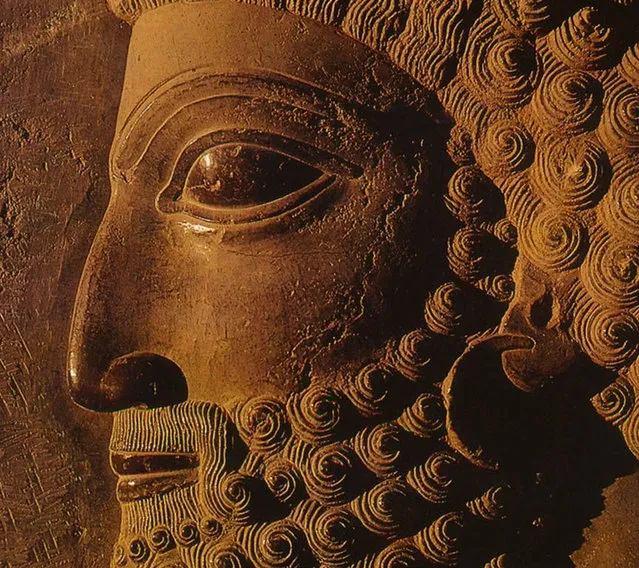
Persepolis, Takht-E-Jamshid Iran

Few people haven’t heard about the ancient city of Persepolis, which lies at the foot of the Mountain of Mercy (Kuh-I-Rahmat). In ancient times, Persepolis was the capital of the Achaemenid Empire. Regretfully, it was burned by the Greeks in 330 BC after they looted the immense treasure of this city. It is said that Greeks needed 5,000 camels and 20,000 mules to carry all the treasures from Persepolis. The only thing of Persepolis that has survived the wear of time is the ginormous stone terrace 530 by 330 meters adorned by elaborate stone sculptures. It is amazing how intricately detailed some of the sculptures are, despite the fact that they were created many centuries ago.
Details
26 Oct 2014 12:30:00
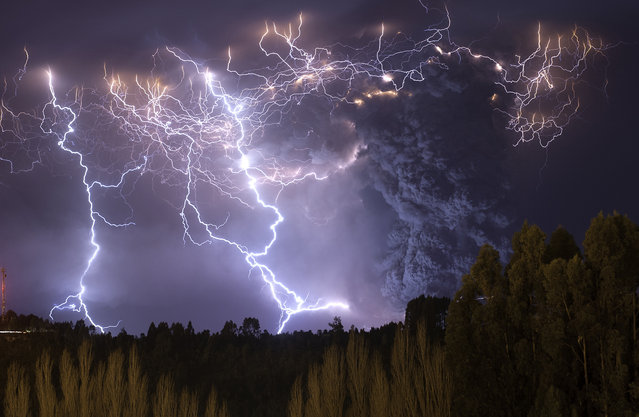
The eruption of Cordon Caulle began on June 4, 2011, located in the Region of Los Rios in Chile. For about 12 months, people and animals became accustomed to living with the daily fall of ash, which also caused problems in the air traffic in South America. The explosions and lightning during first days of the eruption could be seen from hundreds of miles around. This photograph was taken on the second night of eruption from the town of Lago Ranco. (Photo and caption by Francisco Negroni/National Geographic Traveler Photo Contest)

The eruption of Cordon Caulle began on June 4, 2011, located in the Region of Los Rios in Chile. For about 12 months, people and animals became accustomed to living with the daily fall of ash, which also caused problems in the air traffic in South America. The explosions and lightning during first days of the eruption could be seen from hundreds of miles around. This photograph was taken on the second night of eruption from the town of Lago Ranco. (Photo and caption by Francisco Negroni/National Geographic Traveler Photo Contest)

ATTENTION! All pictures are presented in high resolution. To see Hi-Res images – just TWICE click on any picture. In other words, click small picture – opens the BIG picture. Click BIG picture – opens VERY BIG picture.
Details
23 Jun 2013 11:24:00


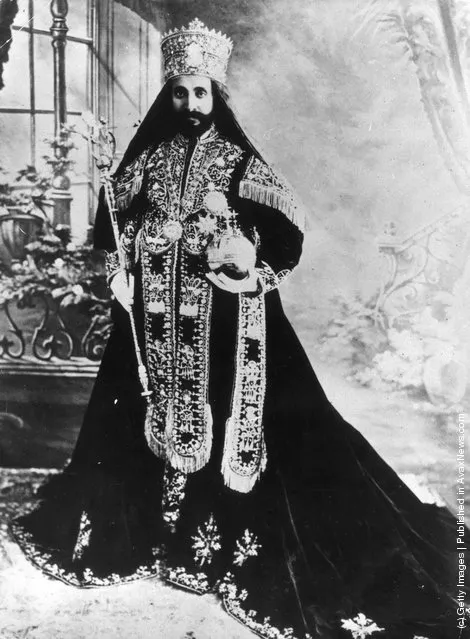
“Haile Selassie I (23 July 1892 – 27 August 1975), born Tafari Makonnen, was Ethiopia's regent from 1916 to 1930 and Emperor of Ethiopia from 1930 to 1974. The heir to a dynasty that traced its origins to the 13th century, and from there by tradition back to King Solomon and Queen Makeda, Empress of Axum, known in the Abrahamic tradition as the Queen of Sheba. Haile Selassie is a defining figure in both Ethiopian and African history.

Haile Selassie is revered as the returned Messiah of the Bible, God incarnate, among the Rastafari movement, the number of followers of which is estimated between 200,000 and 800,000. Begun in Jamaica in the 1930s, the Rastafari movement perceives Haile Selassie as a messianic figure who will lead a future golden age of eternal peace, righteousness, and prosperity. He himself remained an Ethiopian Orthodox Christian throughout his life”. – Wikipedia

Photo: Negusa Negasti, Emperor of Ethiopia Haile Selassie I, known as “Lord of Lords”, “The Conquering Lion of the tribe of Judah”, “Light of the world”, “Elect of God”, in full ceremonial regalia following his coronation. (Photo by Hulton Archive/Getty Images)

Details
21 Jun 2011 11:04:00
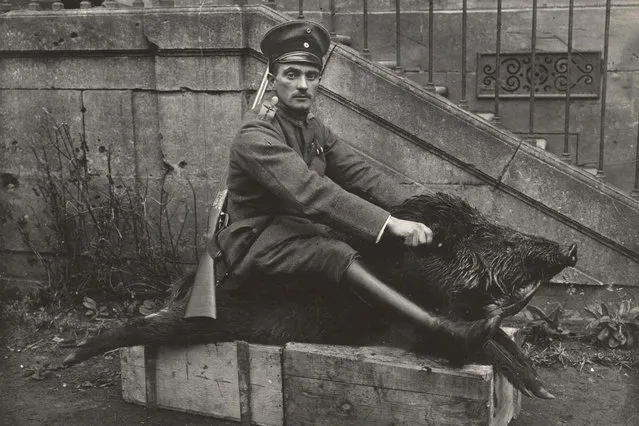
A German Air Force Officer sits astride a dead boar outside a house where he is stationed near the Western Front, in this 1918 handout picture. This picture is part of a previously unpublished set of World War One (WWI) images from a private collection. The pictures offer an unusual view of varied and contrasting aspects of the conflict, from high tech artillery to mobile pigeon lofts, and from officers partying in their headquarters to the grim reality of life and death in the trenches. The year 2014 marks the centenary of the start of the war. (Photo by Reuters/Archive of Modern Conflict London)

A German Air Force Officer sits astride a dead boar outside a house where he is stationed near the Western Front, in this 1918 handout picture. This picture is part of a previously unpublished set of World War One (WWI) images from a private collection. The pictures offer an unusual view of varied and contrasting aspects of the conflict, from high tech artillery to mobile pigeon lofts, and from officers partying in their headquarters to the grim reality of life and death in the trenches. The year 2014 marks the centenary of the start of the war. (Photo by Reuters/Archive of Modern Conflict London)
Details
26 Jun 2014 12:13:00