Loading...
Done
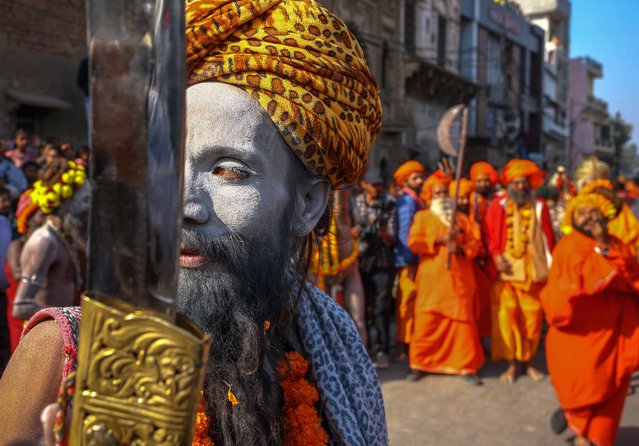
Sadhus take part in a religious roadshow ( Peshwai )  on December 14, 2024 in Allahabad, India. Kumbh Mela in 2025 is a Maha Kumbh, which is a significant Hindu festival celebrated once every 144 years at Prayagraj (Allahabad). Scheduled from January 13 to February 26, 2025, it attracts millions of devotees for ritual bathing at the confluence of the Ganges, Yamuna, and the mythical Saraswati rivers, marking a unique spiritual occasion with enhanced significance compared to regular Kumbh Mela. (Photo by Ritesh Shukla/Getty Images)

Sadhus take part in a religious roadshow (Peshwai) on December 14, 2024 in Allahabad, India. Kumbh Mela in 2025 is a Maha Kumbh, which is a significant Hindu festival celebrated once every 144 years at Prayagraj (Allahabad). Scheduled from January 13 to February 26, 2025, it attracts millions of devotees for ritual bathing at the confluence of the Ganges, Yamuna, and the mythical Saraswati rivers, marking a unique spiritual occasion with enhanced significance compared to regular Kumbh Mela. (Photo by Ritesh Shukla/Getty Images)
Details
26 Dec 2024 01:40:00
Members of Panchayati Akhara Bada Udasin take part in a religious procession as they head towards the Kumbh Mela festival ahead of the royal bath near the Sangam, the confluence of three of the holiest rivers in Hindu mythology – Ganga, Yamuna, and the mythical Saraswati – in Prayagraj, Uttar Pradesh, India, 12 January 2025. Every 12 years, Hindu pilgrims gather for ritual baths at the river's banks during the Maha Kumbh Mela festival. (Photo by Rajat Gupta/EPA)

Members of Panchayati Akhara Bada Udasin take part in a religious procession as they head towards the Kumbh Mela festival ahead of the royal bath near the Sangam, the confluence of three of the holiest rivers in Hindu mythology – Ganga, Yamuna, and the mythical Saraswati – in Prayagraj, Uttar Pradesh, India, 12 January 2025. Every 12 years, Hindu pilgrims gather for ritual baths at the river's banks during the Maha Kumbh Mela festival. (Photo by Rajat Gupta/EPA)
Details
18 Jan 2025 04:05:00
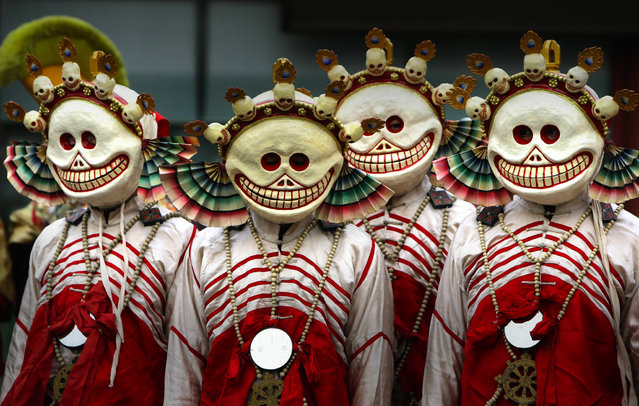
Monks dressed as Tibetan Buddhism characters attend a religious ceremony, known as “Da Gui” or beating ghost, to celebrate the upcoming Tibetan New Year which starts on March 1 at Yonghegong Lama Temple, in Beijing February 28, 2014. This Tibetan ceremony is held annually at the end of the first lunar month with mask dancing to expel ghosts, according to a press release. (Photo by Jason Lee/Reuters)

Monks dressed as Tibetan Buddhism characters attend a religious ceremony, known as “Da Gui” or beating ghost, to celebrate the upcoming Tibetan New Year which starts on March 1 at Yonghegong Lama Temple, in Beijing February 28, 2014. This Tibetan ceremony is held annually at the end of the first lunar month with mask dancing to expel ghosts, according to a press release. (Photo by Jason Lee/Reuters)
Details
01 Mar 2014 13:07:00
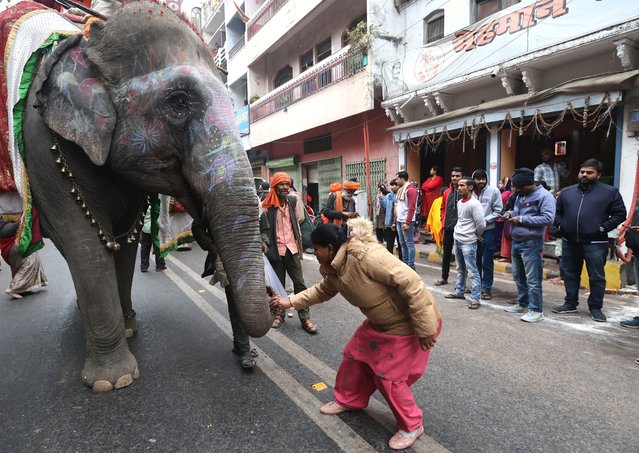
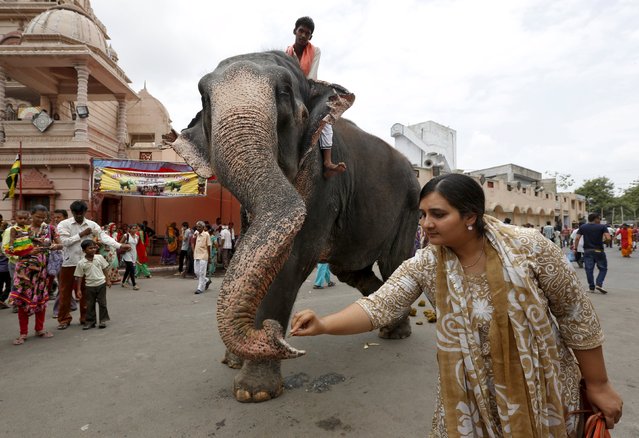
A Hindu woman gives money to an elephant outside the Lord Jagannath temple ahead of the annual Rath Yatra, or chariot procession, in Ahmedabad, India, July 16, 2015. The annual religious procession commemorates a journey by Hindu god Jagannath, his brother Balabhadra and sister Subhadra, in specially made chariots. The annual Rath Yatra is celebrated on July 18. (Photo by Amit Dave/Reuters)

A Hindu woman gives money to an elephant outside the Lord Jagannath temple ahead of the annual Rath Yatra, or chariot procession, in Ahmedabad, India, July 16, 2015. The annual religious procession commemorates a journey by Hindu god Jagannath, his brother Balabhadra and sister Subhadra, in specially made chariots. The annual Rath Yatra is celebrated on July 18. (Photo by Amit Dave/Reuters)
Details
19 Jul 2015 09:33:00
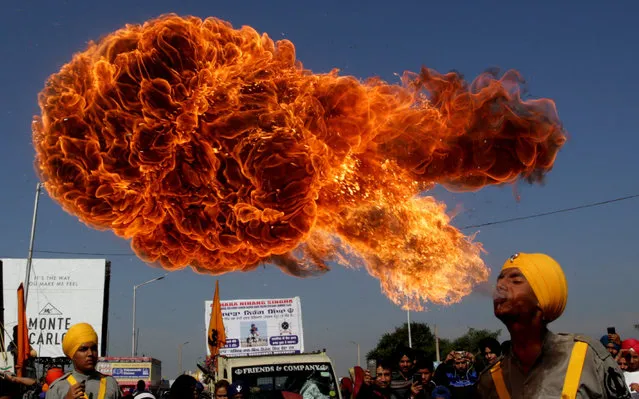
An Indian Sikh devotee spits fire as he performs during religious procession ahead of the birth anniversary of the first Sikh Guru or master, Sri Guru Nanak Dev Ji, the founder of Sikhism, in Jammu, the winter capital of Kashmir, India, 21 November 2018. The birth anniversary of Guru Nanak Dev Ji will be observed on 23 November 2018. (Photo by Jaipal Singh/EPA/EFE)

An Indian Sikh devotee spits fire as he performs during religious procession ahead of the birth anniversary of the first Sikh Guru or master, Sri Guru Nanak Dev Ji, the founder of Sikhism, in Jammu, the winter capital of Kashmir, India, 21 November 2018. The birth anniversary of Guru Nanak Dev Ji will be observed on 23 November 2018. (Photo by Jaipal Singh/EPA/EFE)
Details
23 Nov 2018 00:05:00
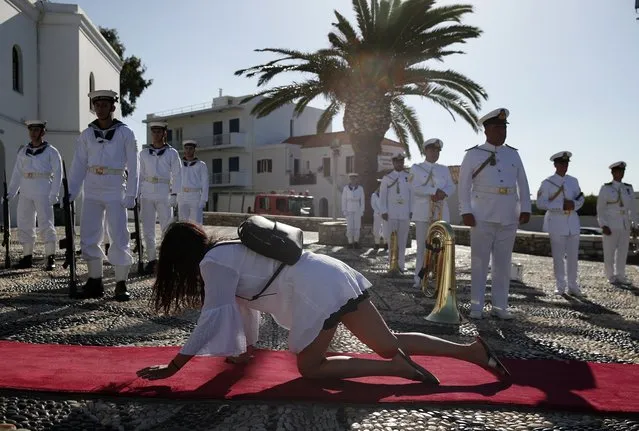
A pilgrim crawls in front of the Navy band outside the Holy Church of Panagia of Tinos, on the Aegean island of Tinos, Greece, on Saturday, August 15, 2020. For nearly 200 years, Greek Orthodox faithful have flocked to Tinos for the August 15 feast day of the Assumption of the Virgin Mary, the most revered religious holiday in the Orthodox calendar after Easter. But this year there was no procession, the ceremony – like so many lives across the globe – upended by the coronavirus pandemic. (Photo by Thanassis Stavrakis/AP Photo)

A pilgrim crawls in front of the Navy band outside the Holy Church of Panagia of Tinos, on the Aegean island of Tinos, Greece, on Saturday, August 15, 2020. For nearly 200 years, Greek Orthodox faithful have flocked to Tinos for the August 15 feast day of the Assumption of the Virgin Mary, the most revered religious holiday in the Orthodox calendar after Easter. But this year there was no procession, the ceremony – like so many lives across the globe – upended by the coronavirus pandemic. (Photo by Thanassis Stavrakis/AP Photo)
Details
17 Aug 2020 00:07:00
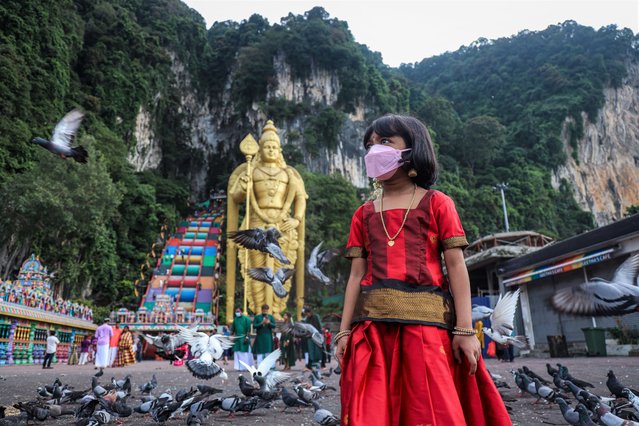
A girl arrives at Batu Caves temple for Diwali celebrations on November 04, 2021 in Gombak, Selangor, Malaysia. Deepavali, or Diwali, known as the festival of light, is celebrated by Hindu communities every autumn all over the world. As Malaysia gradually eases its COVID-19 restrictions, religious activities and prayers in temples are allowed only for fully-vaccinated individuals, with mask-wearing and social distancing measures in place. (Photo by Annice Lyn/Getty Images)

A girl arrives at Batu Caves temple for Diwali celebrations on November 04, 2021 in Gombak, Selangor, Malaysia. Deepavali, or Diwali, known as the festival of light, is celebrated by Hindu communities every autumn all over the world. As Malaysia gradually eases its COVID-19 restrictions, religious activities and prayers in temples are allowed only for fully-vaccinated individuals, with mask-wearing and social distancing measures in place. (Photo by Annice Lyn/Getty Images)
Details
22 Dec 2021 07:37:00
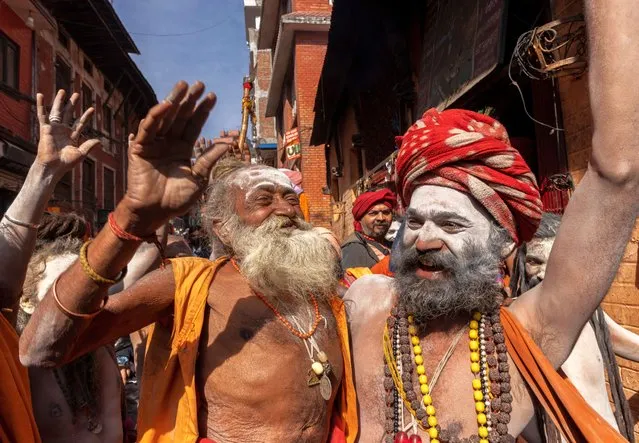
A group of sadhus (holy men) participate in a religious rally to mark the Mahashivaratri festival at Pashupati Temple in Kathmandu, Nepal, 06 March 2024. The festival celebrated on 08 March, sees Hindu devotees from across the country and neighboring India gather to fast and offer special prayers to celebrate the birthday of Lord Shiva, the Hindu god of creation and destruction. (Photo by Narendra Shrestha/EPA/EFE)

A group of sadhus (holy men) participate in a religious rally to mark the Mahashivaratri festival at Pashupati Temple in Kathmandu, Nepal, 06 March 2024. The festival celebrated on 08 March, sees Hindu devotees from across the country and neighboring India gather to fast and offer special prayers to celebrate the birthday of Lord Shiva, the Hindu god of creation and destruction. (Photo by Narendra Shrestha/EPA/EFE)
Details
21 Mar 2024 06:05:00