Loading...
Done
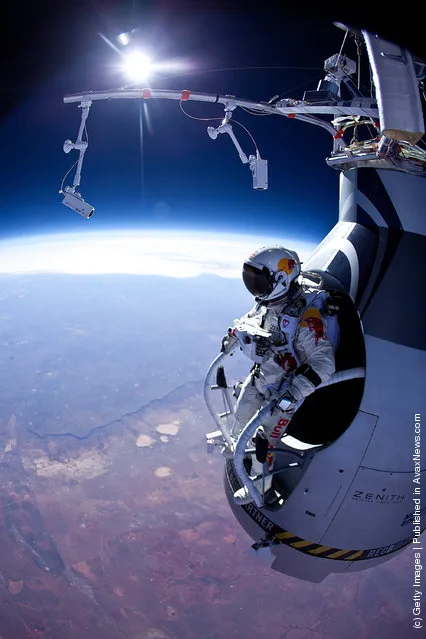
Pilot Felix Baumgartner of Austria is seen before his jump during the first manned test flight for Red Bull Stratos

“Felix Baumgartner (born 20 April 1969 in Salzburg, Austria) is a skydiver and a BASE jumper. He is renowned for the particularly dangerous nature of the stunts he has performed during his career. Baumgartner spent time in the Austrian military where he practiced parachute jumping, including training to land on small target zones”. – Wikipedia

Photo: Pilot Felix Baumgartner of Austria is seen before his jump during the first manned test flight for Red Bull Stratos on March 15, 2012 in Roswell, New Mexico. In this test he reach the altitude 21800 meters (71500 ft) and landed safely near Roswell. Red Bull Stratos is a mission to the edge of the earths atmosphere, where upon reaching altitude of 120,000 feet by helium baloon, pilot and basejumper Felix Baumgartner will then freefall to the ground in an attempt to break the speed of sound. (Photo by Jay Nemeth/Red Bull via Getty Images)
Details
17 Mar 2012 13:11:00
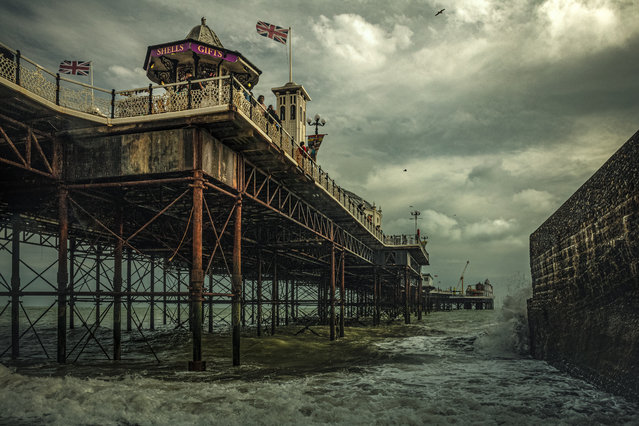
Overall Winner: The Brighton Palace Pier. “Standing in the full force of weather and time: the Brighton Palace Pier. My wife and I have been visiting Brighton for a few years now and I always strive to capture this lovely historic seaside town with a sense of the atmosphere and cinematic interpretation that it instills in me”. (Photo by Michael Marsh/Historic Photographer of the Year 2020)

The winners of the Historic Photographer of the Year Awards 2020 from triphistoric.com celebrate the places and cultural sites around the world that offer a window to the history that exists all around us. This year, restricted by Covid, photographers were called on to scour their photographic archive to share their imagery of those places that dominate our past. Here: The Brighton Palace Pier. (Photo by Michael Marsh/Historic Photographer of the Year 2020)
Details
27 Nov 2020 00:03:00


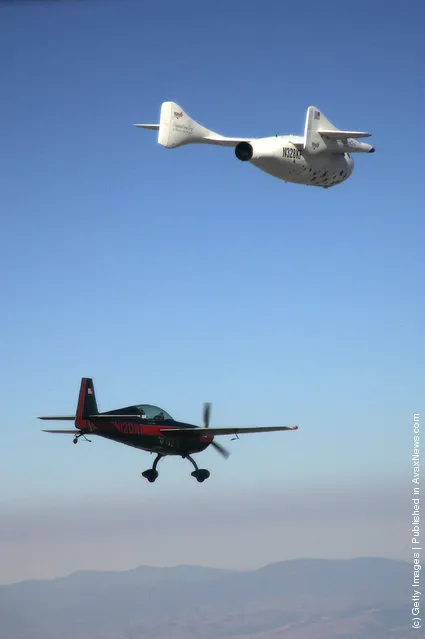
“SpaceShipOne was a suborbital air-launched spaceplane that completed the first manned private spaceflight in 2004. That same year, it won the US$10 million Ansari X Prize and was immediately retired from active service. Its mothership was named “White Knight”. Both craft were developed and flown by Mojave Aerospace Ventures, which was a joint venture between Paul Allen and Scaled Composites, Burt Rutan's aviation company. Allen provided the funding of approximately US$25 million”. – Wikipedia

Photo: A chase plane follows SpaceShipOne after it reached a height of 62 miles in the first non-governmental flight to leave the Earth's atmosphere on June 21, 2004 in Mojave, California. SpaceShipOne spacecraft was carried to a height of 50,000 by the twin-turbojet high-altitude research aircraft, “White Knight”, where it was launched for its final climb. The space effort was funded by Microsoft co-founder Paul Allen and headed by aerospace engineer Burt Rutan. (Photo by Jim Campbell-Pool/Getty Images)
Details
26 Jun 2011 09:56:00
Two women wearing nun outfits drink beer while watching the 2014 Tim Hortons Brier curling championships in Kamloops, British Columbia in this March 8, 2014 file photo. (Photo and caption by Ben Nelms/Reuters)

Two women wearing nun outfits drink beer while watching the 2014 Tim Hortons Brier curling championships in Kamloops, British Columbia in this March 8, 2014 file photo. Although some people might conclude that a curling event could produce a dull atmosphere, it is actually far from it. Some of the most energetic and loyal fans are committed to showing their colours at tournaments around the world. There was a lull in the games that were being held on this day and I remember spotting these nuns sitting in their seats earlier. Although them just sitting there didn't produce a picture, I kept my eye on them for the entire match. As soon as I spotted them with beer in their hands, I slowly turned my camera towards them and waited for them to take a drink. One of the challenges of shooting this image was to not have everyone notice me taking the photo. I had a longer lens on and was right in the middle of the rink. I slowly turned my lens, not to make my intentions too obvious, and waited until they drank from their beers together. (Photo and caption by Ben Nelms/Reuters)
Details
27 Nov 2014 14:39:00
Miners pulling up lazy tourists to the rim of Kawah Ijen (Ijen Volcano), East Java, Indonesia on September 21, 2017. They will earn as much as they would bring down a load of sulfur. Nomadic Explorer, Cultural Lifestyle Photographer Claudio Sieber captured striking images of miners working at Ijen volcanic range in East Java, Indonesia. The sulphur miners risk their lives daily as they climb the active volcano carrying heavy loads, which they sell to sugar refineries. Shortly after midnight curious tourists are flocking in hundreds through the gate of Ijen's foothills to be right on time, driven by the images others took before them. Kawah Ijen is the one of the world's largest acidic volcanic crater lake; famous for its turquoise color as well as the unreal atmosphere it offers during darkness. A dusty path zigzags 3 kilometers up to the crater rim. This doesn't mean anything challenging; in particular, special sights have to be deserved anyway. The irritating smell of sulfur announces the near of the crater's existence. Arriving on the crater's rim the reward for the torture becomes visible. Blue fire darts its tongues through the fumes of sulfur dioxide. Somehow, the spectacle isn't as romantic as expected, since it is also the rough working space of approx. 150 sulfur miners who start their shift at 1 am. Lately, harvesting the abundance of devil's gold received international attention. This did obviously not really improve a miner's lifestyle; neither did it contribute to a better wage. (Photo by Claudio Sieber/Barcroft Images)

Miners pulling up lazy tourists to the rim of Kawah Ijen (Ijen Volcano), East Java, Indonesia on September 21, 2017. They will earn as much as they would bring down a load of sulfur. Nomadic Explorer, Cultural Lifestyle Photographer Claudio Sieber captured striking images of miners working at Ijen volcanic range in East Java, Indonesia. The sulphur miners risk their lives daily as they climb the active volcano carrying heavy loads, which they sell to sugar refineries. (Photo by Claudio Sieber/Barcroft Images)
Details
02 Oct 2017 08:31:00
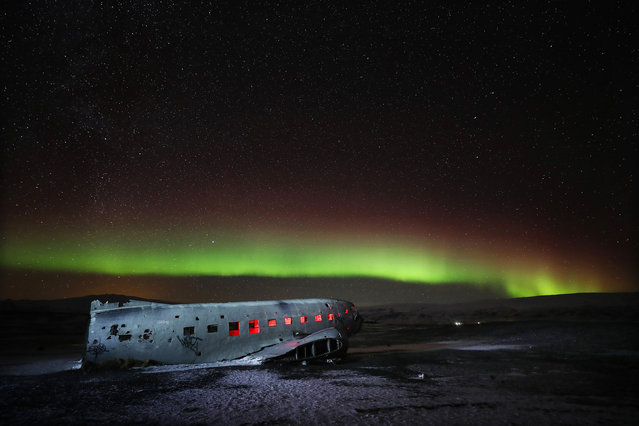
Aurora Borealis, or Northern Lights, shine over the plane wreck of a US Navy airplane – a Douglas Super DC-3 – on the Black Beach in Solheimasandur, south Iceland on January 18, 2018. (Photo by Owen Humphreys/PA Images via Getty Images)

Aurora Borealis, or Northern Lights, shine over the plane wreck of a US Navy airplane – a Douglas Super DC-3 – on the Black Beach in Solheimasandur, south Iceland on January 18, 2018. (Photo by Owen Humphreys/PA Images via Getty Images)
Details
29 Feb 2020 00:05:00
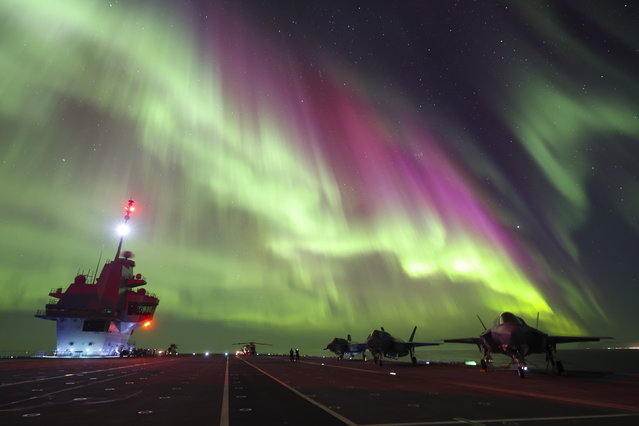
In this photo provided by Britain's Ministry of Defense, on Monday, March 4, 2024, F-35B Lightning jets are parked at a flight deck of HMS Prince of Wales aircraft carrier of the Royal Navy, under the northern lights (Aurora Borealis) near the coast of Norway, Sunday, March 3, 2024. (Photo by UK Ministry of Defence via AP Photo)

In this photo provided by Britain's Ministry of Defense, on Monday, March 4, 2024, F-35B Lightning jets are parked at a flight deck of HMS Prince of Wales aircraft carrier of the Royal Navy, under the northern lights (Aurora Borealis) near the coast of Norway, Sunday, March 3, 2024. (Photo by UK Ministry of Defence via AP Photo)
Details
14 May 2024 04:45:00
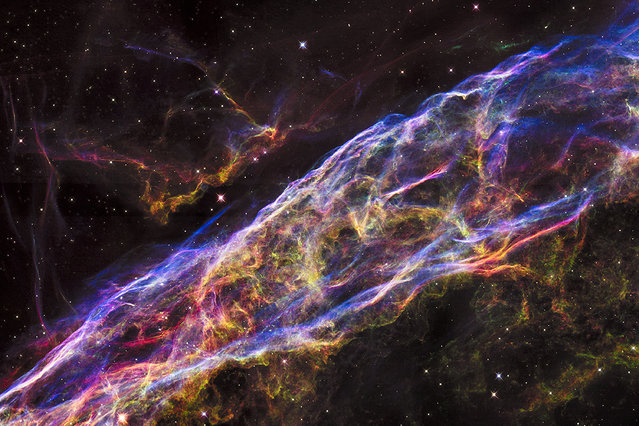
A small section of the expanding remains of the Veil Nebula, a massive star that exploded about 8,000 years ago. The entire nebula is 110 light-years across, covering six full moons on the sky as seen from Earth, and resides about 2,100 light-years away in the constellation Cygnus, the Swan. Image taken by NASA's Hubble Space Telescope. Released September 24, 2015. (Photo by Reuters/NASA/ESA/Hubble Heritage Team)

A small section of the expanding remains of the Veil Nebula, a massive star that exploded about 8,000 years ago. The entire nebula is 110 light-years across, covering six full moons on the sky as seen from Earth, and resides about 2,100 light-years away in the constellation Cygnus, the Swan. Image taken by NASA's Hubble Space Telescope. Released September 24, 2015. (Photo by Reuters/NASA/ESA/Hubble Heritage Team)
Details
10 Dec 2015 08:01:00