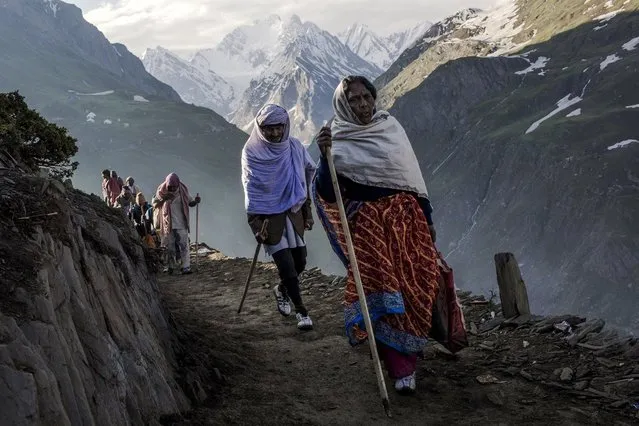
Hindu pilgrims walk along a mountain path as they make their pilgrimage to the sacred Amarnath Cave, one of the most revered Hindu shrines, near Baltal, Kashmir, India. (Photo by Daniel Berehulak)
A frog sits on a leaf and instead of seeing a reflection of itself in the water below, it sees a snail, attached to the bottom of the leaf, in a fish tank in Vietnam. (Photo by Duong Quoc Dinh/Solent Ne/SIPA Press)
Vietnam's Pham Hong Anh in action during her single dance final during the Southeast Asian Games' DanceSport competition in Mabalacat, Philippines, December 1, 2019. (Photo by Athit Perawongmetha/Reuters)
U.S. President Donald Trump boards Air Force One to depart for Vietnam from Beijing Airport in Beijing, China on November 10, 2017. (Photo by Jonathan Ernst/Reuters)
Myanmar's Theiri Aung, seen in action during the women's sepak takraw semifinal against Vietnam, at the Southeast Asian Games in Hanoi, on May 17, 2022. (Photo by Athit Perawongmetha/Reuters)
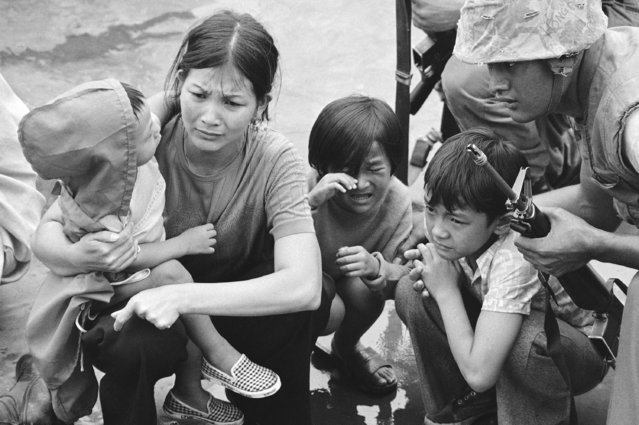
A weeping South Vietnamese mother and her three children are shown on the deck of this amphibious command ship being plucked out of Saigon by U.S. Marine helicopters in Vietnam, April 29, 1975. (Photo by AP Photo)
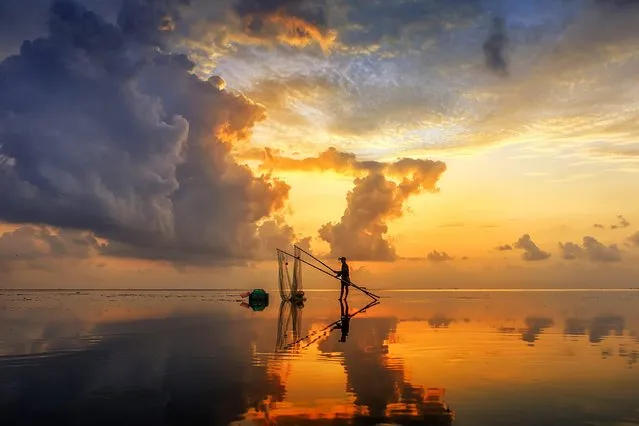
In the mangrove swamps of Quang Lang in Vietnam fishermen use stilts to take them into the deeper water on December 18, 2021. (Photo by Bang Nguyen Trong/Solent News)
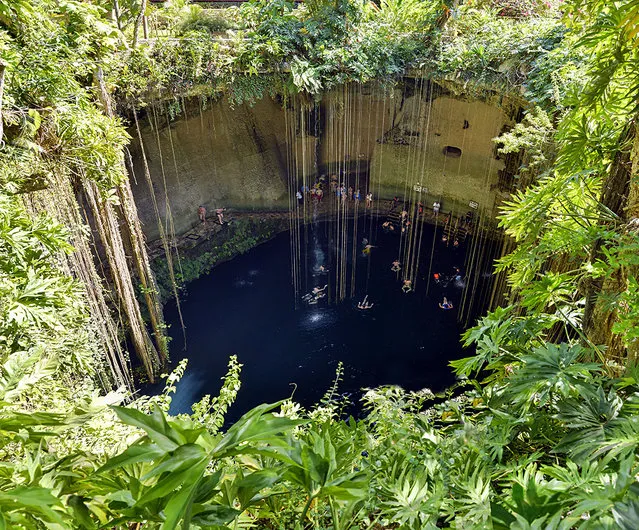
A cenote is a natural phenomenon, a sinkhole in the Earth’s surface. The Yucatan Peninsula in Mexico has an estimated 7,000 cenotes because it is primarily made up of porous limestone. For millions of years, rainfall slowly ate away at the limestone and a huge system of underground caves and caverns was formed. Many filled with water from rain or from the underground water table. When the roof of a water filled cave collapses, a cenote is born. The water found in a cenote may be fresh water, salt water, or both. Structurally it may be completely open, like a lake, almost completely closed with just a small opening at the top, or somewhere in between.