Loading...
Done
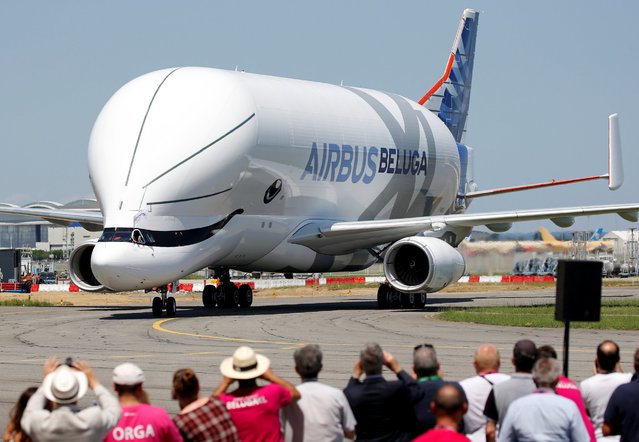
People take pictures as an Airbus Beluga XL transport plane lands during its first flight event in Colomiers near Toulouse, France, July 19, 2018. Airbus employees were asked to vote on possible designs for the craft, which ended up being painted to resemble a cartoon cetacean. “The six designs we proposed for consideration by employees respected our brand identity while running from the conventional to the unconventional, even adding a touch of fun”, said Tim Orr, head of branding at Airbus. (Photo by Regis Duvignau/Reuters)

People take pictures as an Airbus Beluga XL transport plane lands during its first flight event in Colomiers near Toulouse, France, July 19, 2018. The Beluga XL, the new cargo plane of the Airbus family has taken off from Blagnac, in the south of France, for its first test flight. The launch of the aircraft triggered thunderous applause in an audience of more than 10,000 people, mostly employees and subcontractors of the European aircraft manufacturer. (Photo by Regis Duvignau/Reuters)
Details
20 Jul 2018 07:30:00
Military Woman Part 3

'Military woman' is a constantly updated gallery of images of women wearing uniform: military, police and so on. We truly hope that our beloved visitors won't remain passive and will take part in this project making it even more interesting! Note that all the images featured in the gallery are taken from publically available sources: their copyright belongs to their respective creators and the trade mark to the owners. ...

See also:Part 1 _ Part 2
Details
11 Mar 2015 10:29:00
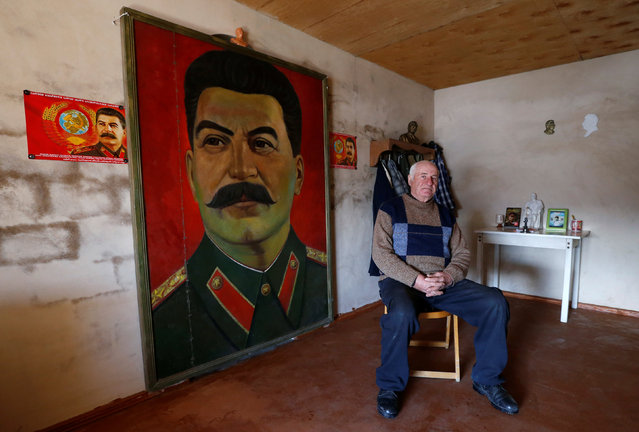
Retired builder Vasili Sidamonidze, 70, poses for a portrait at his home in Gori, Georgia, December 6, 2016. “Unfortunately, Stalin is not popular nowadays. Our people don't respect him. Only we, members of the (Communist) Party, respect him”, Sidamonidze said. “I always try to attend Stalin's birthday anniversaries in Gori. Unfortunately many people don't want to join us even if they live nearby. They look at us from their windows”. Stalin, who was born in Gori in 1878 and died in 1953, is largely reviled today in Georgia, which regained its independence during the 1991 collapse of the Soviet Union. Over the years, his memorials have been dismantled, most recently in 2010 when authorities removed a statue of the dictator from Gori's central square. But Stalin is still revered by a small group of mainly elderly supporters who stress his role in the industrialisation of the Soviet Union and in defeating Nazi Germany in World War Two. Each Dec. 21, a few dozen people mark his birthday by gathering outside a Gori museum dedicated to Stalin, where they make speeches and walk to the square where a 6-meter-high bronze statue of him once stood, calling for it to be reinstated. Opponents say it was a symbol of Moscow's still lingering shadow. In 2008, Russia fought a brief war with Georgia and recognised its breakaway regions of Abkhazia and South Ossetia as independent states. (Photo by David Mdzinarishvili/Reuters)

Retired builder Vasili Sidamonidze, 70, poses for a portrait at his home in Gori, Georgia, December 6, 2016. “Unfortunately, Stalin is not popular nowadays. Our people don't respect him. Only we, members of the (Communist) Party, respect him”, Sidamonidze said. “I always try to attend Stalin's birthday anniversaries in Gori. Unfortunately many people don't want to join us even if they live nearby. They look at us from their windows”. (Photo by David Mdzinarishvili/Reuters)
Details
17 Dec 2016 07:59:00
“The sustainable development goals cannot be met unless waste management is addressed as a priority”, says UK waste management charity Waste Aid. “E-waste is one of the fastest growing categories of the 7-10bn tonnes of waste produced globally every year”, adds director Mike Webster. “In our view, decent waste management is a basic right and we want governments around the world take this issue much more seriously – in 2012 only 0.2% of international aid went on improving solid waste management – it’s just not enough”. (Photo by Kai Loeffelbein/laif Agentur)

Sustainable development goal target 12.5 is to reduce waste. But with a planet increasingly dependent on technology, is that even possible? As of today, over 30m tonnes of electronic waste has been thrown out so far this year, according to the World Counts. Most e-waste is sent to landfills in Asia and Africa where it is recycled by hand, exposing the people who do it to environmental hazards. Kai Loeffelbein’s photographs of e-waste recycling in Guiyu, southern China show what happens to discarded computers. (Photo by Kai Loeffelbein/laif Agentur)
Details
19 Oct 2016 12:14:00
Tourists play at a beach covered by a thick layer of green algae on July 3, 2013 in Qingdao, China. A large quantity of non-poisonous green seaweed, enteromorpha prolifera, hit the Qingdao coast in recent days. More than 20,000 tons of such seaweed has been removed from the city's beaches. (Photo by ChinaFotoPress/ChinaFotoPress)

Tourists play at a beach covered by a thick layer of green algae on July 3, 2013 in Qingdao, China. A large quantity of non-poisonous green seaweed, enteromorpha prolifera, hit the Qingdao coast in recent days. More than 20,000 tons of such seaweed has been removed from the city's beaches. (Photo by China Foto Press)
Details
04 Jul 2013 11:01:00
A gibbon drinks from a soft drink bottle, given by a tourist, at a zoo in Kunming, Yunnan province, June 18, 2015. (Photo by Wong Campion/Reuters)

A gibbon drinks from a soft drink bottle, given by a tourist, at a zoo in Kunming, Yunnan province, June 18, 2015. (Photo by Wong Campion/Reuters)
Details
30 Jun 2015 11:48:00
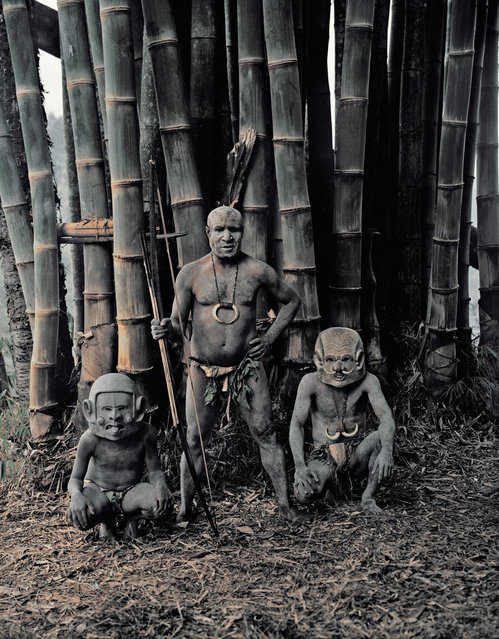
“Asaro from the Eastern Highlands”. The mudmen could not cover their faces with mud because the people of Papua New Guinea thought that the mud from the Asaro river was poisonous. So instead of covering their faces with this alleged poison, they made masks from pebbles that they heated and water from the waterfall, with unusual designs such as long or very short ears either going down to the chin or sticking up at the top, long joined eyebrows attached to the top of the ears, horns and sideways mouths. (Jimmy Nelson)

“Asaro from the Eastern Highlands”. The mudmen could not cover their faces with mud because the people of Papua New Guinea thought that the mud from the Asaro river was poisonous. So instead of covering their faces with this alleged poison, they made masks from pebbles that they heated and water from the waterfall, with unusual designs such as long or very short ears either going down to the chin or sticking up at the top, long joined eyebrows attached to the top of the ears, horns and sideways mouths. (Photo and caption by Jimmy Nelson)
Details
20 Oct 2013 08:54:00
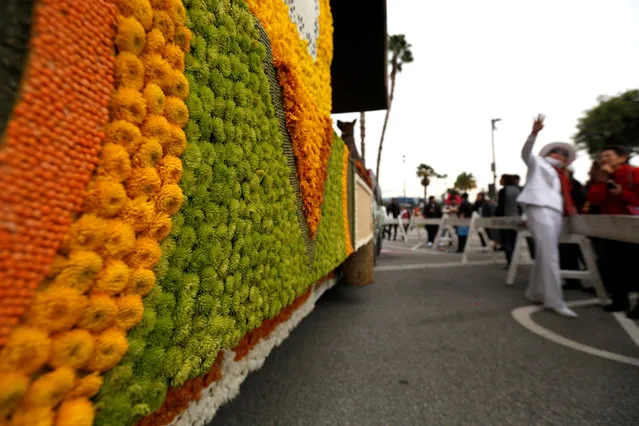
A detail of Farmers Insurance “We Came, We Saw, We Covered” float which was featured in the 128th annual Rose Parade is pictured in Pasadena, California U.S., January 3, 2017. (Photo by Mario Anzuoni/Reuters)

A detail of Farmers Insurance “We Came, We Saw, We Covered” float which was featured in the 128th annual Rose Parade is pictured in Pasadena, California U.S., January 3, 2017. (Photo by Mario Anzuoni/Reuters)
Details
05 Jan 2017 13:37:00