Loading...
Done
Paramasivan points to the statue of sun god Surya at a temple outside the Kodaikanal Solar Observatory, India, February 5, 2017. (Photo by Danish Siddiqui/Reuters)

Paramasivan points to the statue of sun god Surya at a temple outside the Kodaikanal Solar Observatory, India, February 5, 2017. In the early morning darkness, Devendran P. walks up a hill to a solar observatory in India's southern hill town of Kodaikanal, trudging the same path his father and grandfather walked in a century-old family tradition of studying the sun. (Photo by Danish Siddiqui/Reuters)
Details
24 Feb 2017 00:03:00
Female soldiers march during a military parade marking the country's Independence Day in Caracas, Venezuela, Wednesday, July 5, 2017. Venezuela is marking 206 years of their declaration of independence from Spain. (Photo by Ariana Cubillos/AP Photos)

Female soldiers march during a military parade marking the country's Independence Day in Caracas, Venezuela, Wednesday, July 5, 2017. Venezuela is marking 206 years of their declaration of independence from Spain. (Photo by Ariana Cubillos/AP Photos)
Details
06 Jul 2017 09:17:00
A lemur licks a block of ice containing fruit at Rome's Bioparco zoo, Wednesday, July 5, 2017. Zookeepers at the Bioparco often give animals ice blocks with either fruit or meat on hot summer days. (Photo by Gregorio Borgia/AP Photo)

A lemur licks a block of ice containing fruit at Rome's Bioparco zoo, Wednesday, July 5, 2017. Zookeepers at the Bioparco often give animals ice blocks with either fruit or meat on hot summer days. (Photo by Gregorio Borgia/AP Photo)
Details
09 Jul 2017 07:44:00
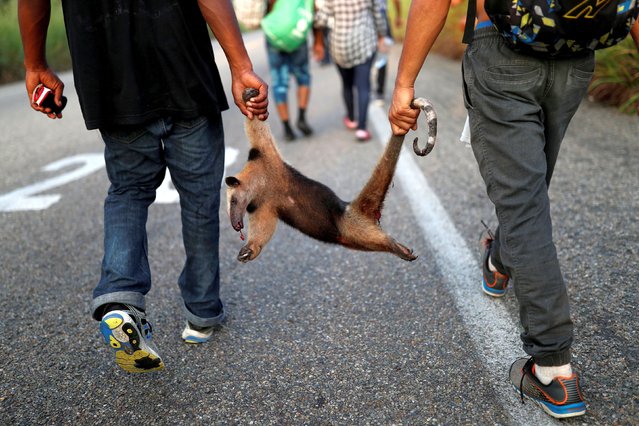
Migrants, part of a caravan traveling en route to the United States, carry an anteater that was hit by a car, according to them, as they walk on the road that links Arriaga and Tapanatepec, near Arriaga, Mexico, November 5, 2018. (Photo by Carlos Garcia Rawlins/Reuters)

Migrants, part of a caravan traveling en route to the United States, carry an anteater that was hit by a car, according to them, as they walk on the road that links Arriaga and Tapanatepec, near Arriaga, Mexico, November 5, 2018. (Photo by Carlos Garcia Rawlins/Reuters)
Details
17 Nov 2019 00:03:00
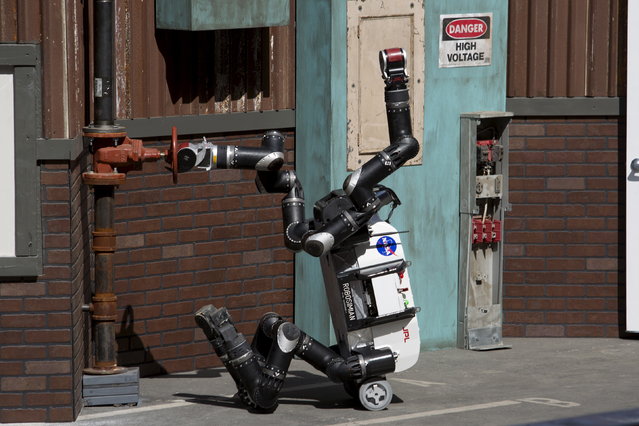
The Jet Propulsion Lab team's RoboSimian robot turns on a valve at a simulated disaster-response course during day one of the Defense Advanced Research Projects Agency (DARPA) Robotics Challenge finals in Pomona, California, June 5, 2015. (Photo by David McNew/Reuters)

The Jet Propulsion Lab team's RoboSimian robot turns on a valve at a simulated disaster-response course during day one of the Defense Advanced Research Projects Agency (DARPA) Robotics Challenge finals in Pomona, California, June 5, 2015. (Photo by David McNew/Reuters)
Details
13 Dec 2015 08:29:00
Tesla CEO Elon Musk (R) jumps on stage as he joins former US President and Republican presidential candidate Donald Trump during a campaign rally at site of his first assassination attempt in Butler, Pennsylvania on October 5, 2024. (Photo by Jim Watson/AFP Photo)

Tesla CEO Elon Musk (R) jumps on stage as he joins former US President and Republican presidential candidate Donald Trump during a campaign rally at site of his first assassination attempt in Butler, Pennsylvania on October 5, 2024. (Photo by Jim Watson/AFP Photo)
Details
14 Oct 2024 03:25:00
Rag pickers collect recyclable material at a garbage dump in New Delhi November 19, 2014. (Photo by Ahmad Masood/Reuters)

Rag pickers collect recyclable material at a garbage dump in New Delhi November 19, 2014. (Photo by Ahmad Masood/Reuters)
Details
20 Nov 2014 12:41:00
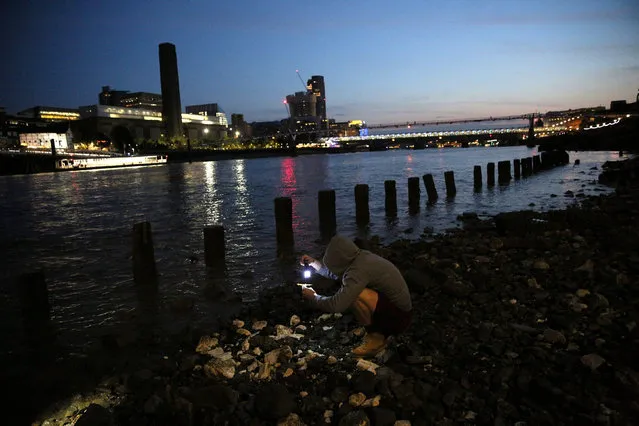
A mudlark uses a torch to look for items on the bank of the River Thames in London, Britain June 06, 2016. Mudlarking is believed to trace its origins to the 18th and 19th century, when scavengers searched the Thames' shores for items to sell. These days, history and archaeology fans are the ones hoping to find old relics such as coins, ceramics, artifacts or everyday items from across centuries. They wait for the low tide and then scour specific areas of exposed shores. "If you're in a field you could be out all day long, with the river you're restricted to about two or three hours," mudlark Nick Stevens said. While many just use the naked eye for their searches, others rely on metal detectors for which a permit from the Port of London Authority is needed. Digging also requires consent. (Photo by Neil Hall/Reuters)

A mudlark uses a torch to look for items on the bank of the River Thames in London, Britain June 06, 2016. Mudlarking is believed to trace its origins to the 18th and 19th century, when scavengers searched the Thames' shores for items to sell. These days, history and archaeology fans are the ones hoping to find old relics such as coins, ceramics, artifacts or everyday items from across centuries. their finds with the Portable Antiquities Scheme. Any item over 300 years old must be recorded. (Photo by Neil Hall/Reuters)
Details
27 Aug 2016 10:43:00