Loading...
Done
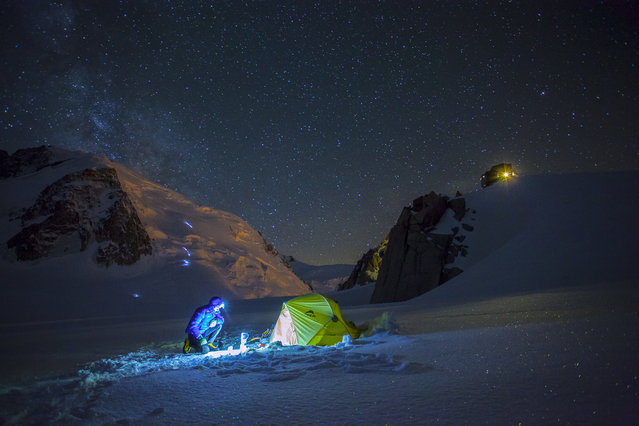
“A snapshot from mountaineer's life”. Have you ever wondered how does a mountaineer's day start? (Photo and caption by Kamil Tamiola/National Geographic Traveler Photo Contest)

“A snapshot from mountaineer's life”. Have you ever wondered how does a mountaineer's day start? I will give you a hint: you wake up at 3 am, set the stove, wake up your partner, pretend it is warm, quickly consume a high-calorie breakfast, watch your friends slowly ascending the icy slopes of your dream summit with their tiny head torches glimmering against perfectly blue ice, and hope for the good weather. One would ask: why all this trouble? The answer is easy: for the love of the adventure and the unknown. Location: Chamonix, Haute Savoye, France. (Photo and caption by Kamil Tamiola/National Geographic Traveler Photo Contest)

ATTENTION! All pictures are presented in high resolution. To see Hi-Res images – just TWICE click on any picture. In other words, click small picture – opens the BIG picture. Click BIG picture – opens VERY BIG picture.
Details
27 Jun 2013 12:47:00
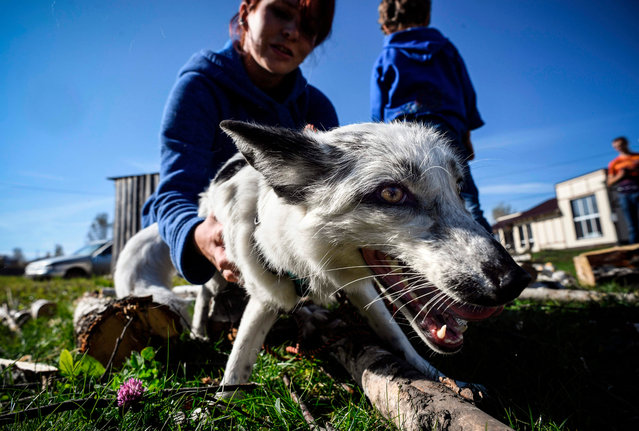
Tatyana Abramova, 33, plays with her home fox Plombir at her countryside house outside Siberian city of Novosibirsk on September 12, 2020. The official start of the Soviet experiment to better understand the domestication of animals by humans began in 1959, and was initiated by geneticists Dmitri Beliaiev and Lioudmila Trout on a farm in Akademgorodok, the scientific center of excellence in Siberia. Their primary objective was to domesticate foxes, to understand how the ancestor of wolves, another canine, evolved into a loyal and loving dog. And understand what this domestication tells us about the genetic evolution of species. (Photo by Alexander Nemenov/AFP Photo)

Tatyana Abramova, 33, plays with her home fox Plombir at her countryside house outside Siberian city of Novosibirsk on September 12, 2020. The official start of the Soviet experiment to better understand the domestication of animals by humans began in 1959, and was initiated by geneticists Dmitri Beliaiev and Lioudmila Trout on a farm in Akademgorodok, the scientific center of excellence in Siberia. Their primary objective was to domesticate foxes, to understand how the ancestor of wolves, another canine, evolved into a loyal and loving dog. And understand what this domestication tells us about the genetic evolution of species. (Photo by Alexander Nemenov/AFP Photo)
Details
25 Oct 2020 00:05:00
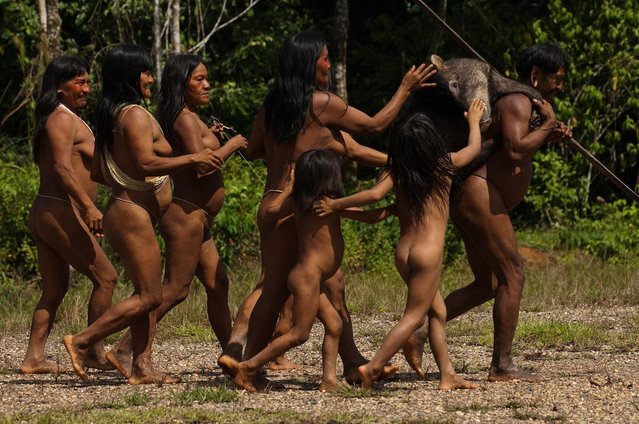
Spectacular images offering insight into the lives of the Huaorani people in the Ecuadorian Amazon have been revealed showing how they use traditional methods to hunt monkeys for food. The stunning pictures were taken by conservation photographer Pete Oxford from Torquay, Devon in the Ecuadorian Amazon. “The Huaorani Indians are a forest people highly in tune with their environment. Many are now totally acculturated since the 1950s by missionaries”, said Pete. “Today they face radical change to their culture to the proximity of oil exploration within their territory and the Yasuni National Park and Biosphere Reserve, they are vastly changed. Some still live very traditionally and for this shoot, through my Huaorani friend, a direct relative of those photographed he wanted to depict them as close to their original culture as possible. They still largely hunt with blow pipes and spears eating a lot of monkeys and peccaries”. The Huaorani are also known as the Waorani, Waodani or the Waos and are native Amerindians. Their lands are located between the Curaray and Napo rivers and speak the Huaorani language. Pete says that during his visit he was welcomed into the group and hopes that ancient cultures can be saved. Here: The tribe were seen celebrating after a hunter returned to camp with a wild pig. (Photo by Pete Oxford/Mediadrumworld.com)

Spectacular images offering insight into the lives of the Huaorani people in the Ecuadorian Amazon have been revealed showing how they use traditional methods to hunt monkeys for food. The stunning pictures were taken by conservation photographer Pete Oxford from Torquay, Devon in the Ecuadorian Amazon. Here: The tribe were seen celebrating after a hunter returned to camp with a wild pig. (Photo by Pete Oxford/Mediadrumworld.com)
Details
20 Jan 2017 07:58:00


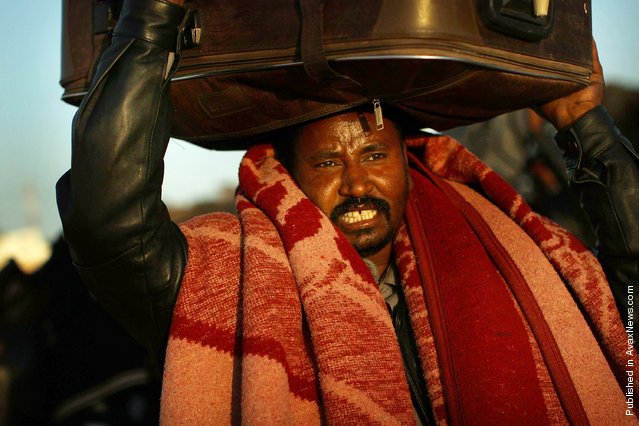
A Sudanese man walks to a United Nations displacement camp after crossing into Tunisia from Libya on March 06, 2011 in Ras Jdir, Tunisia. As fighting continues in and around the Libyan capital of Tripoli, tens of thousands of guest workers from Egypt, Tunisia, Bangladesh and other countries are fleeing to the border of Tunisia to escape the violence. The situation has turned into a humanitarian emergency as fledgling Tunisia is overwhelmed with the workers. Libyan leader Muammar Gaddafi has vowed to fight to the end. (Photo by Spencer Platt/Getty Images). RAS JDIR, TUNISIA – MARCH 06 2011
Details
10 Mar 2011 11:44:00
Antarctic World Record Attempt

James Castrission, “Cas” and Justin Jones “Jonesy” ski across an ice staking rink with two “You Can” patients on August 2, 2011 in Sydney, Australia. In 75 days, the Aussie adventure pair will attempt to cross 2,200 kilometres of Antarctic ice to the South Pole and back on foot to raise money for youth with cancer. The journey will require the two to trek with all the supplies for approximately three months of walking. Cas and Jonesy became the first to kayak unassisted over 3,300 kilometres from New Zealand to Australia in 2008. (Photo by Ryan Pierse/Getty Images)
Details
02 Aug 2011 14:00:00
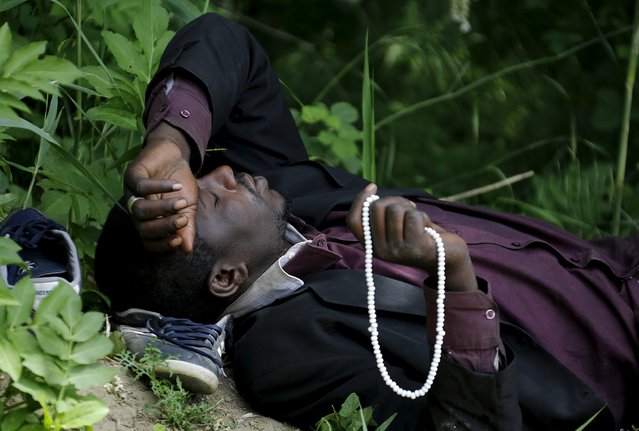
An  immigrant from Mali rests at the Greek-Macedonian border before an attempt to flee to Macedonia  May 13, 2015 village of Idomeni in Kilkis prefecture May 13, 2015. (Photo by Yannis Behrakis/Reuters)

An immigrant from Mali rests at the Greek-Macedonian border before an attempt to flee to Macedonia May 13, 2015 village of Idomeni in Kilkis prefecture May 13, 2015. Hundreds of mostly Afghan, Syrian, and African immigrants cross daily from Greece into Macedonia on their way to northern European countries; most of them are turned back by Macedonian border guards. (Photo by Yannis Behrakis/Reuters)
Details
17 May 2015 11:50:00
Kate & Canine Partner "Byron"

As dog owners know, you are lucky if your pooch can be persuaded to collect your slippers without chewing them to pieces.
But golden labrador Byron performs dozens of such tasks faultlessly for his owner every day.
He helps 'best friend' Kate Cross peg out her washing, make her bed, go shopping and even take money out of the cash machine.
Details
12 Feb 2013 13:57:00
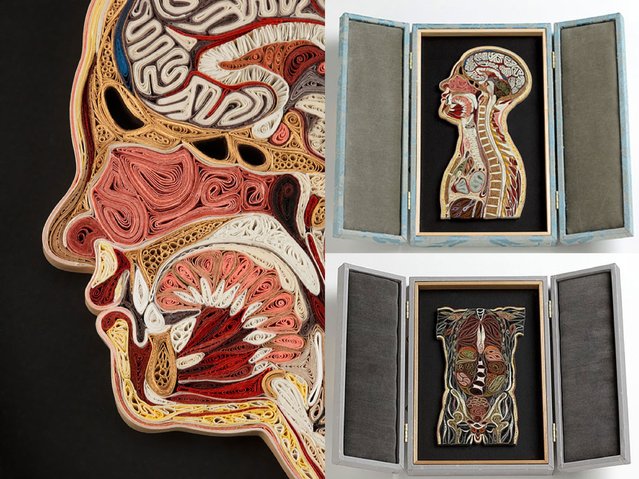
 Paper Anatomy By Lisa Nilsson

These pieces are made of Japanese mulberry paper and the gilded edges of old books. They are constructed by a technique of rolling and shaping narrow strips of paper called quilling or paper filigree. Quilling was first practiced by Renaissance nuns and monks who are said to have made artistic use of the gilded edges of worn out bibles, and later by 18th century ladies who made artistic use of lots of free time. I find quilling exquisitely satisfying for rendering the densely squished and lovely internal landscape of the human body in cross section.
Details
14 Apr 2013 11:07:00