Loading...
Done
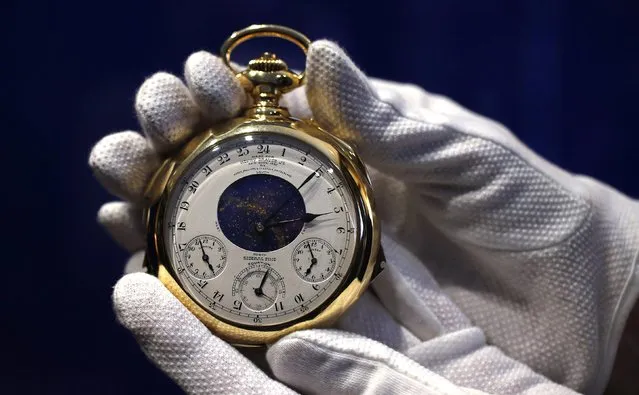
A staff member holds “The Henry Graves Supercomplication” handmade watch by Patek Philippe which was completed in 1932 at Sotheby's auction house in London October 21, 2014. (Photo by Suzanne Plunkett/Reuters)

What makes a watch the most valuable in the world? It’s supercomplicated – literally. In 1925 banker Henry Graves Jr. (considered the greatest watch collector of the 20th century) commissioned Patek Philippe to create a unique gold pocket watch. When Graves finally received it – eight years later – it was the most complex timepiece ever created by human hands... (Photo by Suzanne Plunkett/Reuters)
Details
21 Oct 2014 13:23:00
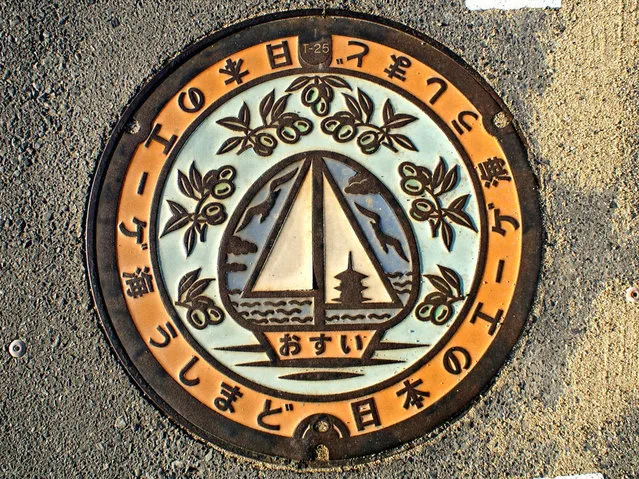
Japanese Manhole Covers Photos By S. Morita Part 2

Japan is a country full of art. Much of this is housed in museums and galleries, but others are right under our feet. We speak, of Japan’s peculiar obsession with manhole covers. Almost anywhere in the country you can find manhole covers with spectacular grounds, each more beautiful and complex than the previous. In recent years, S. Morita photographer has traveled around Japan and leave us this great gathering on the beautiful and artistic Japanese manhole covers.
Details
06 Apr 2014 12:03:00
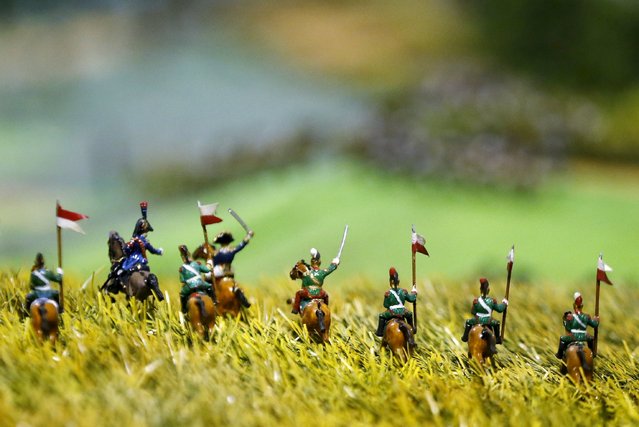
Figurines representing French Brigade of Lancers are seen on a 40-square-metre miniature model of the June 18, 1815 Waterloo battlefield, in Diest, Belgium, in this picture taken on April 29, 2015. (Photo by Francois Lenoir/Reuters)

Figurines representing French Brigade of Lancers are seen on a 40-square-metre miniature model of the June 18, 1815 Waterloo battlefield, in Diest, Belgium, in this picture taken on April 29, 2015. Waterloo enthusiast Willy Smout said he spent 40,000 hours and around 150,000 euros over the past 40 years, to recreate the battlefield as closely as possible in a purpose-built room in his house. (Photo by Francois Lenoir/Reuters)
Details
06 May 2015 13:42:00
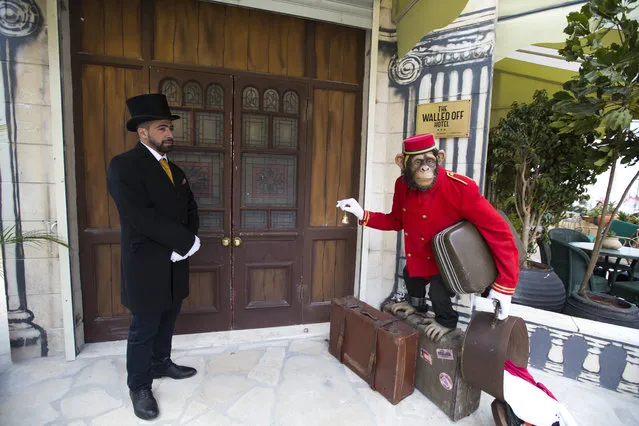
A doorman stands at the entrance of the “The Walled Off Hotel” in the West Bank city of Bethlehem, Friday, March 3, 2017. (Photo by Dusan Vranic/AP Photo)

A doorman stands at the entrance of the “The Walled Off Hotel” in the West Bank city of Bethlehem, Friday, March 3, 2017. The owner of a guest house packed with the elusive artist Banksy's work has opened the doors of his West Bank establishments to media, showcasing its unique “worst view in the world”. The hotel, several of whose rooms look onto an Israeli security watchtower, is awash in the trademark satirical work of the mysterious artist. (Photo by Dusan Vranic/AP Photo)
Details
05 Mar 2017 00:01:00
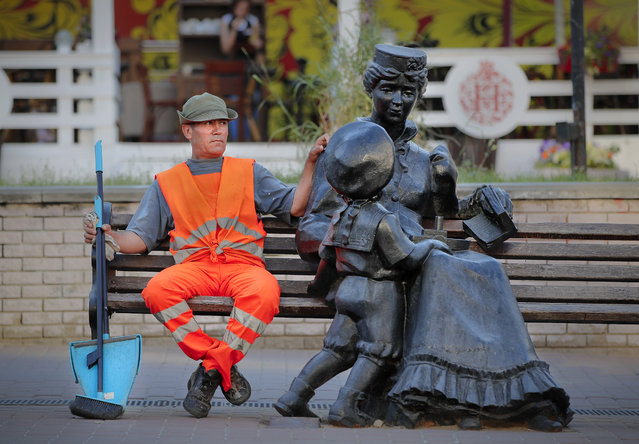
A municipal worker sits on a bench, next to a statue, in Nizhny Novgorod, Russia, during the 2018 soccer World Cup, Thursday, June 28, 2018. (Photo by Vadim Ghirda/AP Photo)

A municipal worker sits on a bench, next to a statue, in Nizhny Novgorod, Russia, during the 2018 soccer World Cup, Thursday, June 28, 2018. Nizhny Novgorod was a “closed city” during the Soviet era. It was known as Gorky until 1990 and it was here that dissident scientist Andrei Sakharov was held under house arrest. Now the city hosts six World Cup matches and is teeming with tourists. That was unthinkable in the Soviet era and even rare now in a city that is seldom visited by outsiders. (Photo by Vadim Ghirda/AP Photo)
Details
03 Jul 2018 00:03:00
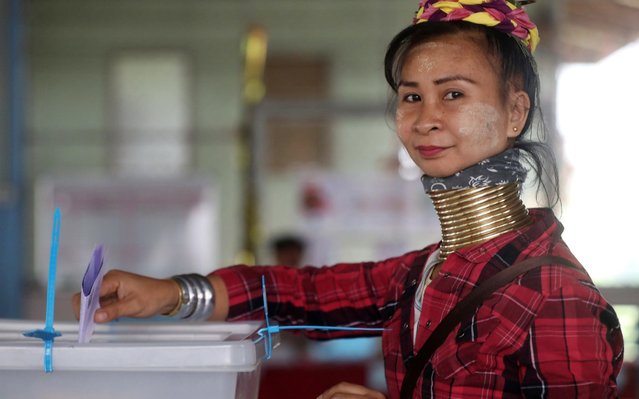
An ethnic Kayan woman, also known as a long neck villager casts her vote for the general election in Mae Hong Son, Thailand, March 24, 2019. (Photo by Ann Wang/Reuters)

An ethnic Kayan woman, also known as a long neck villager casts her vote for the general election in Mae Hong Son, Thailand, March 24, 2019. This is Thailand's first election since a military coup in 2014. Voters head to the polls to elect members of the lower house and Prime Minister. (Photo by Ann Wang/Reuters)
Details
26 Mar 2019 07:48:00
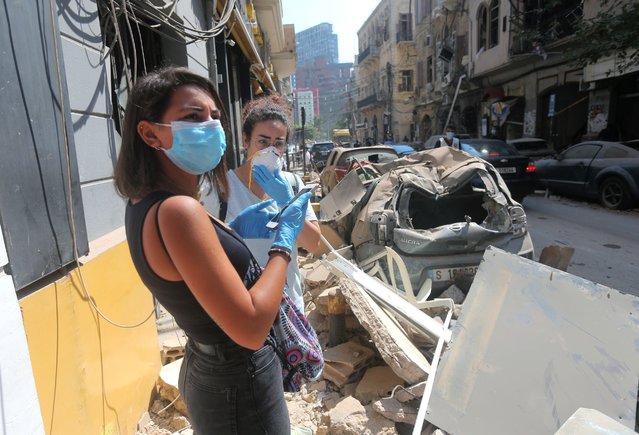
Young Lebanese women wearing protective masks and gloves against the coronavirus pandemic, stand on August 5, 2020 amid the rubble in Beirut's Gimmayzeh commercial district which was heavily damaged by the previous day's powerful explosion that tore through Lebanon's capital, resulting from the ignition of a huge depot of ammonium nitrate at the city's main port. Rescuers searched for survivors in Beirut after a cataclysmic explosion at the port sowed devastation across entire neighbourhoods, killing more than 100 people, wounding thousands and plunging Lebanon deeper into crisis. The blast, which appeared to have been caused by a fire igniting 2,750 tonnes of ammonium nitrate left unsecured in a warehouse, was felt as far away as Cyprus, some 150 miles (240 kilometres) to the northwest. (Photo by AFP Photo/Stringer)

Young Lebanese women wearing protective masks and gloves against the coronavirus pandemic, stand on August 5, 2020 amid the rubble in Beirut's Gimmayzeh commercial district which was heavily damaged by the previous day's powerful explosion that tore through Lebanon's capital, resulting from the ignition of a huge depot of ammonium nitrate at the city's main port. Rescuers searched for survivors in Beirut after a cataclysmic explosion at the port sowed devastation across entire neighbourhoods, killing more than 100 people, wounding thousands and plunging Lebanon deeper into crisis. The blast, which appeared to have been caused by a fire igniting 2,750 tonnes of ammonium nitrate left unsecured in a warehouse, was felt as far away as Cyprus, some 150 miles (240 kilometres) to the northwest. (Photo by AFP Photo/Stringer)
Details
10 Aug 2020 00:05:00
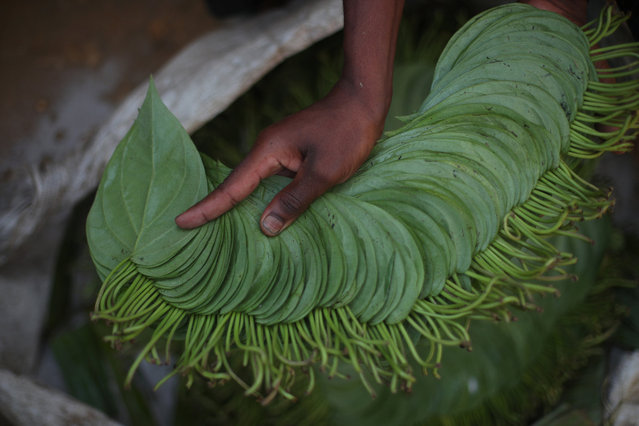
Faruk, 17, a Rohingya refugee trader holds betel leaves which are on sale at a stall in Palong Khali refugee camp near Cox's Bazar, Bangladesh, November 3, 2017. He left his village in Myanmar when the military opened fire towards the Rohingya. “I buy this betel leaf from Palong Khali market, in one bundle there are 160 pieces, I buy it for 80 taka and I sell it for 100 taka. Bangladeshi's and I sell for the same rate in the camp. Outside in the local market it is 80 taka per bundle. My problem is that I don't have money so I can't buy anything to eat, I can't buy fish to eat”, he said. (Photo by Hannah McKay/Reuters)

Faruk, 17, a Rohingya refugee trader holds betel leaves which are on sale at a stall in Palong Khali refugee camp near Cox's Bazar, Bangladesh, November 3, 2017. He left his village in Myanmar when the military opened fire towards the Rohingya. “I buy this betel leaf from Palong Khali market, in one bundle there are 160 pieces, I buy it for 80 taka and I sell it for 100 taka (1 Bangladeshi Taka = 0.012 US Dollar). Bangladeshi's and I sell for the same rate in the camp. Outside in the local market it is 80 taka per bundle. My problem is that I don't have money so I can't buy anything to eat, I can't buy fish to eat”, he said. (Photo by Hannah McKay/Reuters)
Details
27 Nov 2017 08:54:00