Loading...
Done
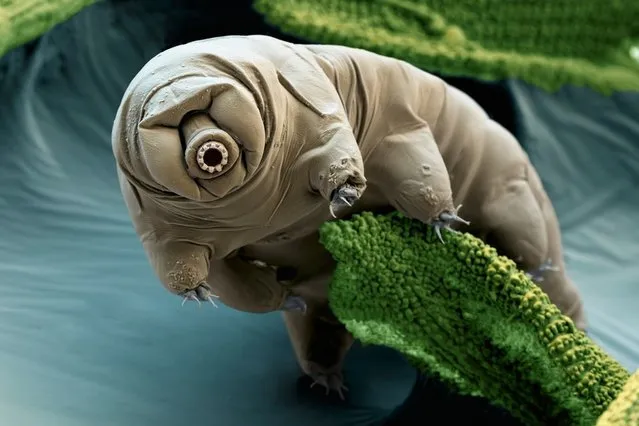
Tardigrades (commonly known as waterbears or moss piglets). (Photo by SPL/East News)

“Tardigrades (commonly known as waterbears or moss piglets) are small, water-dwelling, segmented animals with eight legs. Tardigrades were first discovered in 1773 by Johann August Ephraim Goeze, who called them kleiner Wasserbär, meaning “little water bear” in German. The name Tardigrada means “slow walker” and was given by Lazzaro Spallanzani in 1777. The name water bear comes from the way they walk, reminiscent of a bear's gait. The biggest adults may reach a body length of 1.5 millimetres (0.059 in), the smallest below 0.1 mm. Freshly hatched tardigrades may be smaller than 0.05 mm”. – Wikipedia. Photo: Tardigrades. (Photo by SPL/East News)
Details
26 Sep 2012 09:55:00
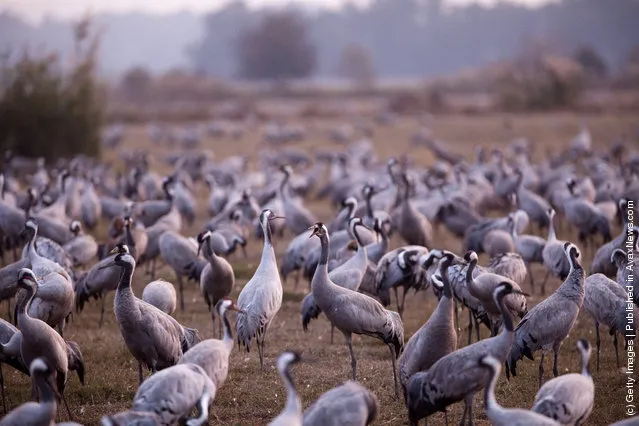
Migrating gray cranes fly over the Hula Lakes in in northern Israel

Migrating gray cranes, on November 30, 2009 around the Hula Lakes in northern Israel. (Photo by Uriel Sinai/Getty Images)
Details
01 Dec 2011 12:49:00
Some of the most powerful narratives of the past decade have been produced by a forward-thinking generation of women photojournalists as different as the places and the subjects they have covered. National Geographic's “Women of Vision” exhibit features the work of 11 photographers and is on display at the Fernbank Museum of Natural History in Atlanta until January 3, 2016. (Photo by Stephanie Sinclair/National Geographic)

Some of the most powerful narratives of the past decade have been produced by a forward-thinking generation of women photojournalists as different as the places and the subjects they have covered. National Geographic's “Women of Vision” exhibit features the work of 11 photographers and is on display at the Fernbank Museum of Natural History in Atlanta until January 3, 2016. Here: Nujood Ali stunned the world in 2008 by obtaining a divorce at age 10 in Yemen, striking a blow against forced marriage. (Photo by Stephanie Sinclair/National Geographic)
Details
11 Dec 2015 08:05:00
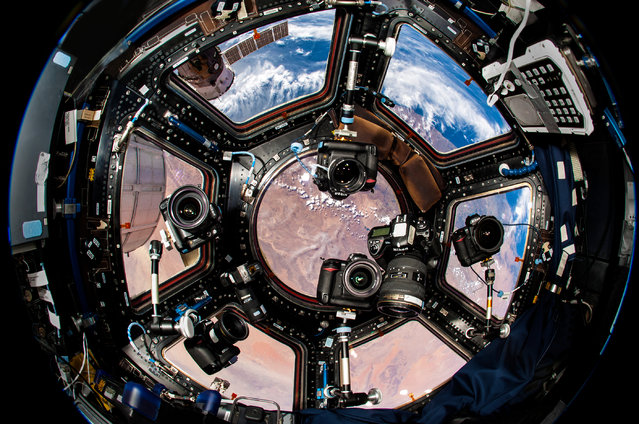
Astronaut Donald R. Pettit would often rig an array of as many as six cameras in the cupola windows and set them all to fire continuously for events such as sunsets, which only last around seven seconds on the ISS. (Photo by Donald R. Pettit)

Astronaut Donald R. Pettit would often rig an array of as many as six cameras in the cupola windows and set them all to fire continuously for events such as sunsets, which only last around seven seconds on the ISS. (Photo by Donald R. Pettit)
Details
05 Sep 2016 11:34:00
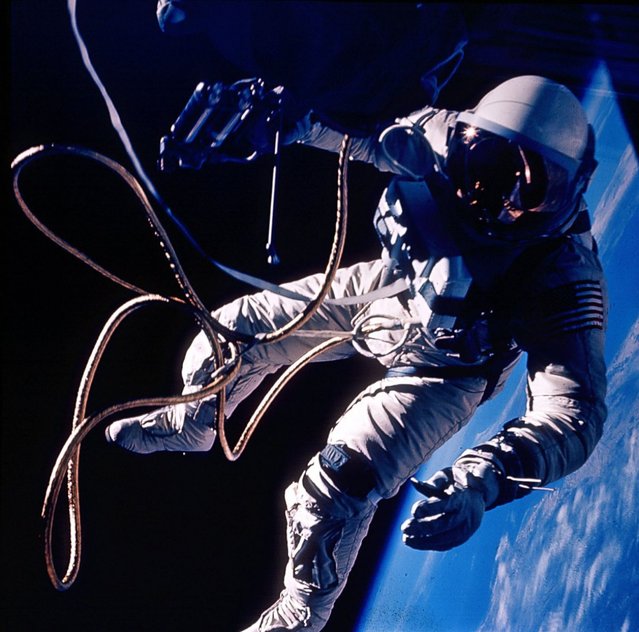
The First U.S. Spacewalk – Gemini 4 Ed White made the United States' first spacewalk on June 3, 1965 during the Gemini 4 mission. The extra-vehicular activity (EVA) started at 19:45 UT (3:45 p.m. EDT) on the third orbit when White opened his hatch and used the hand-held manuevering oxygen-jet gun to push himself out of the capsule. (Photo by NASA)

The First U.S. Spacewalk – Gemini 4 Ed White made the United States' first spacewalk on June 3, 1965 during the Gemini 4 mission. The extra-vehicular activity (EVA) started at 19:45 UT (3:45 p.m. EDT) on the third orbit when White opened his hatch and used the hand-held manuevering oxygen-jet gun to push himself out of the capsule. (Photo by NASA)
Details
11 Apr 2014 08:40:00
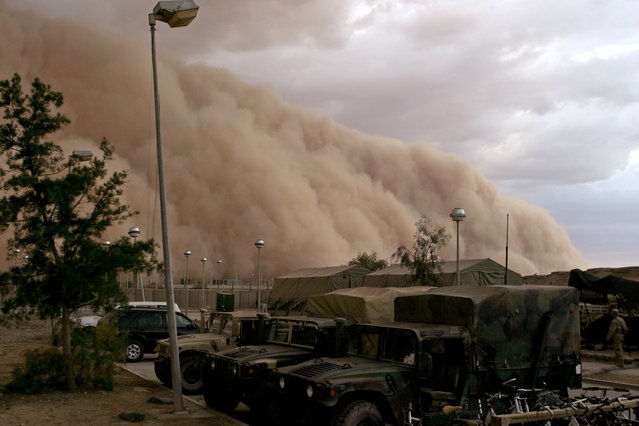
A massive sand storm cloud is close to enveloping a military camp as it rolls over Al Asad, Iraq, April 27, 2005. (Photo by Cpl. Alicia M. Garcia, U.S. Marine Corps/Reuters/U.S. Department of Defense)

A massive sand storm cloud is close to enveloping a military camp as it rolls over Al Asad, Iraq, April 27, 2005. (Photo by Cpl. Alicia M. Garcia, U.S. Marine Corps/Reuters/U.S. Department of Defense)
Details
03 Apr 2015 13:02:00
In this Thursday, April 11, 2013 photo, North Korean female soldiers stand watch on the river bank of the North Korean town of Sinuiju, opposite to the Chinese border city of Dandong. (Photo by AP Photo)

In this Thursday, April 11, 2013 photo, North Korean female soldiers stand watch on the river bank of the North Korean town of Sinuiju, opposite to the Chinese border city of Dandong. (Photo by AP Photo)
Details
22 May 2013 13:28:00
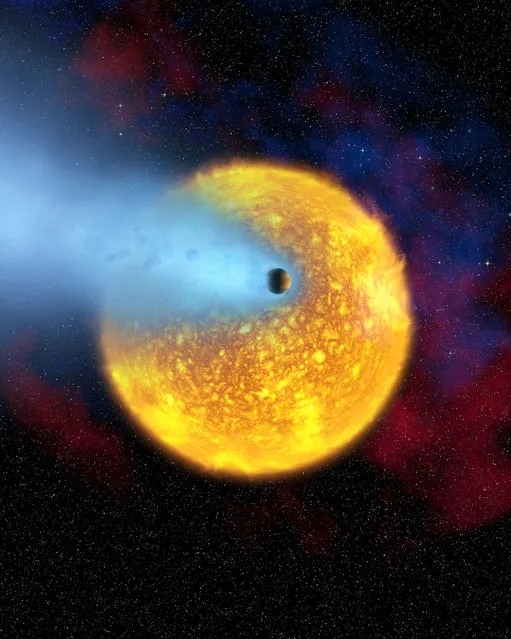
Dramatic changes spotted in HD 189733b exoplanet atmosphere

This artist's rendering illustrates the evaporation of HD 189733b's atmosphere in response to a powerful eruption from its host star. NASA's Hubble Space Telescope detected the escaping gases and NASA's Swift satellite caught the stellar flare. (Credit: NASA's Goddard Space Flight Center)
Details
29 Jun 2012 09:45:00