Loading...
Done
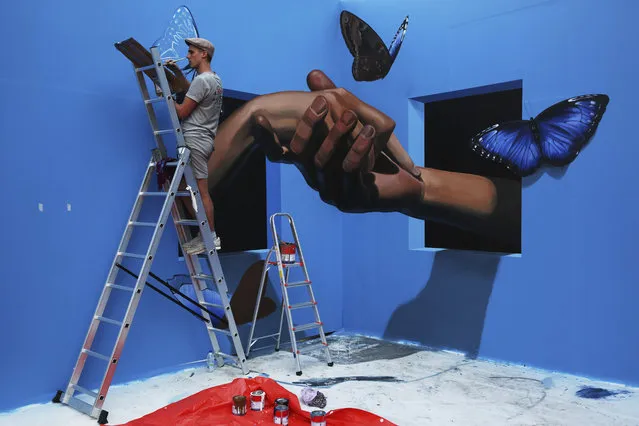
Danila Shmelev, an artist from Moscow, Russia, works on a 3-D picture in Dubai, United Arab Emirates, Monday, February 27, 2017. Artists who focus on 3-D pictures have gathered in Dubai for the Dubai Canvas 3-D Art Festival, which runs from March 1 through March 7. (Photo by Jon Gambrell/AP Photo)

Danila Shmelev, an artist from Moscow, Russia, works on a 3-D picture in Dubai, United Arab Emirates, Monday, February 27, 2017. Artists who focus on 3-D pictures have gathered in Dubai for the Dubai Canvas 3-D Art Festival, which runs from March 1 through March 7. (Photo by Jon Gambrell/AP Photo)
Details
28 Feb 2017 11:18:00
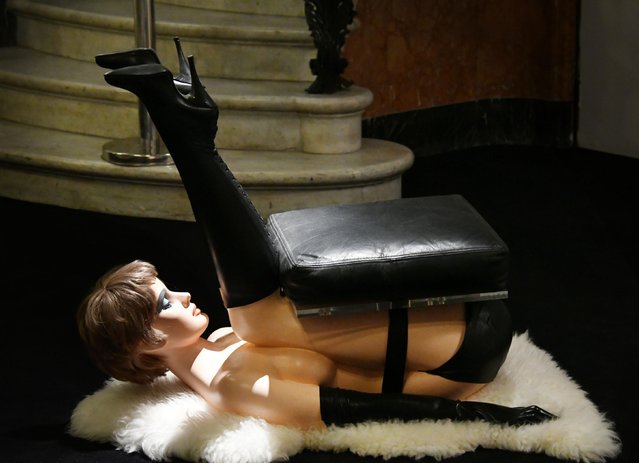
Furniture design “Chair” by Allen Jones ( £600,000-800,000) is seen at Christie's London on September 29, 2017 in London, England. Christie's Auction House is to sell millions of pounds worth of art and design from the 20th and 21st centuries during Frieze Week from October 3rd to October 7th. (Photo by Nils Jorgensen/Rex Features/Shutterstock)

Furniture design “Chair” by Allen Jones ( £600,000-800,000) is seen at Christie's London on September 29, 2017 in London, England. Christie's Auction House is to sell millions of pounds worth of art and design from the 20th and 21st centuries during Frieze Week from October 3rd to October 7th. (Photo by Nils Jorgensen/Rex Features/Shutterstock)
Details
30 Sep 2017 06:23:00
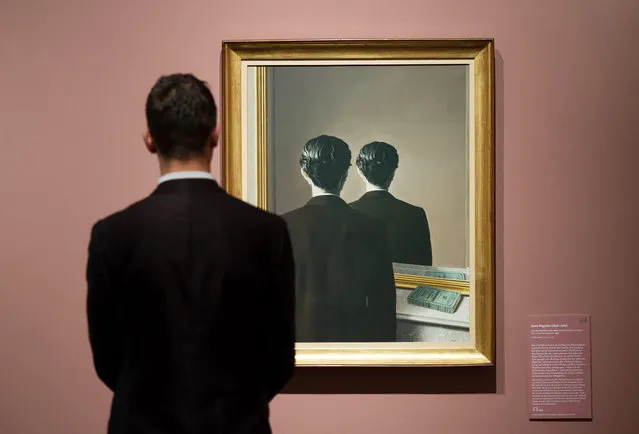
In this October 5, 2016 photo a man looks at the work “Not to be Reproduced” by Rene Magritte at the Kunsthalle art gallery in Hamburg, Germany. The exhibition, which runs from Oct. 7,  2016 until Jan. 22,  2017, features more than 150 masterpieces of surrealism from four of the most significant European private collections of the 20th century. (Photo by Daniel Reinhardt/DPA via AP Photo)

In this October 5, 2016 photo a man looks at the work “Not to be Reproduced” by Rene Magritte at the Kunsthalle art gallery in Hamburg, Germany. The exhibition, which runs from Oct. 7, 2016 until Jan. 22, 2017, features more than 150 masterpieces of surrealism from four of the most significant European private collections of the 20th century. (Photo by Daniel Reinhardt/DPA via AP Photo)
Details
07 Oct 2016 10:29:00
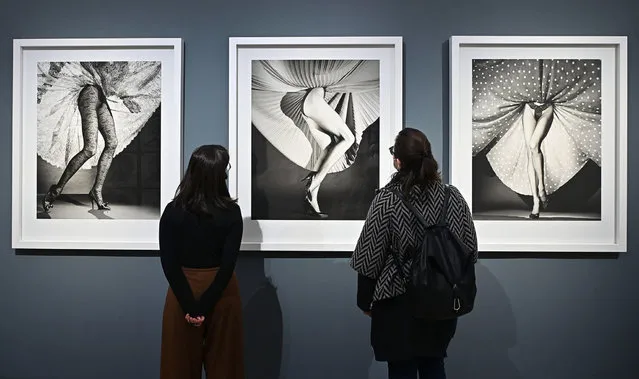
Visitors look at photographs in the exhibition “Lisette Model Street Life e Horst P. Horst Syle and Glamour” at the art gallery “Camera – Centro Italiano per la fotografia” in Turin, Italy, 27 April 2021. Culture venues reopened to the public as several Italian region are back to COVID-19 yellow zone in the country's tier system. (Photo by Alessandro di Marco/EPA/EFE)

Visitors look at photographs in the exhibition “Lisette Model Street Life e Horst P. Horst Syle and Glamour” at the art gallery “Camera – Centro Italiano per la fotografia” in Turin, Italy, 27 April 2021. Culture venues reopened to the public as several Italian region are back to COVID-19 yellow zone in the country's tier system. (Photo by Alessandro di Marco/EPA/EFE)
Details
28 Apr 2021 09:11:00
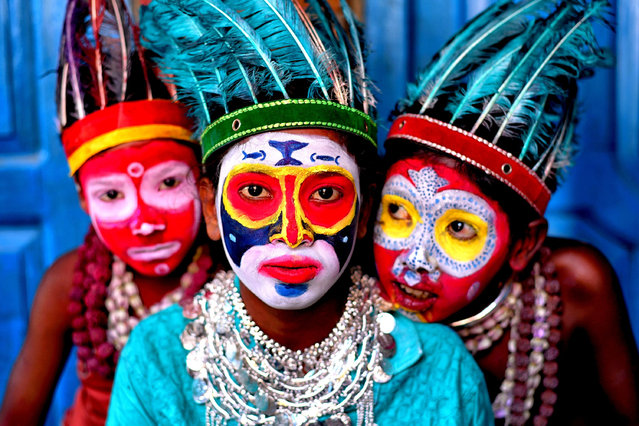
Children with painted faces in the art of the bahurupi tradition in Bardhaman, India on April 24, 2021. Impersonators family where their generations are engaged in making face painting and can easily metamorphose into different characters during a performance, as per different Traditional & Tribal myth which is the main earning source for their family. (Photo by  Avishek Das/SOPA Images/Rex Features/Shutterstock)

Children with painted faces in the art of the bahurupi tradition in Bardhaman, India on April 24, 2021. Impersonators family where their generations are engaged in making face painting and can easily metamorphose into different characters during a performance, as per different Traditional & Tribal myth which is the main earning source for their family. (Photo by Avishek Das/SOPA Images/Rex Features/Shutterstock)
Details
03 May 2021 09:14:00
In this April 18, 2019 photo, tattoo artist Lalo Calva inks a tattoo on client Adrian Alonso Rodriguez, a journalist, announcer and dubbing artist, at the Corona Tattoo parlor in Mexico City. Not only inks and techniques have changed in Mexico over the years, but tattoos themselves have evolved from stigmatized symbols of gangs, violence and poverty to an art form. (Photo by Marco Ugarte/AP Photo)

In this April 18, 2019 photo, tattoo artist Lalo Calva inks a tattoo on client Adrian Alonso Rodriguez, a journalist, announcer and dubbing artist, at the Corona Tattoo parlor in Mexico City. Not only inks and techniques have changed in Mexico over the years, but tattoos themselves have evolved from stigmatized symbols of gangs, violence and poverty to an art form. (Photo by Marco Ugarte/AP Photo)
Details
14 Jul 2019 00:01:00
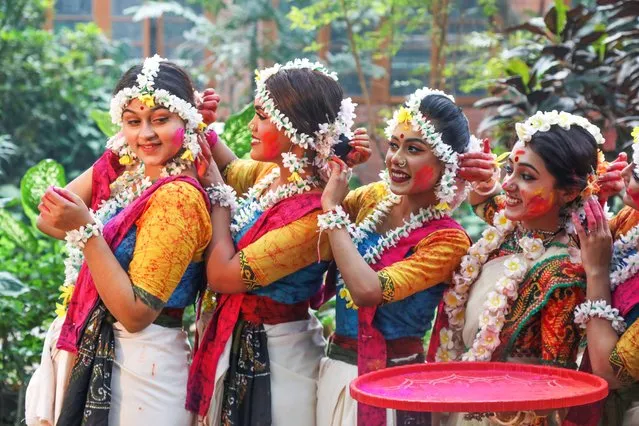
Bangladeshi artists wear floral attire as they join celebrations of the spring festival “Basanta Utsav” at the Faculty of Fine Arts of the University of Dhaka, in Bangladesh, 14 February 2024. The Bashanta Utshab, or Spring Festival, is a local traditional festival which marks the beginning of the Spring Season while young people also celebrate it along with Valentine's Day. (Photo by Monirul Alam/EPA/EFE)

Bangladeshi artists wear floral attire as they join celebrations of the spring festival “Basanta Utsav” at the Faculty of Fine Arts of the University of Dhaka, in Bangladesh, 14 February 2024. The Bashanta Utshab, or Spring Festival, is a local traditional festival which marks the beginning of the Spring Season while young people also celebrate it along with Valentine's Day. (Photo by Monirul Alam/EPA/EFE)
Details
05 Mar 2024 08:10:00


“The Trabant is a car that was produced by former East German auto maker VEB Sachsenring Automobilwerke Zwickau in Zwickau, Sachsen. It was the most common vehicle in East Germany, and was also exported to countries both inside and outside the communist bloc. The main selling points was that it had room for four adults and luggage in a compact, light and durable shell and that it was fast (when introduced) and durable. With its mediocre performance, smoky two-stroke engine, and production shortages, the Trabant is often cited as an example of the disadvantages of centralized planning; on the other hand, it is regarded with derisive affection as a symbol of the failed former East Germany and of the fall of communism (in former West Germany, as many East Germans streamed into West Berlin and West Germany in their Trabants after the opening of the Berlin Wall in 1989). It was in production without any significant changes for nearly 30 years with 3,096,099 Trabants produced in total”. – Wikipedia

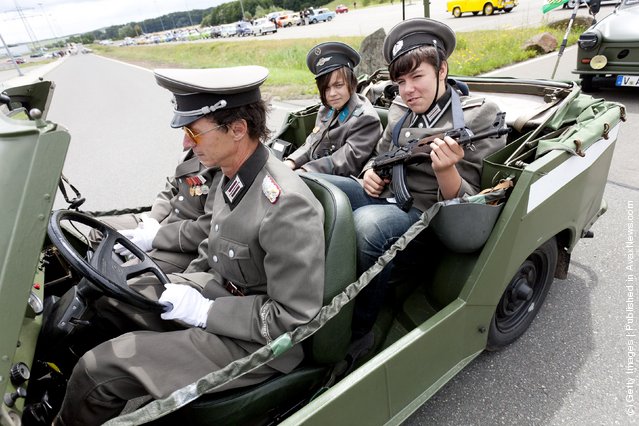
Photo: Enthusiasts weared in uniforms of the former eastern german army trive in a military Trabant car as fans and owners of East German-era Trabant cars gather at the 2011 International Trabantfahrer Treffen (International Trabant Drivers Meeting) on June 26, 2011 in Zwickau, Germany. The Trabant, also known as the Trabi, was among the main cars produced in communist East Germany and built by VEB Sachsenring Automobilwerke in Zwickau for 30 years until 1989. Today the car has cult status for many followers and one company, IndiKar, is even seeking to revive the brand in a modern, electric version. (Photo by Carsten Koall/Getty Images)

Details
27 Jun 2011 12:21:00