Loading...
Done
A terminally ill patient raises his arm in a hospice for those dying of AIDS at the Buddhist temple Wat Prabat Nampu in Lopburi province, north of Bangkok November 30, 2014. From 1992, the temple has provided housing for HIV positive patients and palliative care for those in the final stages of the AIDS disease. (Photo by Damir Sagolj/Reuters)

A terminally ill patient raises his arm in a hospice for those dying of AIDS at the Buddhist temple Wat Prabat Nampu in Lopburi province, north of Bangkok November 30, 2014. From 1992, the temple has provided housing for HIV positive patients and palliative care for those in the final stages of the AIDS disease. Data from 2013 estimates Thailand has 450,000 people living with HIV/AIDS, but only 353,000 have access to life-saving antiretroviral drugs. (Photo by Damir Sagolj/Reuters)
Details
08 Dec 2014 11:52:00
Plagued by Doubt By Thomas Wightman

Thoughts. They fly through the broad expenses of our mind, floating gracefully in midair, going into the clouds, and then reemerging once again. Some are quick and furtive, others are grand and majestic. We reflect upon them as they enter our minds, and once they leave, they are usually gone for good. However, some thoughts are different. These thoughts resemble a flock of angry birds or a swarm of hungry moths that invade your mind, slowly eating away at your sanity, strength, and desire to live. Such thoughts often plague that minds of people with Obsessive Compulsive disorder. They completely occupy their time; constantly there; ever-present. With his book sculpture, Thomas Wightman was able to accurately convey the way these thoughts consume the mind, slowly building a nest within it, resisting all attempts to drive them away.

Thomas Wightman


See Also: Derailing My Train of Thought
Details
19 Mar 2015 09:11:00
Hong Kong Shop Cats #17. Marcel Heijnen returned to Hong Kong in 2015 and found himself living without a cat for the first time in decades. Soon, though, he was indulging in what he calls “re-tail therapy” and found himself on a first-name basis with a number of cats in his neighbourhood, Sai Ying Pun. (Photo by Marcel Heijnen/Blue Lotus)

When Dutch photographer Marcel Heijnen moved to Hong Kong, the territory’s shop cats instantly caught his eye. While the “feline emperors” are the stars, his shots also offer insights into Hong Kong’s wares, from dried fish to paper. Here: Hong Kong Shop Cats #17. (Photo by Marcel Heijnen/Blue Lotus)
Details
03 Jan 2017 11:04:00
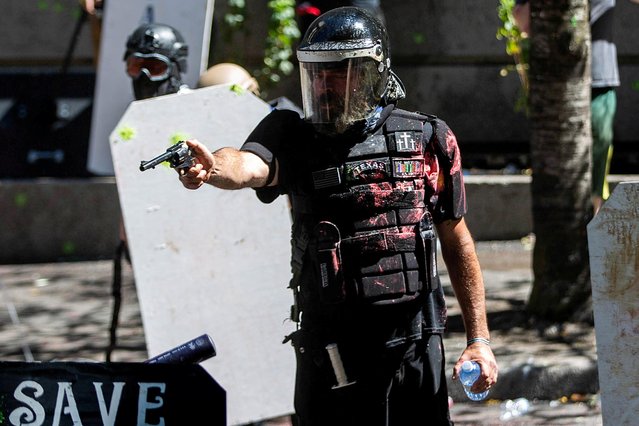
Alan Swinney points a gun during clashes between groups like Proud Boys and Patriot Prayer, and protesters against police brutality and racial injustice in Portland, Oregon, U.S., August 22, 2020. (Photo by Maranie Staab/Reuters)

Alan Swinney points a gun during clashes between groups like Proud Boys and Patriot Prayer, and protesters against police brutality and racial injustice in Portland, Oregon, U.S., August 22, 2020. (Photo by Maranie Staab/Reuters)
Details
30 Aug 2020 00:01:00
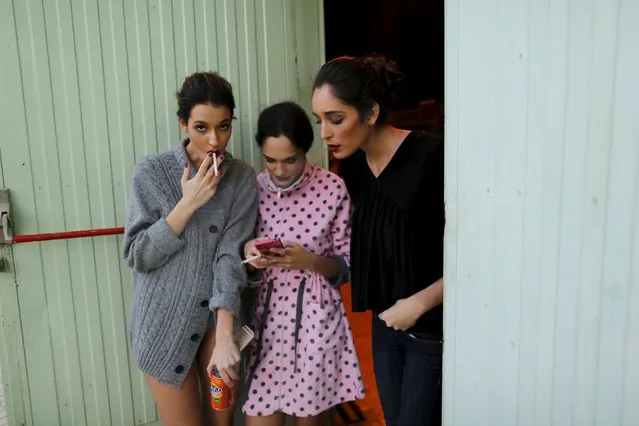
Models smoke during a break at Sevilla de Boda (Seville Wedding) fashion show in the Andalusian capital of Seville November 27, 2015. (Photo by Marcelo del Pozo/Reuters)

Models smoke during a break at Sevilla de Boda (Seville Wedding) fashion show in the Andalusian capital of Seville November 27, 2015. (Photo by Marcelo del Pozo/Reuters)
Details
29 Nov 2015 10:01:00
In this August 17, 2016, photo, from left to right, Chhering Chodom, 60, Tashi Yangzom, 50, Lobsang Chhering, 27, and Dorje Tandup, 58, drink milk tea on the side of the road. For centuries, the sleepy valley nestled in the Indian Himalayas remained a hidden Buddhist enclave forbidden to outsiders. Enduring the harsh year-round conditions of the high mountain desert, the people of Spiti Valley lived by a simple communal code – share the Earth's bounty, be hospitable to neighbors, and eschew greed and temptation at all turns. That's all starting to change, for better or worse. Since India began allowing its own citizens as well as outsiders to visit the valley in the early 1990s, tourism and trade have boomed. And the marks of modernization, such as solar panels, asphalt roads and concrete buildings, have begun to appear around some of the villages that dot the remote landscape at altitudes above 4,000 meters (13,000 feet). (Photo by Thomas Cytrynowicz/AP Photo)

In this August 17, 2016, photo, from left to right, Chhering Chodom, 60, Tashi Yangzom, 50, Lobsang Chhering, 27, and Dorje Tandup, 58, drink milk tea on the side of the road. For centuries, the sleepy valley nestled in the Indian Himalayas remained a hidden Buddhist enclave forbidden to outsiders. Enduring the harsh year-round conditions of the high mountain desert, the people of Spiti Valley lived by a simple communal code – share the Earth's bounty, be hospitable to neighbors, and eschew greed and temptation at all turns. That's all starting to change, for better or worse. (Photo by Thomas Cytrynowicz/AP Photo)
Details
15 Sep 2016 09:22:00
More than 6 billion people live in countries where serious levels of public sector corruption are fueling inequality and exploitation, according to Transparency International's 2015 index of perceived public sector corruption. The group's annual report measures perceptions of corruption due to the secrecy surrounding most corrupt dealings. Two thirds of the 168 countries assessed were identified as having a serious corruption problem. Somalia, which has been mired in conflict since civil war broke out in 1991, ranks bottom of the list. (Photo by Feisal Omar/Reuters)

More than 6 billion people live in countries where serious levels of public sector corruption are fueling inequality and exploitation, according to Transparency International's 2015 index of perceived public sector corruption. The group's annual report measures perceptions of corruption due to the secrecy surrounding most corrupt dealings. Two thirds of the 168 countries assessed were identified as having a serious corruption problem. Somalia, which has been mired in conflict since civil war broke out in 1991, ranks bottom of the list. (Photo by Feisal Omar/Reuters)
Details
13 May 2016 12:10:00
Garbage pickers collect ride on donkey cart while looking for recyclable materials at a rubbish dump in the outskirts of Baghdad, Iraq, August 23, 2016. Despite its huge untapped oil and gas reserves and steadily rising oil output and revenue, 23 percent of the population live below the poverty line, according to the Ministry of Planning. Eg, for 12-year-old Mohammed, life in Sadr City means long days during his school holidays scrabbling through the refuse in the scorching summer heat before selling his daily haul to a middleman. He sells each kilogram (2.2 lb) of plastic bottles or soda cans for 250 Iraqi dinars (around 20 U.S. cents), earning between 2,000 to 4,000 dinars ($1.50–$3) a day. A International Labor Organization report listing dangerous jobs in which children are engaged across the world mentioned collecting garbage as one of the activities in which minors risked suffering violence and injury. (Photo by Khalid al Mousily/Reuters)

Garbage pickers collect ride on donkey cart while looking for recyclable materials at a rubbish dump in the outskirts of Baghdad, Iraq, August 23, 2016. Despite its huge untapped oil and gas reserves and steadily rising oil output and revenue, 23 percent of the population live below the poverty line, according to the Ministry of Planning. (Photo by Khalid al Mousily/Reuters)
Details
24 Aug 2016 11:52:00