Loading...
Done
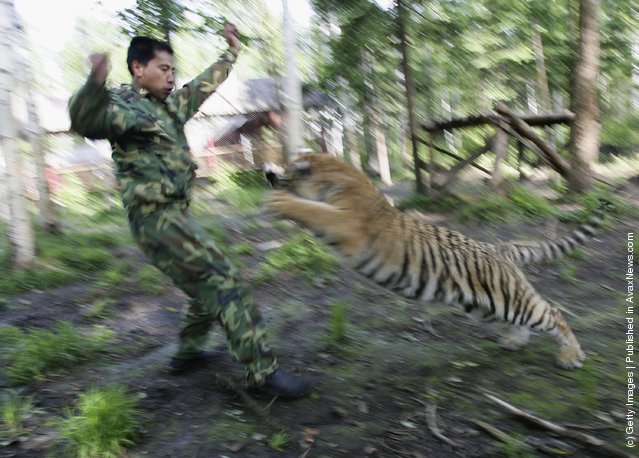
A feeder trains a Siberian tiger cub

A feeder trains a Siberian tiger cub at Erdaohe Tiger Park July 2, 2006 in Antu County of Yanbian Chaoxian Autonomous Prefecture, Jilin Province, China. About 15 artificially-fed Siberian tigers from Harbin Siberian Tiger Park are being trained to develop their ability to live in the wild. The wild Siberian tiger is listed as one of the most endangered species in the world, with its existing number estimated at around 400 worldwide, mainly in the northeastern part of China and the Far East of Russia. Reportedly there are more than 1,300 Siberian tigers which have been raised in China. (Photo by China Photos/Getty Images)
Details
01 Oct 2011 12:23:00
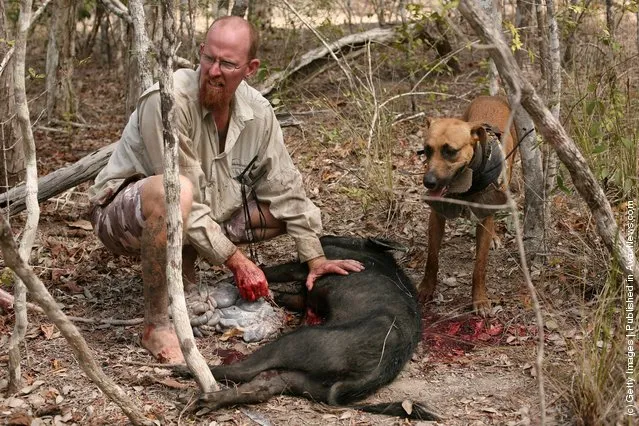
Cooktown Hog Hunt

Tom Nevins guts a feral pig sow during hunting on Silver Plains Station on October 8, 2011 outside of Coen, Australia. Feral pigs are recognised as environmental and agricultural pests reported to have a population of up to 23.5 million over around half of Australia. The Cooktown Hog Hunt is held annually with this year's hunting window open from registration at 2pm on Friday to the end of weigh in at 2pm on Sunday afternoon. (Photo by Mark Kolbe/Getty Images)
Details
12 Oct 2011 11:30:00
Models of Cold War-era Allied (L) and Soviet Bloc weaponry

Models of Cold War-era Allied (L) and Soviet Bloc weaponry face one another at the new Bundeswehr Military History Museum (Militaerhistorisches Museum der Bundeswehr, or MHM) on October 11, 2011 in Dresden, Germany. The museum, redesigned by star architect Daniel Libeskind, traces Germany military history from 1300 to the present, including during the Nazi period and the Cold War, and also examines the influence of the military on popular culture. (Photo by Sean Gallup/Getty Images)
Details
12 Oct 2011 11:55:00
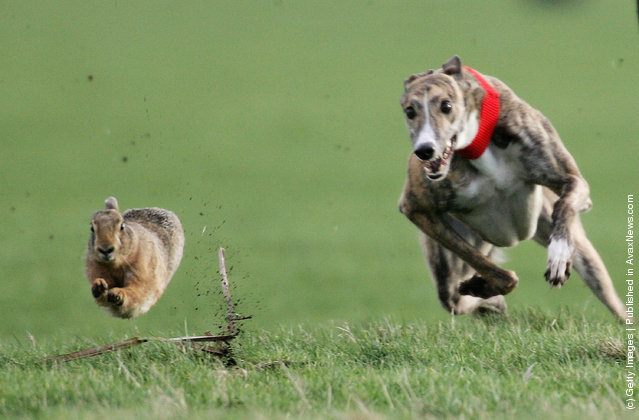
Greyhounds race after a Hare at the last Waterloo Cup Hare coursing event

“The Waterloo Cup was a coursing event. The three day event was run annually at Great Altcar in Lancashire, England from 1836 to 2005 and it used to attract tens of thousands of spectators to watch and gamble on the coursing matches. It was founded by William Philip Molyneux, 2nd Earl of Sefton, and, originally, was supported by his patronage”. – Wikipedia

Photo: A Greyhound races after Hare at the last Waterloo Cup Hare coursing event, February 14, 2005, near Liverpool, England. (Photo by Christopher Furlong/Getty Images)
Details
18 Feb 2012 11:26:00
Amazing Art By Apofiss

hello! finally I got together all my energy leftovers from the day to write a journal entry... and stright to the point about commission works, yup those are still CLOSED. at this point I'm trying to take more time just to draw and paint for myself ( just like in childhood times haha ). whenever I will feel like opening more personal commission work slots I will definitely let you all know ( just in case I must warn about a little price rise, yup o; ). sooner or later I will open few slots this year!
Apofiss
Details
27 Aug 2013 14:07:00
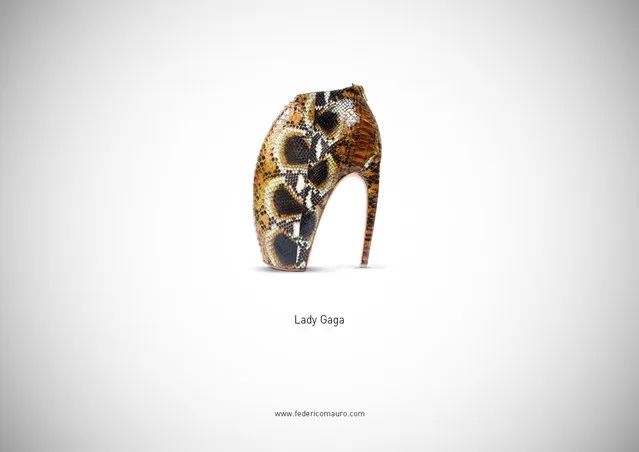
Famous Footwear By Federico Mauro

Ialian artist Federico Mauro latest series takes a look at iconic footwear, and its symbolic representation of the people who wore them. With everything from Steve Jobs’ New Balance 991‘s to the Nike Air Mags sported by Marty McFly in Back to the Future II on show, the minimalist series shows how closely one’s identity can be linked to a single shoe.

See also: Famous Eyeglasses By Federico Mauro / Famous Guns By Federico Mauro
Details
02 Sep 2013 11:50:00
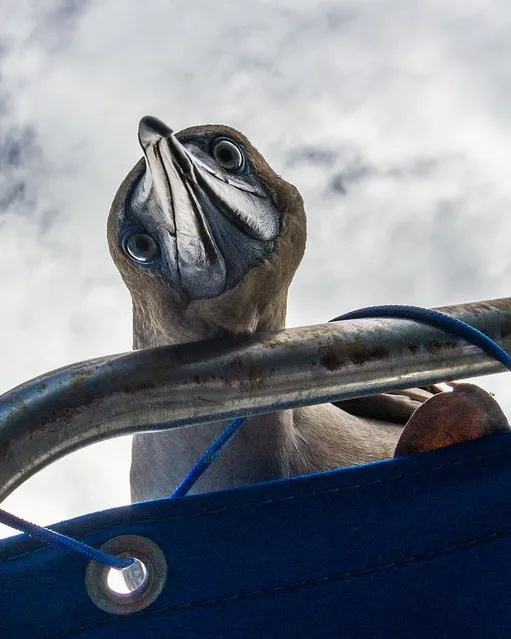
“Close-up. We had a juvenile Red-Footed Booby come visit us on the sun deck. I got some closeups with my ultrawide 11-16mm Tokina”. (Photo by Carl Fredrickson)

Situated in the Pacific Ocean some 620 miles (1,000 km) from the South American continent, these 19 islands and the surrounding marine reserve have been called a unique “living museum and showcase of evolution”. Photo: “Close-up. We had a juvenile Red-Footed Booby come visit us on the sun deck. I got some closeups with my ultrawide 11-16mm Tokina”. (Photo by Carl Fredrickson)
Details
04 Sep 2013 11:49:00
Tim Laman - Wildlife Photojournalist

Tim Laman is a field biologist and wildlife photojournalist. His pioneering research in the rain forest canopy in Borneo led to a PhD from Harvard and his first National Geographic article in 1997. Since then, he has pursued his passion for exploring wild places and documenting little-known and endangered wildlife by becoming a regular contributor to National Geographic. He has eighteen articles to his credit to date, all of which have had a conservation message. Some have focused on endangered species such as Orangutans or Hornbills, while others, such as a series of articles on Conservation International’s Biodiversity Hotspots, have highlighted regions under intense pressure.
Details
14 Sep 2013 10:13:00