Loading...
Done
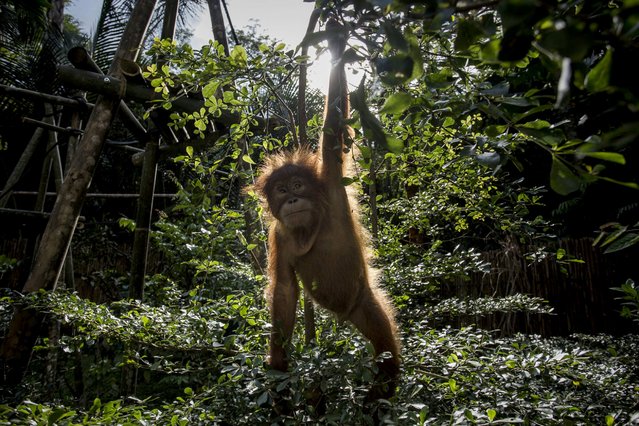
A Baby sumatran orangutan (Pongo abelii) plays around in a tree as they train at Sumatran Orangutan Conservation Programme's rehabilitation center on November 12, 2016 in Kuta Mbelin, North Sumatra, Indonesia. The Orangutans in Indonesia have been known to be on the verge of extinction as a result of deforestation and poaching. Found mostly in South-East Asia, where they live on the islands of Sumatra and Borneo, the endangered species continue to lose their habitat as a result of corporate expansion in a developing economy. Indonesia approved palm oil concessions on nearly 15 million acres of peatlands over the past years and thousands of square miles have been cleared for plantations, including the lowland areas that are the prime habitat for orangutans. (Photo by Ulet Ifansasti/Getty Images)

A Baby sumatran orangutan (Pongo abelii) plays around in a tree as they train at Sumatran Orangutan Conservation Programme's rehabilitation center on November 12, 2016 in Kuta Mbelin, North Sumatra, Indonesia. The Orangutans in Indonesia have been known to be on the verge of extinction as a result of deforestation and poaching. Found mostly in South-East Asia, where they live on the islands of Sumatra and Borneo, the endangered species continue to lose their habitat as a result of corporate expansion in a developing economy. Indonesia approved palm oil concessions on nearly 15 million acres of peatlands over the past years and thousands of square miles have been cleared for plantations, including the lowland areas that are the prime habitat for orangutans. (Photo by Ulet Ifansasti/Getty Images)
Details
16 Nov 2016 11:14:00
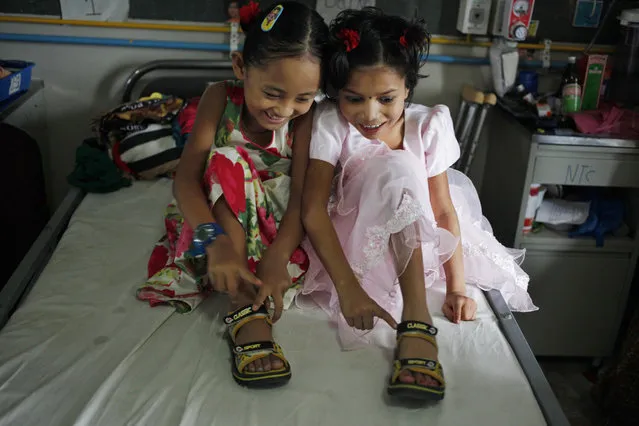
In this July 15, 2015 photo, Nepalese amputee victims Khendo Tamang, left, and Nirmala Pariyar, both 8, share a single pair of shoes at the Bir Trauma Center in Kathmandu, Nepal. After suffering serious leg wounds in Nepal's massive 2015 earthquake that killed and injured thousands, both girls were brought to the Bir Trauma Center in Kathmandu, to receive single leg amputations. Following their surgeries, Nirmala's relentless cheerfulness drew a still very depressed Khendo close and both found an inseparable friendship which has helped their emotional wounds heal. (Photo by Niranjan Shrestha/AP Photo)

In this July 15, 2015 photo, Nepalese amputee victims Khendo Tamang, left, and Nirmala Pariyar, both 8, share a single pair of shoes at the Bir Trauma Center in Kathmandu, Nepal. After suffering serious leg wounds in Nepal's massive 2015 earthquake that killed and injured thousands, both girls were brought to the Bir Trauma Center in Kathmandu, to receive single leg amputations. Following their surgeries, Nirmala's relentless cheerfulness drew a still very depressed Khendo close and both found an inseparable friendship which has helped their emotional wounds heal. (Photo by Niranjan Shrestha/AP Photo)
Details
23 Apr 2016 13:48:00
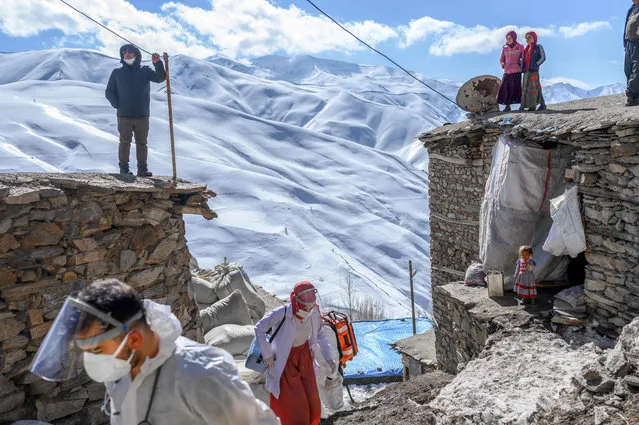
In this photograph taken on February 15, 2021, doctor Sergen Saracoglu (L) and nurse Yilzdiz Ayten (C) from the Bahcesaray public hospital vaccination team, arrive at the village of Guneyyamac in eastern Turkey, as part of an expedition to vaccinate residents of 65 years old or above with Sinovac's CoronaVac Covid-19 vaccine. Turkey's population of more than 83 million is spread out across Europe and Asia and covers some seemingly impregnable terrain. The vaccination effort with China's CoronaVac jab kicked off with a bang in mid-January when Turkey inoculated more than half a million people in the first few days. But it slowed down considerably when doctors left the big cities and tried to reach remote places such as Imamli and Ozbeyli – two ethnically Kurdish hamlets of a few hundred herders and farmers each. (Photo by Bulent Kilic/AFP Photo)

In this photograph taken on February 15, 2021, doctor Sergen Saracoglu (L) and nurse Yilzdiz Ayten (C) from the Bahcesaray public hospital vaccination team, arrive at the village of Guneyyamac in eastern Turkey, as part of an expedition to vaccinate residents of 65 years old or above with Sinovac's CoronaVac Covid-19 vaccine. (Photo by Bulent Kilic/AFP Photo)
Details
18 Mar 2021 09:32:00
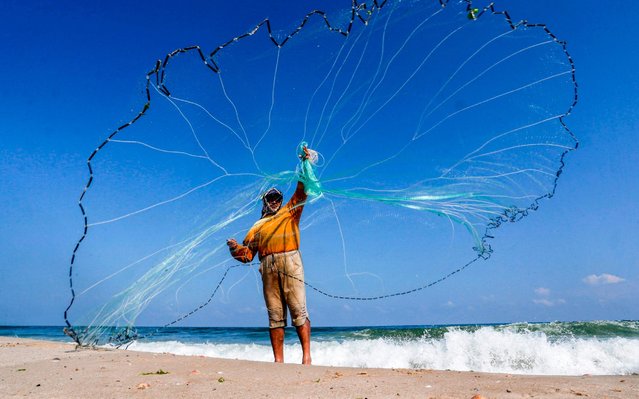
A Palestinian fisherman casts his net as he stands along the beach in Khan Yunis in the southern Gaza Strip on June 14, 2019. The Israeli government said late on June 12 that the fishing zone off the coast of Gaza had been closed, in retaliation for the launch of incendiary balloons from the Palestinian enclave. The move came after COGAT said on Tuesday it had reduced the extent of the fishing zone to six nautical miles offshore from 10 nautical miles, having downscaled it from 15 nautical miles a week ago. (Photo by Said Khatib/AFP Photo)

A Palestinian fisherman casts his net as he stands along the beach in Khan Yunis in the southern Gaza Strip on June 14, 2019. The Israeli government said late on June 12 that the fishing zone off the coast of Gaza had been closed, in retaliation for the launch of incendiary balloons from the Palestinian enclave. The move came after COGAT said on Tuesday it had reduced the extent of the fishing zone to six nautical miles offshore from 10 nautical miles, having downscaled it from 15 nautical miles a week ago. (Photo by Said Khatib/AFP Photo)
Details
12 Jul 2019 00:01:00
“Seven Magic Points”. The rusty red swirls of the circular, iron sculpture Seven Magic Points in Brattebergan, Norway mirror the rippling aurora above. (Photo by Rune Engebø/Royal Observatory Greenwich’s Astronomy Photographer of the Year 2016/National Maritime Museum)

Gorgeous galaxies and stunning stars make up this selection of pictures from the shortlisted entries for this year’s Insight Astronomy Photographer of the Year award. The winners will be announced on 15 September, and an exhibition of the winning images will be will be displayed in a free exhibition at the Royal Observatory Greenwich’s Astronomy Centre from 17 September. Here: “Seven Magic Points”. The rusty red swirls of the circular, iron sculpture Seven Magic Points in Brattebergan, Norway mirror the rippling aurora above. (Photo by Rune Engebø/Royal Observatory Greenwich’s Astronomy Photographer of the Year 2016/National Maritime Museum)
Details
28 Jul 2016 13:51:00
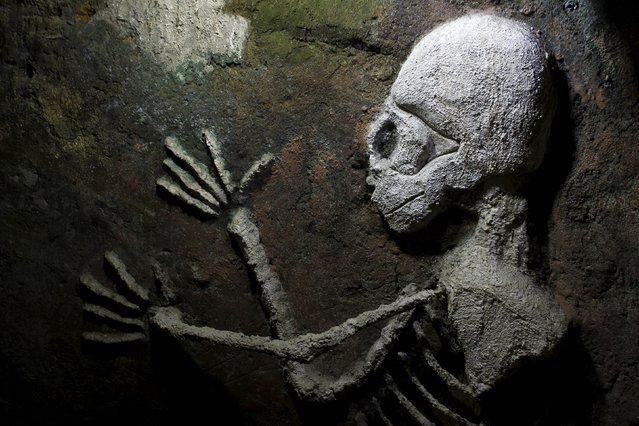
A figure of a skeleton is seen painted in a hallway of the house built underground by Manuel Barrantes in San Isidro de Perez Zeledon, Costa Rica, March 14, 2016. (Photo by Juan Carlos Ulate/Reuters)

A figure of a skeleton is seen painted in a hallway of the house built underground by Manuel Barrantes in San Isidro de Perez Zeledon, Costa Rica, March 14, 2016. Barrantes started digging through red soil and volcanic rock on his farm 12 years ago to build his subterranean house, between 15 and 63 feet (4.57 and 19.2m) underground. The dwelling, which Barrantes says provides a peaceful and comfortable home for him and his family away from noise pollution and the effects of climate change, now covers about 2,000 square feet (185.8 square metres). (Photo by Juan Carlos Ulate/Reuters)
Details
17 Mar 2016 15:34:00
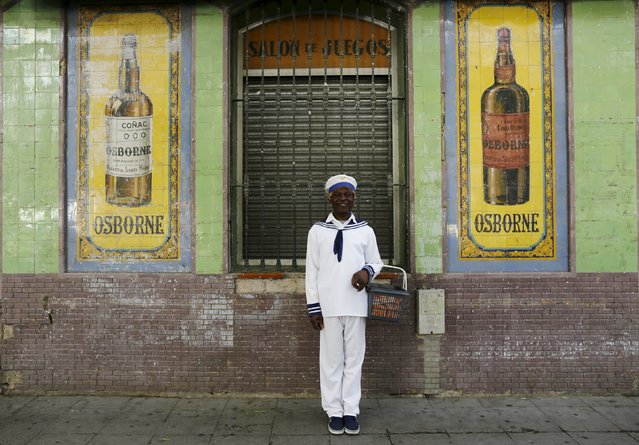
Howard Jackson, a Liberian migrant, poses for a portrait in the Andalusian capital of Seville, southern Spain March 7, 2016. (Photo by Marcelo del Pozo/Reuters)

Howard Jackson, a Liberian migrant, poses for a portrait in the Andalusian capital of Seville, southern Spain March 7, 2016. Jackson escaped civil war and spent three years crossing Africa before reaching Spain. Dressed up in one of his more than 200 costumes, from Peter Pan to Little Red Riding Hood, he is a well-known figure at an intersection entering the Spanish city of Seville where he has sold tissues to motorists for over a decade. Jackson is studying law and wants to become a judge. (Photo by Marcelo del Pozo/Reuters)
Details
24 Mar 2016 12:14:00
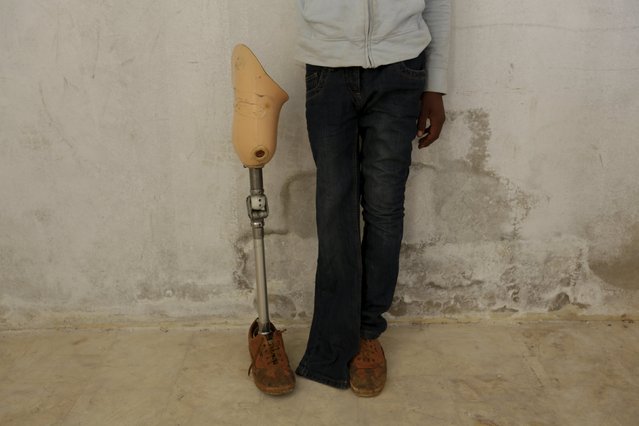
A young man with an amputated leg poses for a photograph standing by his broken artificial limb in the rebel-controlled area of Maaret al-Numan town in Idlib province, Syria March 20, 2016. (Photo by Khalil Ashawi/Reuters)

A young man with an amputated leg poses for a photograph standing by his broken artificial limb in the rebel-controlled area of Maaret al-Numan town in Idlib province, Syria March 20, 2016. Two university students forced to interrupt their studies have learnt to make and fit hundreds of new limbs in the past four years in opposition-held areas of Syria. A mobile clinic operating from a truck has gone some way to improve access to treatment. While most patients are between 15 and 45, the clinic also helps children and the elderly with replacement limbs. (Photo by Khalil Ashawi/Reuters)
Details
16 Apr 2016 12:03:00