Loading...
Done
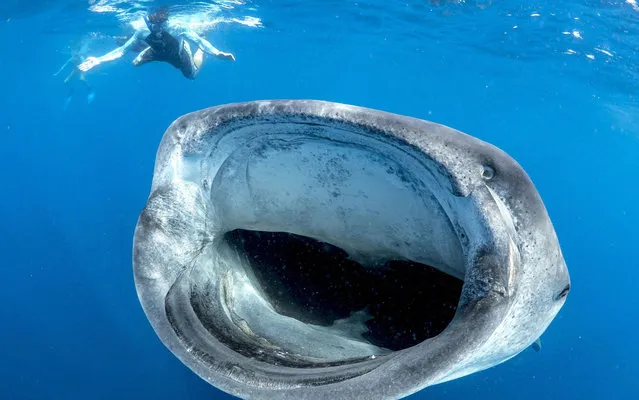
Marine biologist Simon Pierce, who studies whale sharks, happened to be in the right place at the right time to capture amazing photo off Cancun, Mexico. (Photo by Simon Pierce/Mercury Press/Caters News)

Marine biologist Simon Pierce, who studies whale sharks, happened to be in the right place at the right time to capture amazing photo off Cancun, Mexico. (Photo by Simon Pierce/Mercury Press/Caters News)
Details
09 Feb 2014 12:45:00
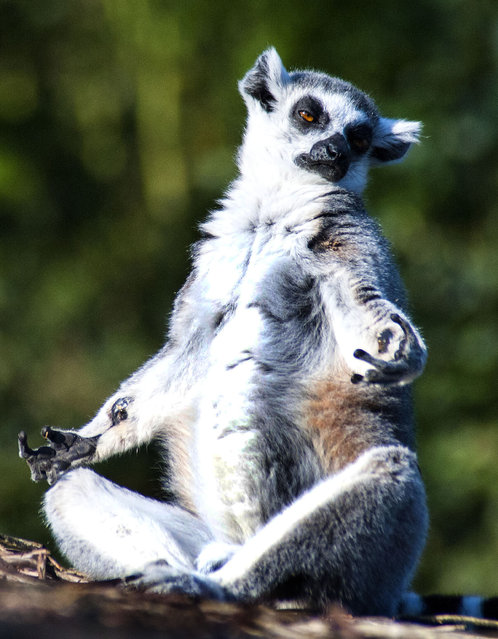
This lemur looks like he is channelling the spirit of Buddha – as he sits meditating. Sitting with his legs crossed, the lemur clasps his thumb and fore finger together with outstretched arms – just like the spiritual teacher. And amateur snapper Sebastien Degardin, 32, was on hand to capture the bizarre moment the animal searched for enlightenment on film. (Photo by Sebastien Degardin/Caters News)

This lemur looks like he is channelling the spirit of Buddha – as he sits meditating. Sitting with his legs crossed, the lemur clasps his thumb and fore finger together with outstretched arms – just like the spiritual teacher. And amateur snapper Sebastien Degardin, 32, was on hand to capture the bizarre moment the animal searched for enlightenment on film. Sebastien, who moved from his native Belgium to Finchley, North London, said: “I was gobsmacked when I saw this lemur meditating”. (Photo by Sebastien Degardin/Caters News)
Details
13 Apr 2014 10:18:00
An indigenous woman holds her child while trying to resist the advance of Amazonas state policemen who were expelling the woman and some 200 other members of the Landless Movement from a privately-owned tract of land on the outskirts of Manaus, in the heart of the Brazilian Amazon, in this March 11, 2008 file photo. (Photo by Luiz Vasconcelos-A Critica/Reuters/AE)

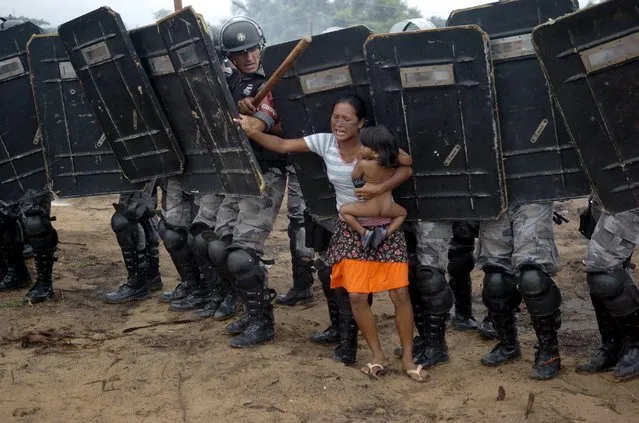
An indigenous woman holds her child while trying to resist the advance of Amazonas state policemen who were expelling the woman and some 200 other members of the Landless Movement from a privately-owned tract of land on the outskirts of Manaus, in the heart of the Brazilian Amazon, in this March 11, 2008 file photo. (Photo by Luiz Vasconcelos-A Critica/Reuters/AE)
Details
19 Apr 2015 09:09:00
Members of the media film as a ranger performs a post mortem on the carcass of a rhino after it was killed for its horn by poachers at the Kruger national park in Mpumalanga province August 27, 2014. Rhino poachers in South Africa now risk giving themselves away when they shoot thanks to a high-tech, gunfire-detection system being piloted in the country's flagship Kruger National Park. (Photo by Siphiwe Sibeko/Reuters)

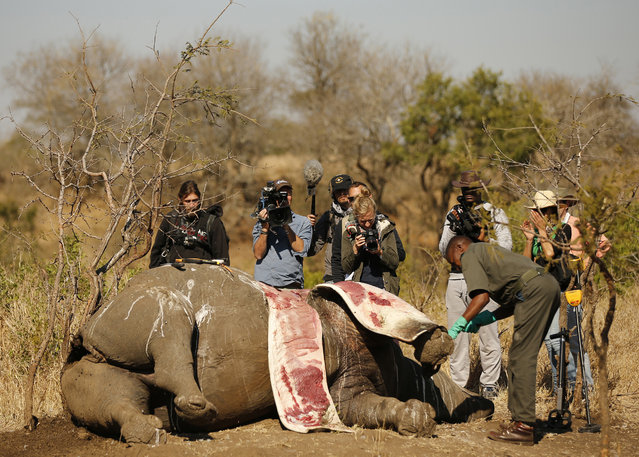
Members of the media film as a ranger performs a post mortem on the carcass of a rhino after it was killed for its horn by poachers at the Kruger national park in Mpumalanga province August 27, 2014. Rhino poachers in South Africa now risk giving themselves away when they shoot thanks to a high-tech, gunfire-detection system being piloted in the country's flagship Kruger National Park. The stakes are high, for rhinos are being slain in escalating numbers for their prized horns, alarming both conservationists and the government since wildlife in South Africa is an important tourist draw. (Photo by Siphiwe Sibeko/Reuters)
Details
07 Nov 2015 08:03:00
Selfie picture shows Swiss pioneer Bertrand Piccard during the last leg of the round the world trip with Solar Impulse 2 over the Arab peninsula July 25, 2016. (Photo by Jean Revillard/Bertrand Piccard/Reuters/SI2)

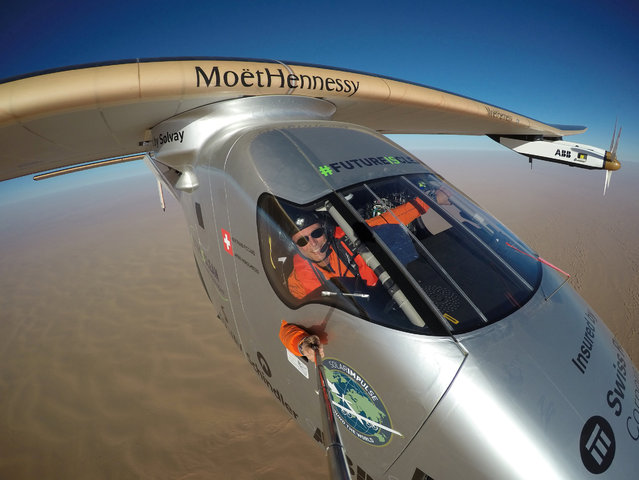
Selfie picture shows Swiss pioneer Bertrand Piccard during the last leg of the round the world trip with Solar Impulse 2 over the Arab peninsula July 25, 2016. (Photo by Jean Revillard/Bertrand Piccard/Reuters/SI2)
Details
27 Jul 2016 09:18:00
Biologist Kelly Martin records her measurements of Electra, a 5 1/2 foot leatherback turtle nesting on the beach behind the Seminole Golf Club course in Juno Beach. Martin uses a red light which is invisible to turtles. (Photo by Greg Lovett/The Palm Beach Post)

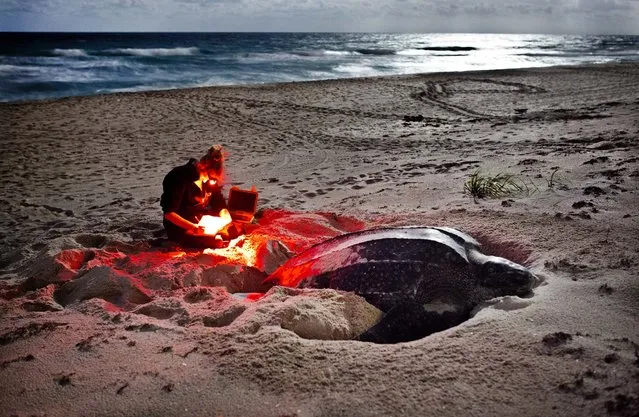
Biologist Kelly Martin records her measurements of Electra, a 5 1/2 foot leatherback turtle nesting on the beach behind the Seminole Golf Club course in Juno Beach. Martin uses a red light which is invisible to turtles. (Photo by Greg Lovett/The Palm Beach Post)
Details
04 Nov 2013 10:17:00
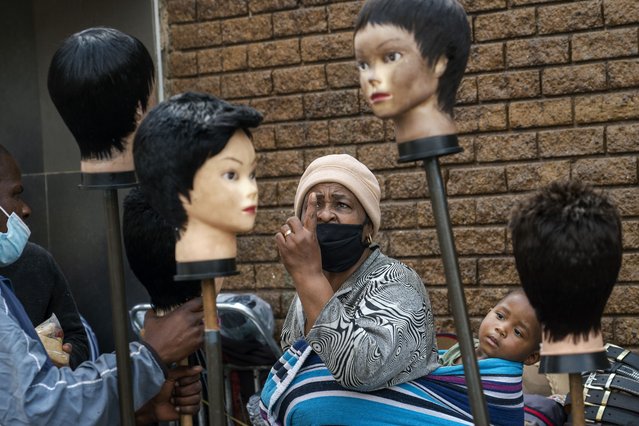
A woman carrying a child on her back looks at wigs on sale at the Baragwanath Taxi Rank in Soweto, South Africa, Wednesday, September 16, 2020. South African president Cyril Ramaphosa is scheduled to address the nation later in the day, as case numbers and death from COVID-19 hit the lowest in months. (Photo by Jerome Delay/AP Photo)

A woman carrying a child on her back looks at wigs on sale at the Baragwanath Taxi Rank in Soweto, South Africa, Wednesday, September 16, 2020. South African president Cyril Ramaphosa is scheduled to address the nation later in the day, as case numbers and death from COVID-19 hit the lowest in months. (Photo by Jerome Delay/AP Photo)
Details
24 Sep 2020 00:03:00
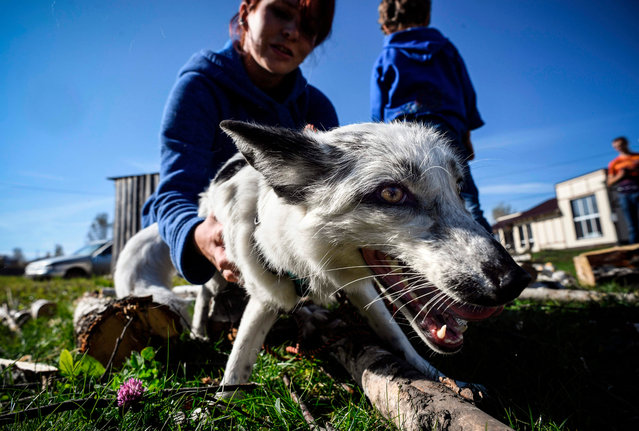
Tatyana Abramova, 33, plays with her home fox Plombir at her countryside house outside Siberian city of Novosibirsk on September 12, 2020. The official start of the Soviet experiment to better understand the domestication of animals by humans began in 1959, and was initiated by geneticists Dmitri Beliaiev and Lioudmila Trout on a farm in Akademgorodok, the scientific center of excellence in Siberia. Their primary objective was to domesticate foxes, to understand how the ancestor of wolves, another canine, evolved into a loyal and loving dog. And understand what this domestication tells us about the genetic evolution of species. (Photo by Alexander Nemenov/AFP Photo)

Tatyana Abramova, 33, plays with her home fox Plombir at her countryside house outside Siberian city of Novosibirsk on September 12, 2020. The official start of the Soviet experiment to better understand the domestication of animals by humans began in 1959, and was initiated by geneticists Dmitri Beliaiev and Lioudmila Trout on a farm in Akademgorodok, the scientific center of excellence in Siberia. Their primary objective was to domesticate foxes, to understand how the ancestor of wolves, another canine, evolved into a loyal and loving dog. And understand what this domestication tells us about the genetic evolution of species. (Photo by Alexander Nemenov/AFP Photo)
Details
25 Oct 2020 00:05:00