Loading...
Done
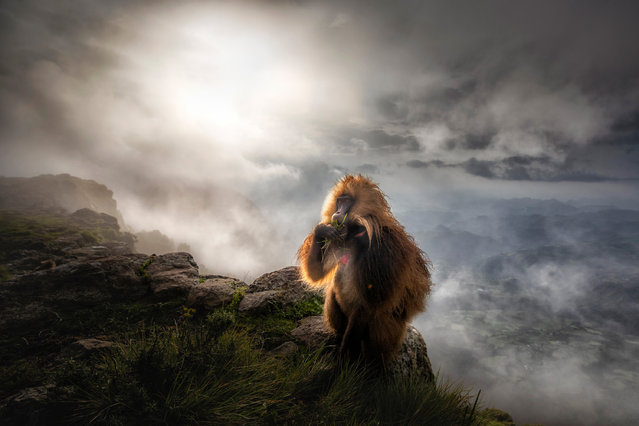
Highly commended, mammals: Gelada after the storm – Marco Gaiotti (Italy). “Gelada baboons are the only monkey species in the world that feed on grasses. They are native to the tableland of Ethiopia. Every morning large family groups wander from their sleeping places in the steep rock face, up to 1,000 metres high, to the feeding grounds at the tablelands. This image clearly depicts their feeding strategy: they pull out bunches of grass, sort the stalks and then lift them to their mouth. This shot was taken towards the end of the rainy season after a heavy storm”. (Photo by Marco Gaiotti/2019 GDT European Wildlife Photographer of the Year)

Highly commended, mammals: Gelada after the storm – Marco Gaiotti (Italy). “Gelada baboons are the only monkey species in the world that feed on grasses. They are native to the tableland of Ethiopia. Every morning large family groups wander from their sleeping places in the steep rock face, up to 1,000 metres high, to the feeding grounds at the tablelands. This image clearly depicts their feeding strategy: they pull out bunches of grass, sort the stalks and then lift them to their mouth. This shot was taken towards the end of the rainy season after a heavy storm”. (Photo by Marco Gaiotti/2019 GDT European Wildlife Photographer of the Year)
Details
31 Oct 2019 00:03:00
A knight parades in the street during the traditional carnival parade in Cologne, western Germany, Monday, February 16, 2015. (Photo by Martin Meissner/AP Photo)

A knight parades in the street during the traditional carnival parade in Cologne, western Germany, Monday, February 16, 2015. (Photo by Martin Meissner/AP Photo)
Details
17 Feb 2015 12:04:00
A woman smokes a mask bong on the final day of Hempfest, Seattle's annual gathering to promote the legalization of marijuana, on August 17, 2014. (Photo by Jordan Stead/Seattlepi.com)

A woman smokes a mask bong on the final day of Hempfest, Seattle's annual gathering to promote the legalization of marijuana, on August 17, 2014. (Photo by Jordan Stead/Seattlepi.com)
Details
23 Aug 2014 11:44:00
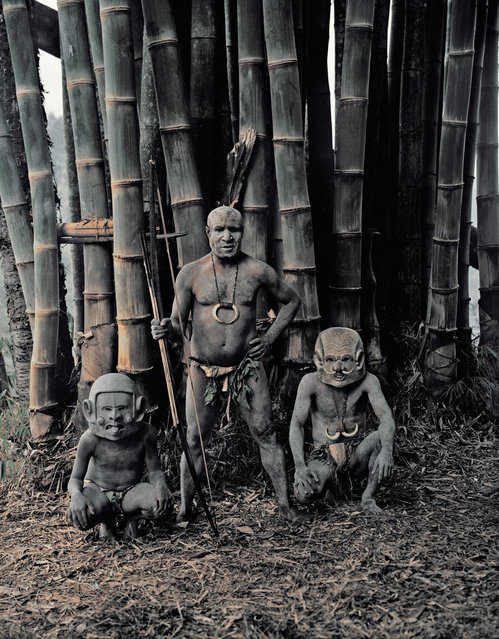
“Asaro from the Eastern Highlands”. The mudmen could not cover their faces with mud because the people of Papua New Guinea thought that the mud from the Asaro river was poisonous. So instead of covering their faces with this alleged poison, they made masks from pebbles that they heated and water from the waterfall, with unusual designs such as long or very short ears either going down to the chin or sticking up at the top, long joined eyebrows attached to the top of the ears, horns and sideways mouths. (Jimmy Nelson)

“Asaro from the Eastern Highlands”. The mudmen could not cover their faces with mud because the people of Papua New Guinea thought that the mud from the Asaro river was poisonous. So instead of covering their faces with this alleged poison, they made masks from pebbles that they heated and water from the waterfall, with unusual designs such as long or very short ears either going down to the chin or sticking up at the top, long joined eyebrows attached to the top of the ears, horns and sideways mouths. (Photo and caption by Jimmy Nelson)
Details
20 Oct 2013 08:54:00
A bear that wandered into a University of Colorado Boulder dorm complex falls from a tree after being tranquilized by Colorado wildlife officials on April 26

A bear that wandered into a University of Colorado Boulder dorm complex falls from a tree after being tranquilized by Colorado wildlife officials on April 26, 2012. Colorado wildlife official Jennifer Churchill said that the 200-pound male bear was tagged and relocated to a remote Rocky Mountain area. The bear was hit by two cars on May 3 and died. (Photo by Andy Duann)
Details
08 May 2012 12:20:00
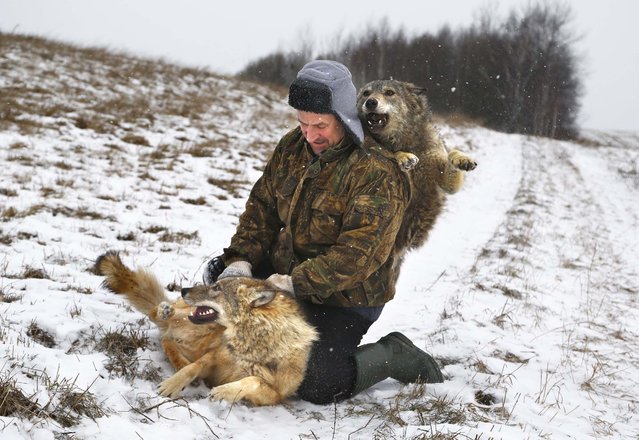
Belarusian Sergei Selekh plays with his 6-month-old tamed wolves on the outskirts of the village of Gaina, 45 kilometers (28 miles) north of Belarus capital Minsk, Wednesday, December 31, 2014. Selekh owns a farmstead, where sheep, wolves and an ethnographic museum serve as entertainment for guests. (Photo by Sergei Grits/AP Photo)

Belarusian Sergei Selekh plays with his 6-month-old tamed wolves on the outskirts of the village of Gaina, 45 kilometers (28 miles) north of Belarus capital Minsk, Wednesday, December 31, 2014. Selekh owns a farmstead, where sheep, wolves and an ethnographic museum serve as entertainment for guests. (Photo by Sergei Grits/AP Photo)
Details
03 Jan 2015 12:51:00
A participant prepares for the Red Bull Air Race World Championships in Abu Dhabi, United Arab Emirates on February 6, 2017. (Photo by Red Bull Content Pool/SIPA Press/Rex Features/Shutterstock)

A participant prepares for the Red Bull Air Race World Championships in Abu Dhabi, United Arab Emirates on February 6, 2017. (Photo by Red Bull Content Pool/SIPA Press/Rex Features/Shutterstock)
Details
08 Feb 2017 09:30:00
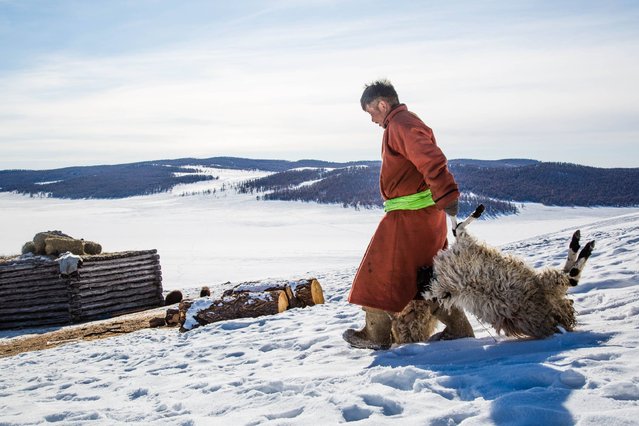
This handout photo taken on February 12, 2017 and released on February 16 by the International Federation of Red Cross and Red Crescent Societies (IFRC) shows Mongolian herder Munkhbat Bazarragchaa (C) dragging two sheep – which recently died due to the weather - to a pile of dead animals behind his “ger” in Khuvsgul province, northern Mongolia. Thousands of Mongolian herders face disastrous livestock losses from dreaded severe weather  known as the “dzud”, the Red Cross said on February 16, 2017 in launching an international emergency aid appeal. (Photo by Mirva Helenius/AFP Photo/IFRC)

This handout photo taken on February 12, 2017 and released on February 16 by the International Federation of Red Cross and Red Crescent Societies (IFRC) shows Mongolian herder Munkhbat Bazarragchaa (C) dragging two sheep – which recently died due to the weather - to a pile of dead animals behind his “ger” in Khuvsgul province, northern Mongolia. Thousands of Mongolian herders face disastrous livestock losses from dreaded severe weather known as the “dzud”, the Red Cross said on February 16, 2017 in launching an international emergency aid appeal. (Photo by Mirva Helenius/AFP Photo/IFRC)
Details
17 Feb 2017 11:40:00