Loading...
Done
“Red Pepperpion. (Photo by Vanessa Dualib)

“Red Pepperpion. Red Pepperpions are secretive, nocturnal arachilli which can be spotted in kitchens of arid climates all around the world.

Red Pepperpions are equipped with a delicious (and depending on the quantity...deadly!) stinger at the end of its tail. If you happen to get bitten (or if you bite him!) it will produce a burning sensation on your taste nerves.

However, there is no need to worry, since the fact is that his potent stinger is usually only used when hunting or whenever the Pepperpion feels like he might become part of someones meal...

At daylight or when encountering a larger foe, such as a Saucier Chef, they retreat into burrows inside the fridge or hide beneath the oven”. (Photo and comment by Vanessa Dualib)


Details
08 Feb 2013 09:24:00
A visitor walks on a giant chalk artwork called “Wasting Time” at the Chalk Urban Arts Festival in Sydney on October 25, 2014. The picture is the biggest 3-D artwork created in Australia by two artists, Leon Keer from Holland and Jenny McCracken from Australia. (Photo by Peter Parks/AFP Photo)

A visitor walks on a giant chalk artwork called “Wasting Time” at the Chalk Urban Arts Festival in Sydney on October 25, 2014. The picture is the biggest 3-D artwork created in Australia by two artists, Leon Keer from Holland and Jenny McCracken from Australia. (Photo by Peter Parks/AFP Photo)
Details
25 Oct 2014 13:58:00
Italian police officers carry away a FEMEN activist during a protest in St. Peter's Square at the Vatican, Friday, November 14, 2014. Members of the Ukrainian feminist group Femen staged a protest against the upcoming visit of Pope Francis at the European Parliament and Council. (Photo by AP Photo)

Italian police officers carry away a FEMEN activist during a protest in St. Peter's Square at the Vatican, Friday, November 14, 2014. Members of the Ukrainian feminist group Femen staged a protest against the upcoming visit of Pope Francis at the European Parliament and Council. (Photo by AP Photo)
Details
15 Nov 2014 13:04:00
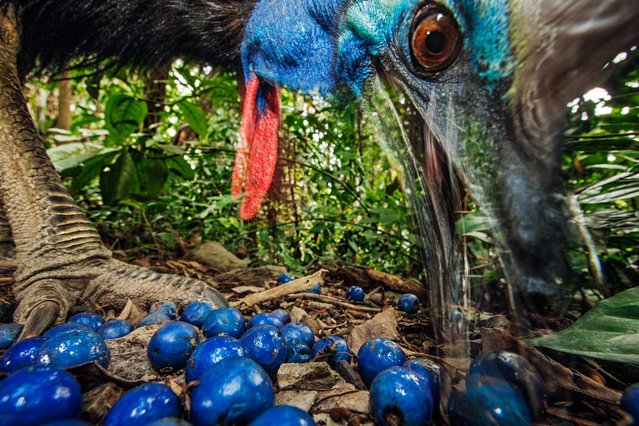
“Cassowaries are large, flightless birds related to emus and (more distantly) to ostriches, rheas, and kiwis”, writes Olivia Judson in the September issue of National Geographic magazine. (Photo by Christian Ziegler/National Geographic)

“Cassowaries are large, flightless birds related to emus and (more distantly) to ostriches, rheas, and kiwis”, writes Olivia Judson in the September issue of National Geographic magazine. How large? People-size: Adult males stand well over five foot five and top 110 pounds. Females are even taller, and can weigh more than 160 pounds. Dangerous when roused, they’re shy and peaceable when left alone. But even birds this big and tough are prey to habitat loss. The dense New Guinea and Australia rain forests where they live have dwindled. Today cassowaries might number 1,500 to 2,000. And because they help shape those same forests – by moving seeds from one place to another – “if they vanish”, Judson writes, “the structure of the forest would gradually change” too. (Photo by Christian Ziegler/National Geographic)
Details
06 Jan 2014 12:21:00
In this April 4, 2014 file photo, a community policeman kicks a man who they alledge participated in an ambush against them near the town of La Concepcion, Mexico. The vigilante force was set-up by affected communities opposed to the construction of the La Parota hydroelectric dam. Two vigilantes were injured and one died. (Photo by Bernandino Hernandez/AP Photo)

In this April 4, 2014 file photo, a community policeman kicks a man who they alledge participated in an ambush against them near the town of La Concepcion, Mexico. The vigilante force was set-up by affected communities opposed to the construction of the La Parota hydroelectric dam. Two vigilantes were injured and one died. (Photo by Bernandino Hernandez/AP Photo)
Details
16 Dec 2014 12:40:00
Devotees ride on the roof of a train as they return to the city after attending the final prayers on the first phase of Bishwa Ijtema in Dhaka January 11, 2015. Hundreds of thousands of pilgrims congregated in the Bangladeshi capital Dhaka as the first phase of this year's Bishwa Ijtema, one of the biggest Islamic gatherings in the world after the Haj in Saudi Arabia, came to an end. (Photo by Reuters/Stringer)

Devotees ride on the roof of a train as they return to the city after attending the final prayers on the first phase of Bishwa Ijtema in Dhaka January 11, 2015. Hundreds of thousands of pilgrims congregated in the Bangladeshi capital Dhaka as the first phase of this year's Bishwa Ijtema, one of the biggest Islamic gatherings in the world after the Haj in Saudi Arabia, came to an end. (Photo by Reuters/Stringer)
Details
17 Jan 2015 12:10:00
A panda bear sits on a logs in a zoo on January 15, 2015 in Hangzhou, China. (Photo by Feature China/Barcroft Media)

A panda bear sits on a logs in a zoo on January 15, 2015 in Hangzhou, China. (Photo by Feature China/Barcroft Media)
Details
17 Jan 2015 12:56:00
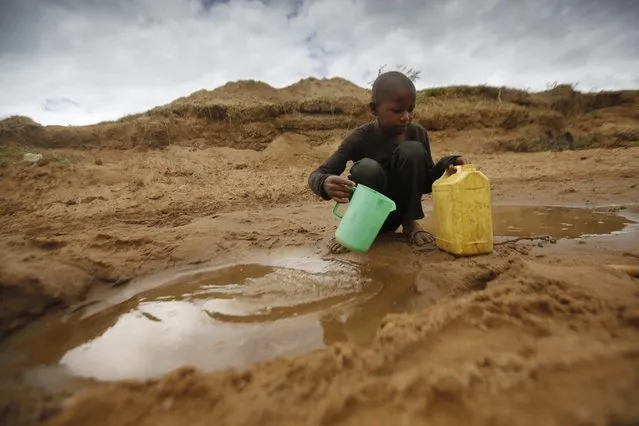
A young boy scoops water from a hand-dug well in the dry riverbed near Matinyani, in the semi-arid Kitui County in southeastern Kenya, 22 March 2015, the World Water Day. Residents of Kitui County and other arid and semi-arid areas of the country have been hard-hit by extremely poor rainfall this year while the government said in previous month that some 1.6 million people countrywide are facing acute starvation due to the drought and will need relief food over the next six months. (Photo by Dai Kurokawa/EPA)

A young boy scoops water from a hand-dug well in the dry riverbed near Matinyani, in the semi-arid Kitui County in southeastern Kenya, 22 March 2015, the World Water Day. Residents of Kitui County and other arid and semi-arid areas of the country have been hard-hit by extremely poor rainfall this year while the government said in previous month that some 1.6 million people countrywide are facing acute starvation due to the drought and will need relief food over the next six months. Residents of Matinyani say they haven't seen a drop of rain in nearly four months. Thousands of Kenyans in rural areas walk tens of kilometers just to fetch water to drink and to be used in their homes. According to an estimate by UNESCO (United Nations Educational, Scientific and Cultural Organization), 17 million people lack access to safe water in Kenya, where the drought is a perennial problem. (Photo by Dai Kurokawa/EPA)
Details
23 Mar 2015 11:01:00