Loading...
Done
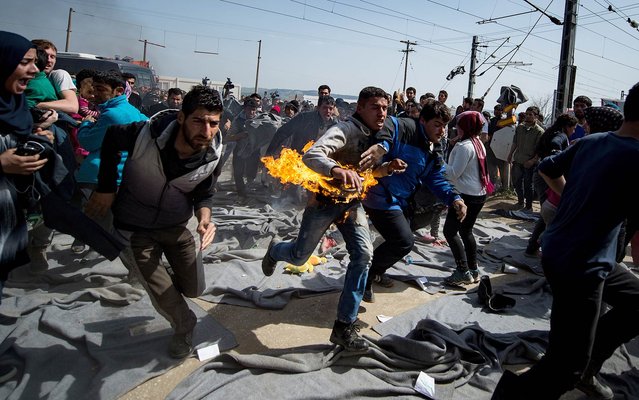
A man runs after he tried to put himself on fire during a protest at a makeshift camp at the Greek-Macedonian border near the village of Idomeni on March 22, 2016. Greece will not be able to start sending refugees back to Turkey from March 20, 2016, the government said, as the country struggles to implement a key deal aimed at easing Europe's migrant crisis. The numbers are daunting: officials said as of Saturday there were 47,500 migrants in Greece, including 8,200 on the islands and 10,500 massed at the Idomeni camp on the Macedonian border. (Photo by Andrej Isakovic/AFP Photo)

A man runs after he tried to put himself on fire during a protest at a makeshift camp at the Greek-Macedonian border near the village of Idomeni on March 22, 2016. Greece will not be able to start sending refugees back to Turkey from March 20, 2016, the government said, as the country struggles to implement a key deal aimed at easing Europe's migrant crisis. The numbers are daunting: officials said as of Saturday there were 47,500 migrants in Greece, including 8,200 on the islands and 10,500 massed at the Idomeni camp on the Macedonian border. (Photo by Andrej Isakovic/AFP Photo)
Details
23 Mar 2016 12:25:00
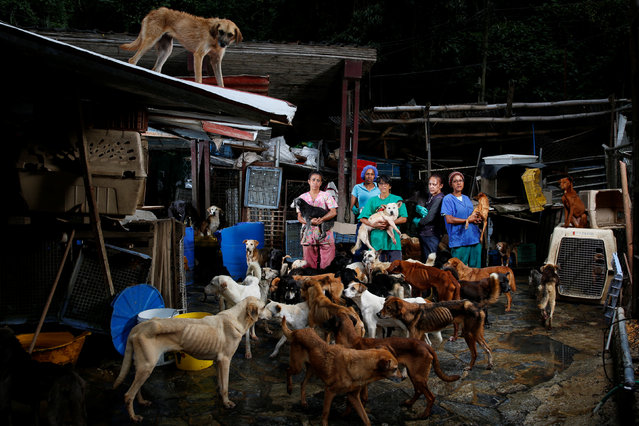
(L-R) Maria Silva, Milena Cortes, Maria Arteaga, Jackeline Bastidas and Gissy Abello pose for a picture at the Famproa dogs shelter where they work, in Los Teques, Venezuela, August 25, 2016. Venezuelans struggling to feed their families let alone their pets are dumping animals on the streets, in parks and at makeshift homes overrun with scrawny animals amid an economic crisis. An hour from Caracas in Los Teques, hundreds of dogs bark and run around the streets scavenging for food outside a makeshift shelter. People come by every few hours to hand over scrawny dogs which are fed by volunteers every day. Venezuela is undergoing a major economic and social crisis, with shortages of basic foods and medicines. Triple digit inflation is hitting everybody hard, including those who own pets. (Photo by Carlos Garcia Rawlins/Reuters)

(L-R) Maria Silva, Milena Cortes, Maria Arteaga, Jackeline Bastidas and Gissy Abello pose for a picture at the Famproa dogs shelter where they work, in Los Teques, Venezuela, August 25, 2016. Venezuelans struggling to feed their families let alone their pets are dumping animals on the streets, in parks and at makeshift homes overrun with scrawny animals amid an economic crisis. An hour from Caracas in Los Teques, hundreds of dogs bark and run around the streets scavenging for food outside a makeshift shelter. (Photo by Carlos Garcia Rawlins/Reuters)
Details
08 Sep 2016 10:01:00
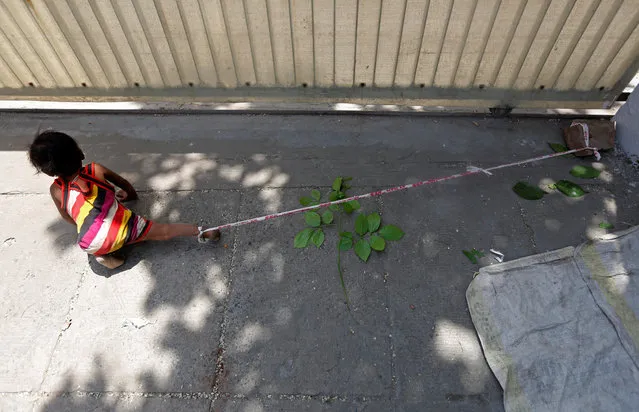
Barrier tape is tied around 15-month-old Shivani's ankle to prevent her from running away, while her mother Sarta Kalara works at a construction site nearby, in Ahmedabad, India, April 19, 2016. Kalara says she has no option but to tether her daughter Shivani to a stone despite her crying, while she and her husband work for 250 rupees ($3.8) each a shift digging holes for electricity cables in the city of Ahmedabad. There are about 40 million construction workers in India, at least one in five of them women, and the majority poor migrants who shift from site to site, building infrastructure for India's booming cities. Across the country it is not uncommon to see young children rolling in the sand and mud as their parents carry bricks or dig for new roads or luxury houses. (Photo by Amit Dave/Reuters)

Barrier tape is tied around 15-month-old Shivani's ankle to prevent her from running away, while her mother Sarta Kalara works at a construction site nearby, in Ahmedabad, India, April 19, 2016. Kalara says she has no option but to tether her daughter Shivani to a stone despite her crying, while she and her husband work for 250 rupees ($3.8) each a shift digging holes for electricity cables in the city of Ahmedabad. There are about 40 million construction workers in India, at least one in five of them women, and the majority poor migrants who shift from site to site, building infrastructure for India's booming cities. Across the country it is not uncommon to see young children rolling in the sand and mud as their parents carry bricks or dig for new roads or luxury houses. (Photo by Amit Dave/Reuters)
Details
14 Dec 2016 07:39:00
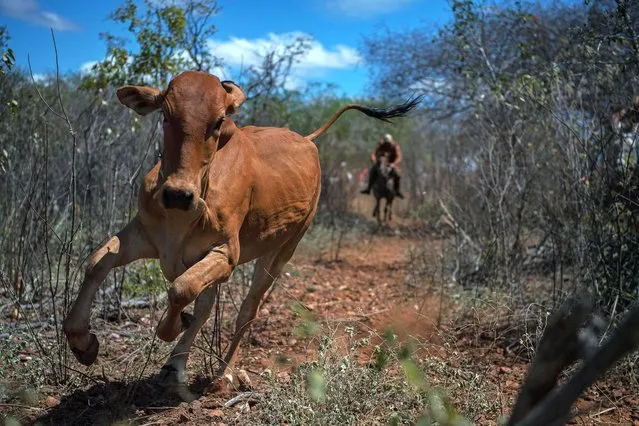
A young bull flees from a Brazilian vaqueiro, or cowboy, competing in the “Pega de Boi” (Ox Catch) tournament in Cabrobo, Pernambuco State, Brazil, on September 4, 2022. The riders compete in pairs to retrieve a cord from a bull which has been released and runs away from them and they are timed on how quickly they can return with the cord. The leather clothing provides them with protection from the dense savannah vegetation which contains a lot of large thorns. Riders have been known to die competing in the tournament (Photo by Carl de Souza/AFP Photo)

A young bull flees from a Brazilian vaqueiro, or cowboy, competing in the “Pega de Boi” (Ox Catch) tournament in Cabrobo, Pernambuco State, Brazil, on September 4, 2022. The riders compete in pairs to retrieve a cord from a bull which has been released and runs away from them and they are timed on how quickly they can return with the cord. The leather clothing provides them with protection from the dense savannah vegetation which contains a lot of large thorns. Riders have been known to die competing in the tournament (Photo by Carl de Souza/AFP Photo)
Details
25 Sep 2022 04:38:00
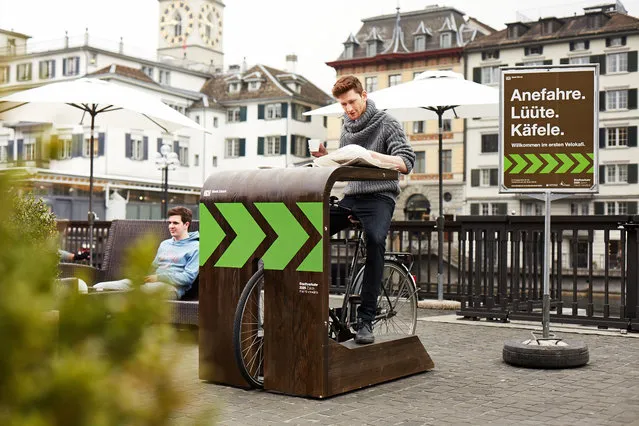
Bicycle Cafe In Zurich, Switzerland

In the past, having a car was synonymous to success. Now, however, having a bicycle in the new trend. Riding a bicycle is all pros and no cons. It makes you slimmer and healthier, it allows you to enjoy the fresh air, traffic jams are no longer a problem, and of course you don’t waste money on gas. However, there was always a problem of leaving your bike unattended. With thieves lurking behind every corner, there is always a risk of someone stealing your bicycle. Thus, the authorities of Zurich have decided to do something for cyclists. They’ve created the first café for cyclists where the person can sit on his bike while enjoying a cup of coffee. This is a great idea since the visitors will not have to worry about their bikes being stolen. Though to visit such a café, you might want to bring a cushion with you, since sitting on small, hard plastic seat is not very relaxing.
Details
22 Dec 2014 11:49:00
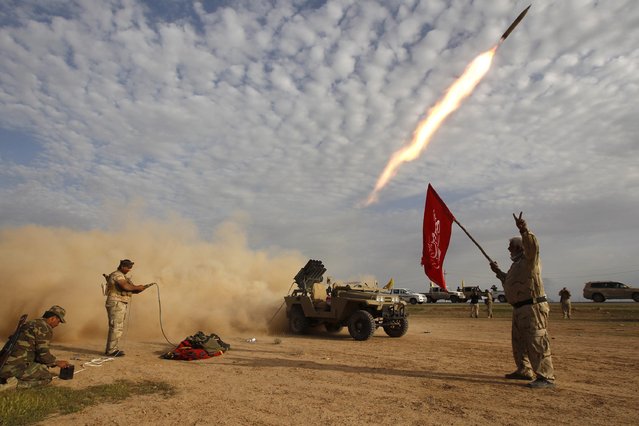
Shi'ite fighters launch a rocket during clashes with Islamic State militants on the outskirts of al-Alam March 8, 2015. Thaier Al-Sudani: “It was me and a few other Iraqi journalists working for local outlets. (Photo by Thaier Al-Sudani/Reuters)

Shi'ite fighters launch a rocket during clashes with Islamic State militants on the outskirts of al-Alam March 8, 2015. Thaier Al-Sudani: “It was me and a few other Iraqi journalists working for local outlets. We went to the frontlines in coordination with the Iraqi government forces and supporting militias. The press officer would come in the morning and take us to the frontline in a convoy. Whenever an area was won from Islamic State, the fighters would chant and pray and show victory signs. Most of the areas we were in didn't have residents, so after the battle they would resemble ghost towns; nothing but burnt cars and charred bodies of Islamic State fighters. Al-Alam was an exception as it had some residents who chanted for the government forces after their victory”. (Photo by Thaier Al-Sudani/Reuters)
Details
14 Mar 2015 14:33:00
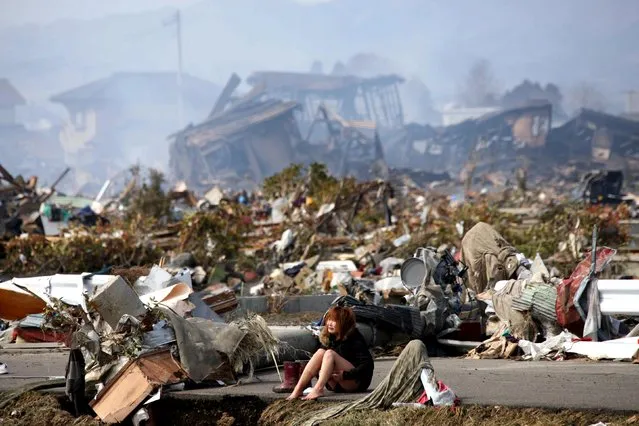
A woman cries while sitting on a road amid the destroyed city of Natori, Miyagi Prefecture in northern Japan March 13, 2011, after a massive earthquake and tsunami that are feared to have killed more than 10,000 people. (Photo by Asahi Shimbun/Reuters)

A woman cries while sitting on a road amid the destroyed city of Natori, Miyagi Prefecture in northern Japan March 13, 2011, after a massive earthquake and tsunami. Five years on from the tsunami that triggered meltdowns at Japan's Fukushima nuclear plant, the page is anything but turned. A magnitude 9 earthquake and towering tsunami on March 11, 2011 killed nearly 16,000 people along Japan's northeastern coast and left more than 2,500 missing. The 10-metre (33-foot) tsunami swept away everything in its path, including houses, ships, cars and farm buildings. (Photo by Asahi Shimbun/Reuters)
Details
09 Mar 2016 12:40:00
T-Mike Kliebert and his son Blaise tackle Chinaman a 12 foot alligator in Hammond, Louisiana. (Photo by Barcroft Media)

These pictures show a five-year-old boy who is already extremely comfortable around alligators. Blaise's dad T-Mike runs the Kliebert Gator Farm, the biggest and oldest in the world and which was started by his grandfather Harvey in 1957. Photo: T-Mike Kliebert and his son Blaise tackle Chinaman a 12 foot alligator in Hammond, Louisiana. (Photo by Barcroft Media)
Details
22 Jul 2014 12:18:00