Loading...
Done
Meerim Momunova wrestles with her fellow Kyrgyz teammate Anara Ryskulova during a performance of a traditional style of wrestling called “Alysh”. Momunova is a champion in Asia and has been competing since 2015, after a background in judo. According to Momunova, one of the advantages of “Alysh” is the ease of the uniform for women – even Muslim women who cover their faces can compete. Momunova holds a degree in sports coaching and hopes to see more women come into this sport. (Photo by Eleanor Moseman/The Guardian)

This year’s World Nomad Games, a celebration of nomadic heritage, took place in the Issyk-Kul province of Kyrgyzstan. Eleanor Moseman photographed female competitors who had travelled from all over central Asia and eastern Europe, and explored the difficulties and challenges they face as competitors. (Photo by Eleanor Moseman/The Guardian)
Details
20 Sep 2018 00:05:00
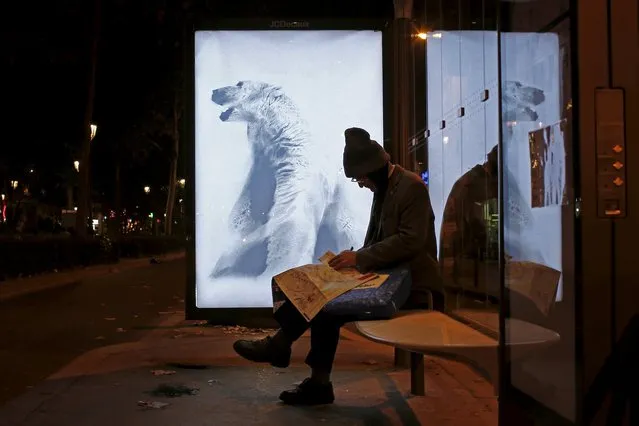
A poster by street artist Aaron Li-Hill as part of the "Brandalism" project is displayed at a bus stop in Paris, France, November 28, 2015, ahead of the United Nations COP21 Climate Change conference in Paris. (Photo by Benoit Tessier/Reuters)

A poster by street artist Aaron Li-Hill as part of the "Brandalism" project is displayed at a bus stop in Paris, France, November 28, 2015, ahead of the United Nations COP21 Climate Change conference in Paris. Brandalism is a revolt against corporate control of the visual realm. Following on in the guerilla art traditions of the 20th Century and taking inspiration from Agitprop, Situationist and Street Art movements, the Brandalism project sees artists from around the world collaborate to challenge the authority and legitimacy of commercial images within public space and within our culture. (Photo by Benoit Tessier/Reuters)
Details
30 Nov 2015 08:03:00
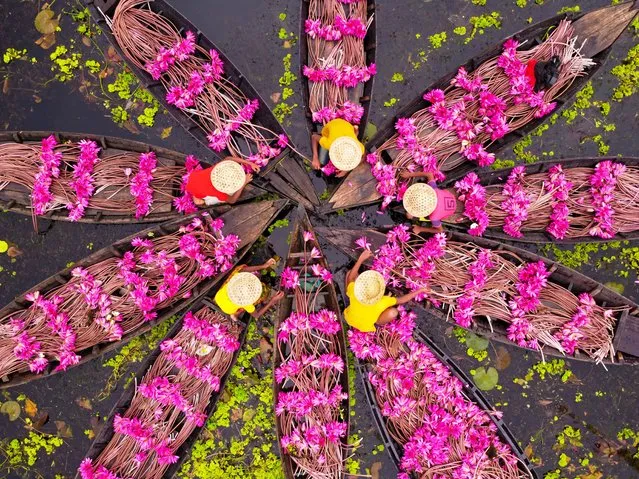
Farmers arrange bunches of water lilies after harvesting them from the wetlands in Barishal, Bangladesh on March 21, 2023. Floating through 10,000 acres of canal, farmers use their little boats to fetch the flowers. They break through the layer of water lilies on the surface of the water as they practice the traditional craft of picking water lilies by hand. Every flower is carefully hand-picked, collected inside the farmers' little wooden boat, tied in bundles, and sold to markets. After working for an entire day, a farmer can pick around 80 to 120 bundles of water lilies. Water lily harvesting is a major source of income for more than 250 families in the area. (Photo by Joy Saha/Cover Images)

Farmers arrange bunches of water lilies after harvesting them from the wetlands in Barishal, Bangladesh on March 21, 2023. Floating through 10,000 acres of canal, farmers use their little boats to fetch the flowers. (Photo by Joy Saha/Cover Images)
Details
01 May 2023 04:00:00
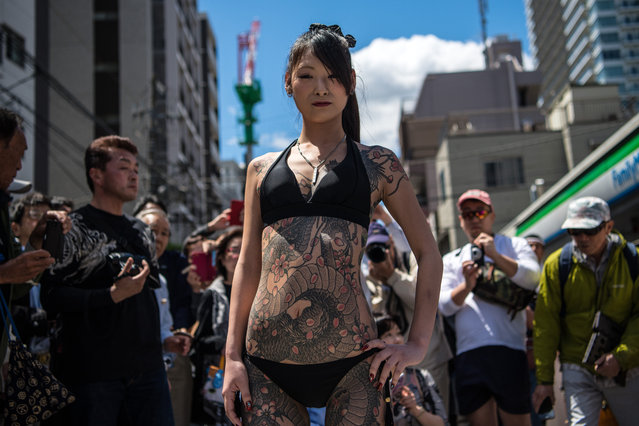
A heavily tattooed Japanese woman poses for photographs near Asakusa Temple during the third and final day of Sanja Festival, on May 20, 2018 in Tokyo, Japan. Sanja Festival is one of Japan's major festivals and is held annually in the Asakusa area of Tokyo. The three day event starts with a grand parade with people in traditional costumes performing dances before around a hundred mikoshi (portable shrines) from the local communities are carried to and from Asakusa Temple watched on by an audience of locals and tourists. (Photo by Carl Court/Getty Images)

A heavily tattooed Japanese woman poses for photographs near Asakusa Temple during the third and final day of Sanja Festival, on May 20, 2018 in Tokyo, Japan. Sanja Festival is one of Japan's major festivals and is held annually in the Asakusa area of Tokyo. (Photo by Carl Court/Getty Images)
Details
22 May 2018 07:21:00
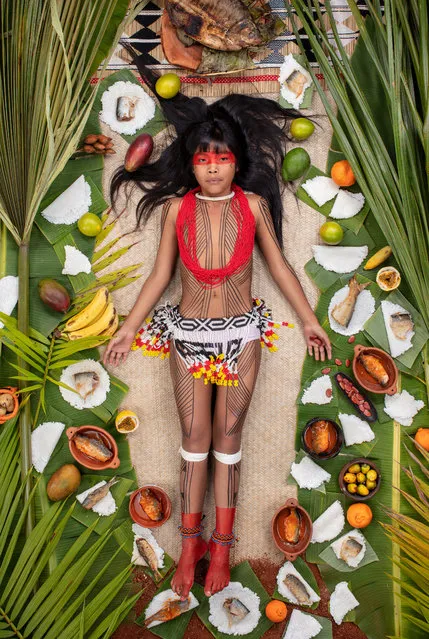
Kawakanih Yawalapiti, 9, Upper Xingu region of Mato Grosso, Brazil, 2018: Kawakanih lives with her tribe, the Yawalapiti, in Xingu national park, a preserve in the Amazon basin of Brazil. The Yawalapiti collect seeds to preserve species unique to their ecosystem, which lies between the rain forest and savannah. Kawakanih’s diet is simple, consisting mainly of fish, cassava, porridge, fruit and nuts. “It takes five minutes to catch dinner”, says Kawakanih. “When you’re hungry, you just go to the river with your net”. (Photo by Gregg Segal/The Guardian)

Photographer Gregg Segal travelled the world to document children and the food they eat in a week. Partly inspired by the increasing problems of childhood obesity, he tracked traditional regional diets as yet unaffected by globalisation, and ironically, found that the healthiest diets were often eaten by the least well off. (Photo by Gregg Segal/The Guardian)
Details
03 Jul 2019 00:03:00
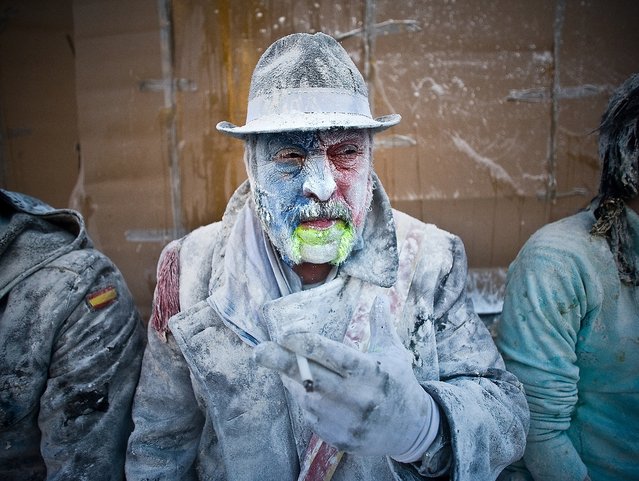
A Reveller smokes during the battle of “Enfarinats”, a flour fight in celebration of the Els Enfarinats festival. (Photo by David Ramos)


It’s a classic tale of dictatorship gone wrong and the fight for freedom. Like in any good battle, there’s fire, albeit from firecrackers, but the ammunition in this one is – flour. It takes place in a Hemingway-esque Spanish village. The battle of “Enfarinats” in celebration of the Els Enfarinats festival, rages on on December 28, 2012 in Ibi, Spain. Citizens of Ibi annually celebrate the festival with a fight using flour, eggs and firecrackers. The battle takes place between two groups, a group of married men called “Els Enfarinats” who take the control of the village for one day pronouncing a number of ridiculous laws and fining the citizens that infringe them and a group called “La Oposicio” who try to restore order. At the end of the day the money collected from the fines is donated to charitable causes in the village. The festival has been celebrated since 1981 after the town of Ibi recovered the tradition but the origins remain unknown.

Photo: A Reveller smokes during the battle of “Enfarinats”, a flour fight in celebration of the Els Enfarinats festival. (Photo by David Ramos)
Details
30 Dec 2012 10:28:00
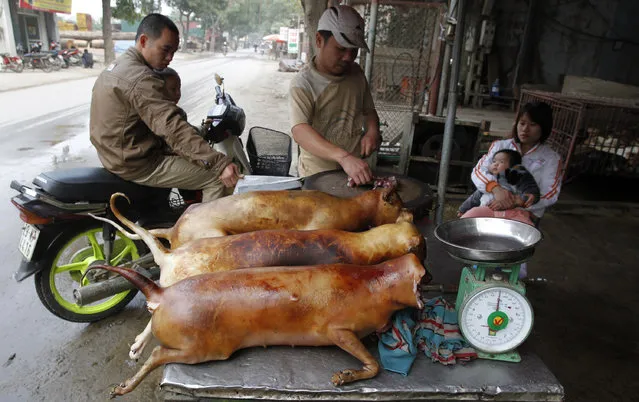
A vendor (C) cuts slaughtered dogs for sale at his roadside stall in Duong Noi village, outside Hanoi December 16, 2011. While animal rights activists have condemned eating dog meat as cruel treatment of the animals, it is still an accepted popular delicacy for some Vietnamese, as well in some other Asian countries. (Photo by Reuters/Kham)

A vendor (C) cuts slaughtered dogs for sale at his roadside stall in Duong Noi village, outside Hanoi December 16, 2011. While animal rights activists have condemned eating dog meat as cruel treatment of the animals, it is still an accepted popular delicacy for some Vietnamese, as well in some other Asian countries. Duong Noi is well-known as a dog-meat village, where hundreds of dogs are killed each day for sale as popular traditional food. Dog-eating as a custom is rooted in Vietnam and was developed as a result of poverty. One kilogram of dog meat costs about 130,000 dongs ($6.2). (Photo by Reuters/Kham)
Details
16 Jul 2013 11:40:00
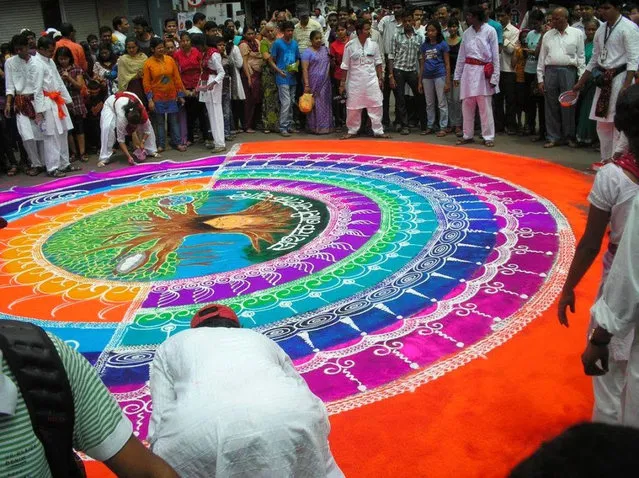
Rangoli Folk Art From India

Rangoli, also known as kolam or Muggu, is a folk art from India in which patterns are created on the floor in living rooms or courtyards using materials such as colored rice, dry flour, colored sand or flower petals. It is usually made during Diwali, Onam, Pongal and other Indian festivals. They are meant to be sacred welcoming areas for the Hindu deities. The ancient symbols have been passed down through the ages, from each generation to the next, keeping both the art form and the tradition alive. Similar practices are followed in different Indian states: in Tamil Nadu, there is Kolam in Tamil Nadu; Mandana in Rajasthan; Chaookpurna in Chhattisgarh; Alpana in West Bengal; Aripana in Bihar; Chowk pujan in Uttar Pradesh; Muggu in Andhra Pradesh and others.
Details
16 Jun 2014 10:37:00