Loading...
Done
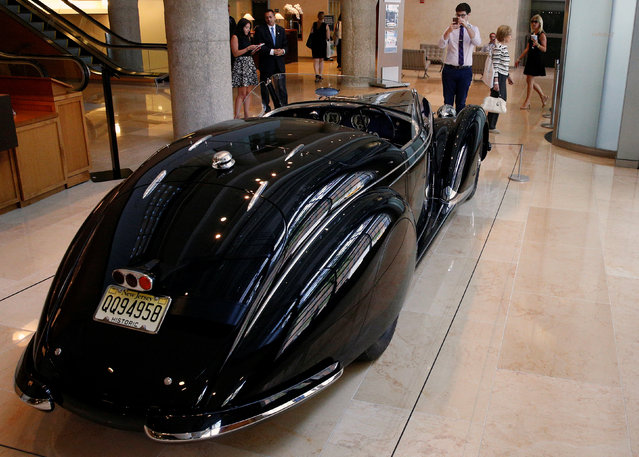
People look at a 1939 Alfa Romeo 8C 2900B Lungo Touring Spider displayed at Sotheby's in New York City, New York, U.S. July 21, 2016. The car, unveiled in a pre-publicity showing in New York on Thursday, is expected to sell for more than US$15 million – and could set a record for the most money ever paid for a pre-war auto at auction. “This is a personal favourite of mine, the 1939 Alfa Romeo is one of the grandest pre-war cars ever built”, said Ian Kelleher, managing director, RM Sotheby's US West Coast division. “You can achieve speeds in excess of 100 miles an hour in this car. (Photo by Brendan McDermid/Reuters)

People look at a 1939 Alfa Romeo 8C 2900B Lungo Touring Spider displayed at Sotheby's in New York City, New York, U.S. July 21, 2016. The car, unveiled in a pre-publicity showing in New York on Thursday, is expected to sell for more than US$15 million – and could set a record for the most money ever paid for a pre-war auto at auction. (Photo by Brendan McDermid/Reuters)
Details
22 Jul 2016 12:22:00
Britain's Mo Farah reacts as he wins the men's 5000m final at the London 2012 Olympic Games at the Olympic Stadium in Britain August 11, 2012. Lucy Nicholson: “When Mo Farah was rounding the final corner for the 5000m the huge stadium was electric, everybody was on their feet and he knew he was going to win as he came into that final stretch. All the photographers were excited because we knew he was going to react in a very dramatic way so it was a lovely sequence of photos as he crossed the finish line – he put his hands over his head, he wrapped himself in the British flag, it was a very long celebration sequence, which is all you can really wish for as a photographer”. (Photo by Lucy Nicholson/Reuters)

The Rio de Janeiro Olympics kick off on August 5 for some two weeks of competitive games drawing athletes as well as audiences from around the world. As they prepare to cover the event, Reuters photographers look back on their favourite pictures from past Olympics where they captured the action on the ground as well as the participants' tears and joy that followed. (Photo by Lucy Nicholson/Reuters)
Details
03 Aug 2016 11:19:00
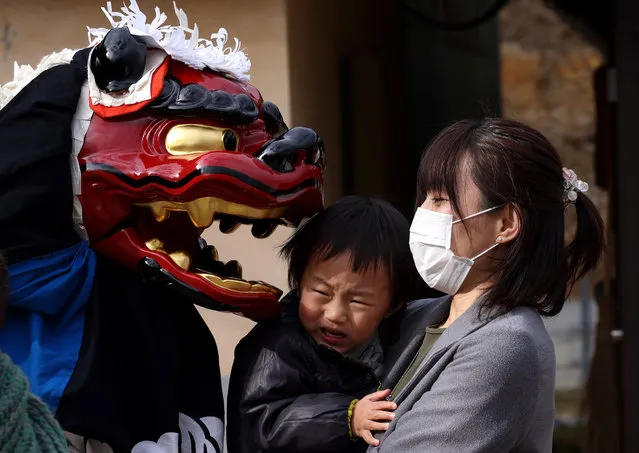
A performer wearing a lion mask performs the Ise Daikagura lion dance at the remote village of Yamanawa on February 08, 2021 in Ryuo, Japan. Ise Daikagura is a group of traditional Lion Dance performers who pray in front of farmers houses and businesses for good grain harvests and disease-free lives. Performers play sacred music using drums and flutes with two lion mask dancers. A lion mask is considered a symbol of God, who enters the house and performs in front of the Shinto God, a statue placed inside the house, mostly in the kitchen. These prayers are called “Kamodo Barai”. After the prayers, they are gifted with money, rice, sake and Japanese sweets from the householders. A group can travel for more than one hundred days to thousands of households and businesses throughout rural-villages in western Japan, and pray to those who are unable to visit the country’s most sacred shrine, the Grand Ise Shrine in Mie Prefecture. The group started its performance in the Edo era between 1603 to 1868 according to Japanese history. The Japanese government designated it as an important folk cultural national property in 1981. (Photo by Buddhika Weerasinghe/Getty Images)

A performer wearing a lion mask performs the Ise Daikagura lion dance at the remote village of Yamanawa on February 08, 2021 in Ryuo, Japan. Ise Daikagura is a group of traditional Lion Dance performers who pray in front of farmers houses and businesses for good grain harvests and disease-free lives. (Photo by Buddhika Weerasinghe/Getty Images)
Details
18 Feb 2021 09:27:00
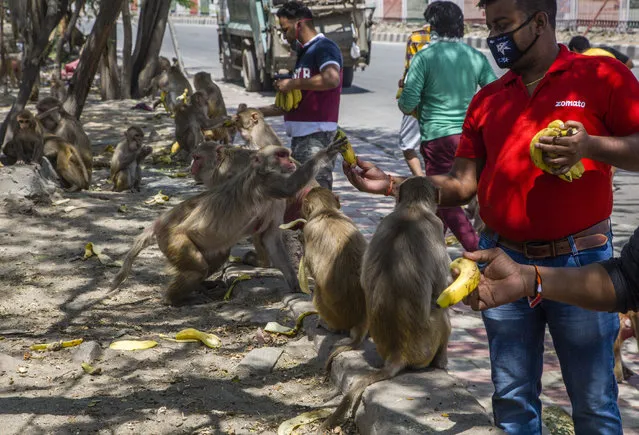
Men give bananas to monkeys gathered on the side of the road as India remains under an unprecedented lockdown over the highly contagious coronavirus (COVID-19) on April 08, 2020 in New Delhi, India. Wild animals, including monkeys, are roaming human settlements in India as people are staying indoors due to the 21-day lockdown. With India's 1.3 billion population and tens of millions of cars off the roads, wildlife is moving towards areas inhabited by humans. Wild animals in many countries have been seen roaming streets. A study says some 60 percent of the new diseases found around the globe every year are zoonotic, meaning they originate in animals and are passed on to humans. COVID-19 is a zoonotic disease that is suspected to have come from the wet markets of Wuhan, China. (Photo by Yawar Nazir/Getty Images)

Men give bananas to monkeys gathered on the side of the road as India remains under an unprecedented lockdown over the highly contagious coronavirus (COVID-19) on April 08, 2020 in New Delhi, India. Wild animals, including monkeys, are roaming human settlements in India as people are staying indoors due to the 21-day lockdown. (Photo by Yawar Nazir/Getty Images)
Details
12 Apr 2020 00:05:00
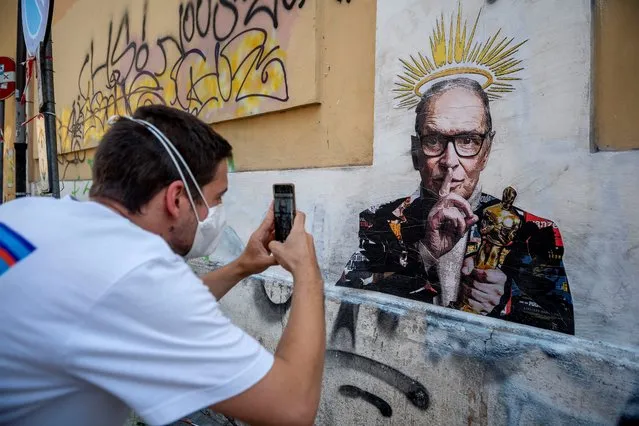
A man takes a picture of the mural painted by the street artist Harry Greb depicting the Italian music composer Ennio Morricone, a day after the 91-year-old composer's death, on July 7, 2020 in Rome, Italy. (Photo by Antonio Masiello/Getty Images)

A man takes a picture of the mural painted by the street artist Harry Greb depicting the Italian music composer Ennio Morricone, a day after the 91-year-old composer's death, on July 7, 2020 in Rome, Italy. (Photo by Antonio Masiello/Getty Images)
Details
15 Jul 2020 00:03:00
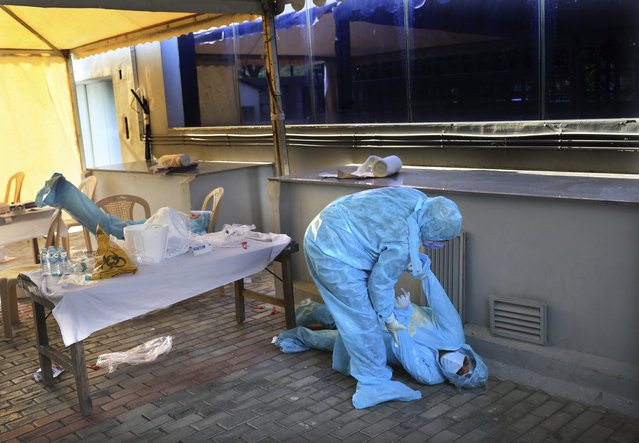
In this April 27, 2020 photo, a health worker helps another as she fainted because of exhaustion and long working hours during a swab test drive for COVID 19, in New Delhi, India. Two and a half months of nationwide lockdown kept numbers of infections relatively low in India. But with restrictions easing in recent weeks, cases have shot up, raising questions about whether authorities have done enough to avert catastrophe. Half of Delhi’s 8,200 hospital beds dedicated to COVID-19 patients are already full and officials are projecting more than half a million cases in the city alone by July 31. (Photo by Manish Swarup/AP Photo)

In this April 27, 2020 photo, a health worker helps another as she fainted because of exhaustion and long working hours during a swab test drive for COVID 19, in New Delhi, India. Two and a half months of nationwide lockdown kept numbers of infections relatively low in India. But with restrictions easing in recent weeks, cases have shot up, raising questions about whether authorities have done enough to avert catastrophe. Half of Delhi’s 8,200 hospital beds dedicated to COVID-19 patients are already full and officials are projecting more than half a million cases in the city alone by July 31. (Photo by Manish Swarup/AP Photo)
Details
08 Jan 2021 00:01:00
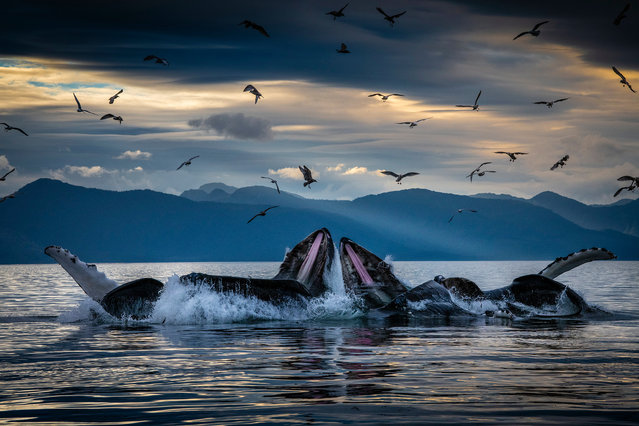
“Secrets of the Whales”. Skerry’s photographs celebrate the lives and culture of whales, illuminating recent research and their diverse behaviours. His latest work focuses on four key species: sperm whales, humpbacks, orca and beluga whales. Humpback whales bubble-net feeding off the coast of Alaska. They work cooperatively to feed on herring by blowing a perfect ring of bubbles underwater to form a net encircling the fish. The whales then swim up through the centre of the bubble net with their mouths open. (Photo by Brian Skerry/National Geographic Photo/Visa pour l'Image)

“Secrets of the Whales”. Skerry’s photographs celebrate the lives and culture of whales, illuminating recent research and their diverse behaviours. His latest work focuses on four key species: sperm whales, humpbacks, orca and beluga whales. Humpback whales bubble-net feeding off the coast of Alaska. They work cooperatively to feed on herring by blowing a perfect ring of bubbles underwater to form a net encircling the fish. The whales then swim up through the centre of the bubble net with their mouths open. (Photo by Brian Skerry/National Geographic Photo/Visa pour l'Image)
Details
04 Sep 2021 09:02:00
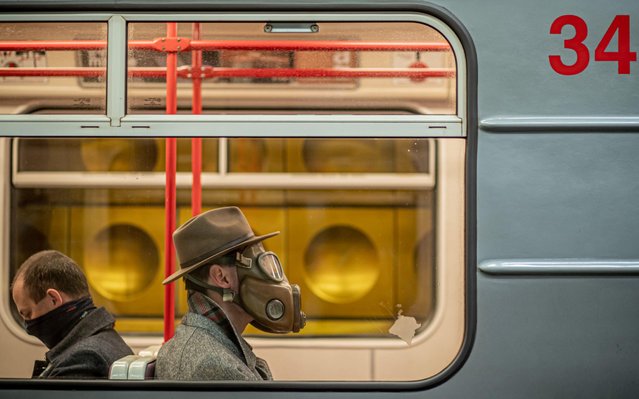
Men wear masks as they sit in the metro in Prague, Czech Republic, 17 March 2020. According to media reports, the Czech government decided to impose a two-week quarantine in the country on the evening of 15 March, and ban all international travel from 16 March 2020. Currently 383 cases of the coronavirus SARS-CoV-2, which causes the Covid-19 disease, have been officially confirmed in Czech Republic. (Photo by Martin Divisek/EPA/EFE)

Men wear masks as they sit in the metro in Prague, Czech Republic, 17 March 2020. According to media reports, the Czech government decided to impose a two-week quarantine in the country on the evening of 15 March, and ban all international travel from 16 March 2020. Currently 383 cases of the coronavirus SARS-CoV-2, which causes the Covid-19 disease, have been officially confirmed in Czech Republic. (Photo by Martin Divisek/EPA/EFE)
Details
06 Jan 2021 00:03:00