Loading...
Done
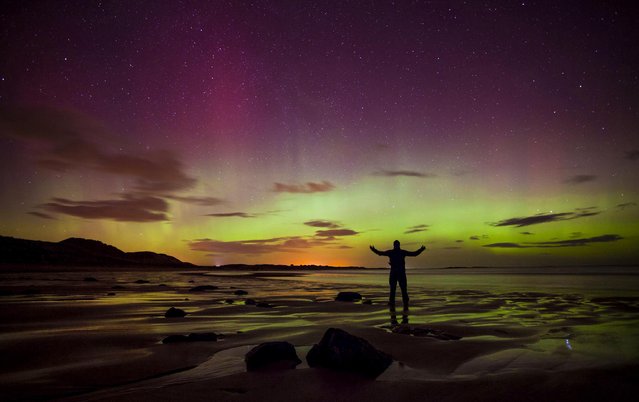
A man poses standing on a rock looking at the aurora borealis, or northern lights, illuminating the night sky at Embleton Bay in Northumberland, England, on February 27, 2014. The northern lights is a fantastical natural light display with fast moving light effects caused by particles charged by the sun colliding with particles in Earth's upper atmosphere. (Photo by Tom White/PA Wire)

A man poses standing on a rock looking at the aurora borealis, or northern lights, illuminating the night sky at Embleton Bay in Northumberland, England, on February 27, 2014. The northern lights is a fantastical natural light display with fast moving light effects caused by particles charged by the sun colliding with particles in Earth's upper atmosphere. (Photo by Tom White/PA Wire)
Details
02 Mar 2014 10:12:00
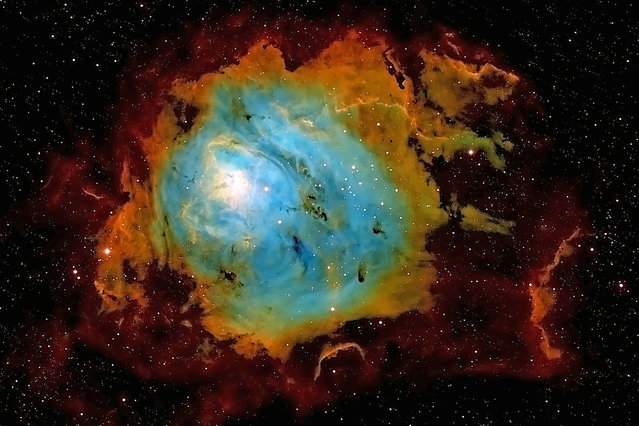
Lagoon Master. These amazing pictures of nebula thousands of light years from Earth have been captured by an amateur astronomer Dr. Dennis Roscoe snapped the beautiful celestial formations from his own personal observatory. His telescope looks into deep space at the nebula, which show both the birth and death of stars, like our very own Sun. (Photo by Dennis Roscoe/Caters News)

Lagoon Master. These amazing pictures of nebula thousands of light years from Earth have been captured by an amateur astronomer Dr. Dennis Roscoe snapped the beautiful celestial formations from his own personal observatory. His telescope looks into deep space at the nebula, which show both the birth and death of stars, like our very own Sun. (Photo by Dennis Roscoe/Caters News)
Details
23 Sep 2014 13:12:00
Max Gold, 20, of NYC, cruises on his skateboard as thousands gather on the National Mall for the March for Science on Saturday, April 22, 2017, in Washington, DC.  Activists and scientists descend on the nation's capital to rally for environmental causes and government policies rooted in scientific research as part of the Earth Day and March for Science rallies. (Photo by Jahi Chikwendiu/The Washington Post)

Max Gold, 20, of NYC, cruises on his skateboard as thousands gather on the National Mall for the March for Science on Saturday, April 22, 2017, in Washington, DC. Activists and scientists descend on the nation's capital to rally for environmental causes and government policies rooted in scientific research as part of the Earth Day and March for Science rallies. (Photo by Jahi Chikwendiu/The Washington Post)
Details
22 May 2017 07:38:00
A young girl from the Makonde ethnic group wearing earth makeup on her facen, a beauty symbol, carries a baby on her back as she poses for pictures in the community of Marupa, a relocation center for internally displaced families in the Chiure district, on February 23, 2021. Thousands of families from different districts of the Cabo Delgado province who have been displaced have been located by the government in different areas of the province. (Photo by Alfredo Zuniga/AFP Photo)

A young girl from the Makonde ethnic group wearing earth makeup on her facen, a beauty symbol, carries a baby on her back as she poses for pictures in the community of Marupa, a relocation center for internally displaced families in the Chiure district, on February 23, 2021. Thousands of families from different districts of the Cabo Delgado province who have been displaced have been located by the government in different areas of the province. (Photo by Alfredo Zuniga/AFP Photo)
Details
04 Mar 2021 08:40:00
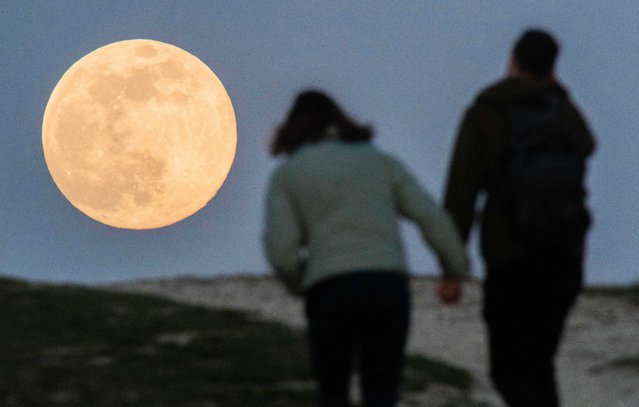
A couple is walking hand-held up Kronsberg, just outside Hanover, Germany on April 7, 2020, when the moon rises on the horizon as the so-called supermoon. The moon reaches its perigee, i.e. the point closest to the Earth's orbit, on the night of 7-8 April as a full moon and therefore appears particularly large to the human observer. (Photo by Julian Stratenschulte/dpa via ZUMA Press)

A couple is walking hand-held up Kronsberg, just outside Hanover, Germany on April 7, 2020, when the moon rises on the horizon as the so-called supermoon. The moon reaches its perigee, i.e. the point closest to the Earth's orbit, on the night of 7-8 April as a full moon and therefore appears particularly large to the human observer. (Photo by Julian Stratenschulte/dpa via ZUMA Press)
Details
09 Apr 2020 00:07:00
This artist's scoreboard displays a fictional game between Mars and Earth, with Mars in the lead. (Image by NASA/JPL-Caltech)

This artist's scoreboard displays a fictional game between Mars and Earth, with Mars in the lead. It refers to the success rate of sending missions to Mars, both as orbiters and landers. Of the previous 39 missions targeted for Mars from around the world, 15 have been successes and 24 failures. For baseball fans, that's a batting average of .385. The United States has had 13 successes out of 18 attempts, or a “batting average” of .722. NASA's Curiosity rover, set to land on the Red Planet the evening of Aug. 5, 2012 PDT (morning of Aug. 6 EDT), will mark the United States' 19th attempt to tackle the challenge of Mars, and the world's 40th attempt. (Image by NASA/JPL-Caltech)
Details
06 Aug 2012 09:47:00
An employee of the National Park Service takes a selfie with President Barack Obama, left, in the background meeting with the crowd after a tour of Everglades National Park on Earth Day, Wednesday, April 22, 2015, in Florida. Obama used the visit  to warn of the damage that climate change is already inflicting on the nation's environmental treasures. (Photo by Lynne Sladky/AP Photo)

An employee of the National Park Service takes a selfie with President Barack Obama, left, in the background meeting with the crowd after a tour of Everglades National Park on Earth Day, Wednesday, April 22, 2015, in Florida. Obama used the visit to warn of the damage that climate change is already inflicting on the nation's environmental treasures. (Photo by Lynne Sladky/AP Photo)
Details
29 Apr 2015 06:52:00
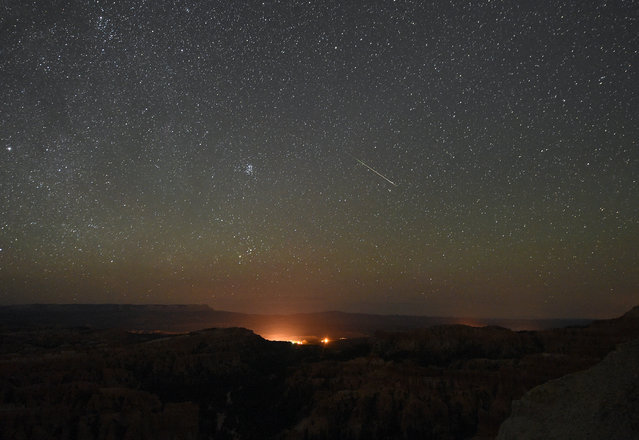
A Perseid meteor streaks across the sky above Inspiration Point early on August 12, 2016 in Bryce Canyon National Park, Utah. The annual display, known as the Perseid shower because the meteors appear to radiate from the constellation Perseus in the northeastern sky, is a result of Earth's orbit passing through debris from the comet Swift-Tuttle. (Photo by Ethan Miller/Getty Images)

A Perseid meteor streaks across the sky above Inspiration Point early on August 12, 2016 in Bryce Canyon National Park, Utah. The annual display, known as the Perseid shower because the meteors appear to radiate from the constellation Perseus in the northeastern sky, is a result of Earth's orbit passing through debris from the comet Swift-Tuttle. (Photo by Ethan Miller/Getty Images)
Details
13 Aug 2016 11:19:00