Loading...
Done
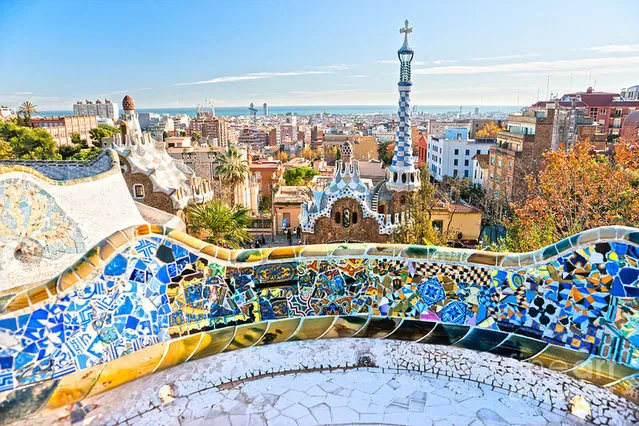
Barcelona in ParK Güell

Park Güell is a garden complex with architectural elements situated on the hill of El Carmel in the Gràcia district of Barcelona, Catalonia, Spain. It was designed by the Catalan architect Antoni Gaudí and built in the years 1900 to 1914. It has an extension of 17.18 ha (0.1718 km²), which makes it one of the largest architectural works in south Europe. It is part of the UNESCO World Heritage Site "Works of Antoni Gaudí".
Details
24 Apr 2013 10:58:00
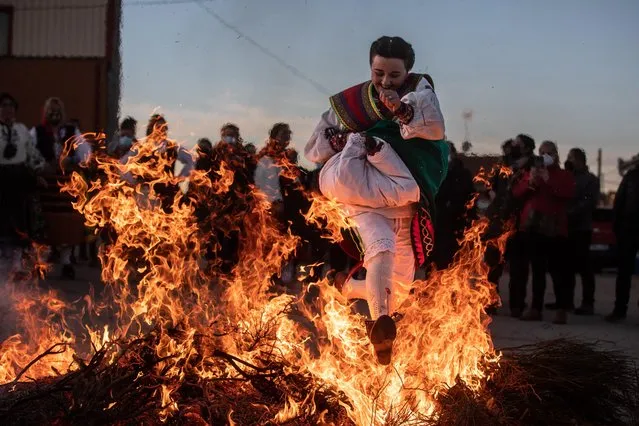
People celebrate the traditional Fiesta de las Aguedas on February 6, 2022 in Andavias, Zamora, Castilla y Leon, Spain. This celebration, also known as “El dia de las mujeres”, is a deep-rooted tradition in Castilla y Leon, especially in rural areas. The day of the Aguedas has its origin in the cult of Santa Agueda, and is celebrated every February 5. During this day, women are the protagonists and take over the city. For their part, the town councils give them the baton as a sign of authority. Around seven days of festivities are celebrated where the attendees dance, eat, sing, and even jump over a bonfire. (Photo By Emilio Fraile/Europa Press via Getty Images)

People celebrate the traditional Fiesta de las Aguedas on February 6, 2022 in Andavias, Zamora, Castilla y Leon, Spain. This celebration, also known as “El dia de las mujeres”, is a deep-rooted tradition in Castilla y Leon, especially in rural areas. The day of the Aguedas has its origin in the cult of Santa Agueda, and is celebrated every February 5. (Photo By Emilio Fraile/Europa Press via Getty Images)
Details
31 Mar 2022 06:18:00
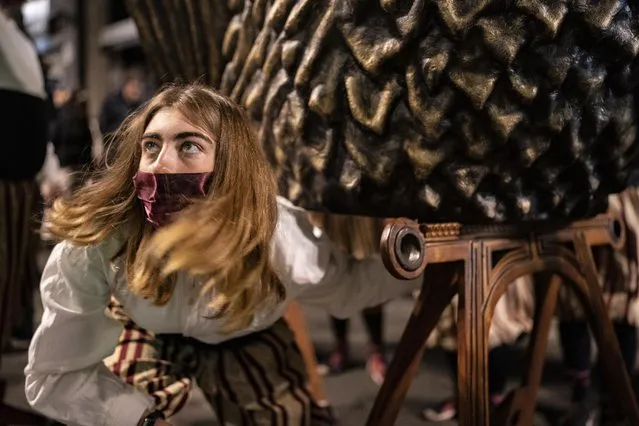
A performer removes a traditional eagle costume after performing “El Ball de l'Àliga” (Dance of the Eagle) during Saint Eulàlia fesitivities in Barcelona, Spain, Friday, February 11, 2022. After two years of canceled or muted celebrations due to the pandemic, this Mediterranean city went all-out to celebrate the feast, or “fest” in the Catalan language, of its patron. (Photo by Joan Mateu Parra/AP Photo)

A performer removes a traditional eagle costume after performing “El Ball de l'Àliga” (Dance of the Eagle) during Saint Eulàlia fesitivities in Barcelona, Spain, Friday, February 11, 2022. After two years of canceled or muted celebrations due to the pandemic, this Mediterranean city went all-out to celebrate the feast, or “fest” in the Catalan language, of its patron. (Photo by Joan Mateu Parra/AP Photo)
Details
31 Mar 2023 04:18:00
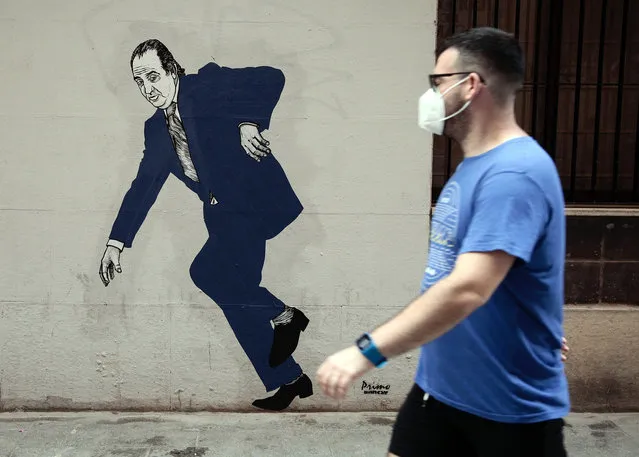
A person walks past graffiti by arstist selfnamed El Primo de Bansky (the cousin of Bansky) of former Spanish King Juan Carlos in Valencia, Spain, 05 August 2020. The Spanish Royal Household has announced that Emeritus King Juan Carlos I has proclaimed his intended decision to move abroad so as to not interfere in the image of the Spanish monarchy due to his alleged implication in a Swiss offshore account investigation. (Photo by Biel Aliño/EPA/EFE)

A person walks past graffiti by arstist selfnamed El Primo de Bansky (the cousin of Bansky) of former Spanish King Juan Carlos in Valencia, Spain, 05 August 2020. The Spanish Royal Household has announced that Emeritus King Juan Carlos I has proclaimed his intended decision to move abroad so as to not interfere in the image of the Spanish monarchy due to his alleged implication in a Swiss offshore account investigation. (Photo by Biel Aliño/EPA/EFE)
Details
07 Aug 2020 00:07:00
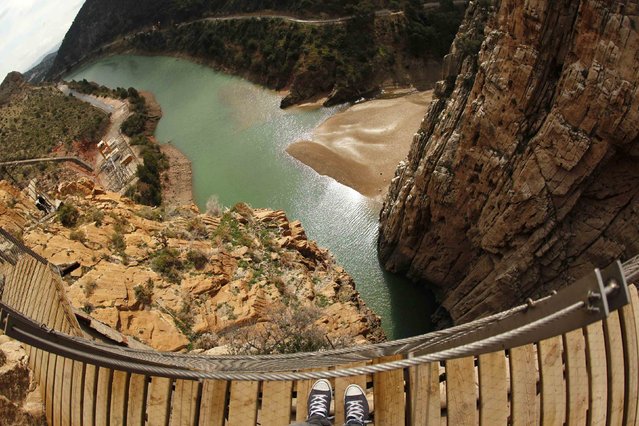
Journalists (L) walk along the new Caminito del Rey (The King's Little Pathway) in El Chorro-Alora, near Malaga, southern Spain March 15, 2015. (Photo by Jon Nazca/Reuters)

Journalists (L) walk along the new Caminito del Rey (The King's Little Pathway) in El Chorro-Alora, near Malaga, southern Spain March 15, 2015. Dubbed by many media outlets as the world's scariest pathway, the three-kilometre long pathway, which was built at about 100 metres (330 ft) above the gorge of Los Gaitanes between the years of 1901 and 1905, was closed in 2001 after five people died. A new walkway has then been built over the old walkway and will open to the public on March 28, 2015. (Photo by Jon Nazca/Reuters)
Details
16 Mar 2015 09:56:00
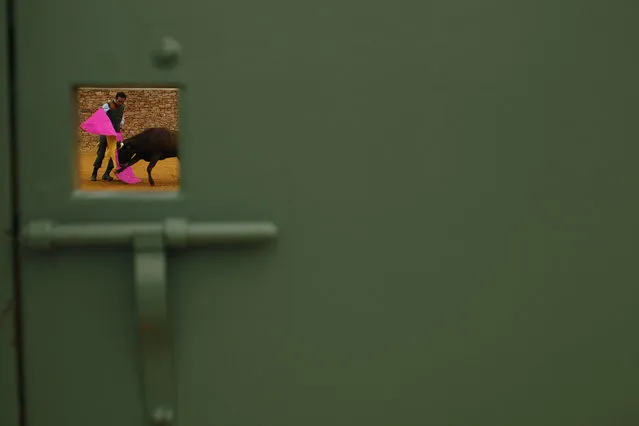
Spanish bullfighter Manuel Jesus “El Cid” is seen through a small window of a door as he performs a pass to a heifer during a “tentadero” (a small bullfight to check the bravery of calves and heifers which are not killed) during the first International Biennial of bullfighting at Reservatauro Ronda cattle ranch in Ronda, near Malaga February 17, 2013. Spain's parliament voted last Tuesday to consider protecting bullfighting as a national pastime, angering animal rights campaigners and politicians in two regions where the sport is banned. (Photo by Jon Nazca/Reuters)

Spanish bullfighter Manuel Jesus “El Cid” is seen through a small window of a door as he performs a pass to a heifer during a “tentadero” (a small bullfight to check the bravery of calves and heifers which are not killed) during the first International Biennial of bullfighting at Reservatauro Ronda cattle ranch in Ronda, near Malaga February 17, 2013. Spain's parliament voted last Tuesday to consider protecting bullfighting as a national pastime, angering animal rights campaigners and politicians in two regions where the sport is banned. (Photo by Jon Nazca/Reuters)
Details
22 Feb 2013 11:15:00
People take part in the “The Burial of the Sardine” funeral procession, which marks the end of carnival festivities, in Madrid, Spain, February 10, 2016. (Photo by Juan Medina/Reuters)

People take part in the “The Burial of the Sardine” funeral procession, which marks the end of carnival festivities, in Madrid, Spain, February 10, 2016. “Mourners” carry a coffin with a mock sardine through the streets to celebrate the countdown to Lent. Spanish painter Francisco de Goya's painting “El entierro de la sardina” (The Burial of the Sardine) was inspired by this tradition, which started in Madrid in the 18th century, around the time of Spanish King Carlos III. (Photo by Juan Medina/Reuters)
Details
11 Feb 2016 12:29:00
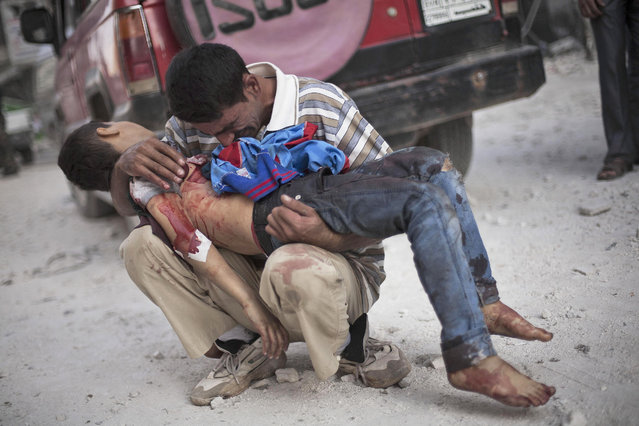
A Syrian man cries while holding the body of his son, killed by the Syrian Army, near Dar El Shifa hospital in Aleppo, Syria, Wednesday, October 3, 2012. (Photo by Manu Brabo/AP Photo)

Manu Brabo was born in Spain in 1981. After studying Photography in The School of Arts and Crafts in Oviedo, he moved to Madrid where he started Journalism in Carlos III University while he was working as a photographer for several humble newspapers and agencies. In 2011, Manu was held captive and then released by by Libyan forces. Brabo, along with fellow AP photographers were awarded the 2013 Pulitzer Prize for Breaking News Photography. Here: a Syrian man cries while holding the body of his son, killed by the Syrian Army, near Dar El Shifa hospital in Aleppo, Syria, Wednesday, October 3, 2012. (Photo by Manu Brabo/AP Photo)
Details
27 Oct 2015 08:04:00