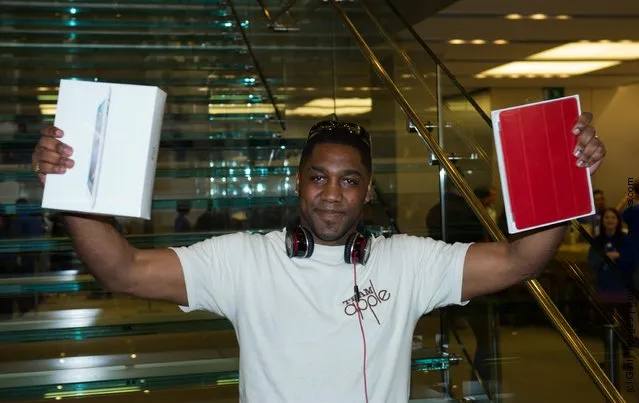
Jewels Lewis poses as the first customer to purchase the new Apple iPad 2 at Apple Store, Regent Street on March 25, 2011 in London, England. The latest iPad went on sale in the UK at 5:00pm.
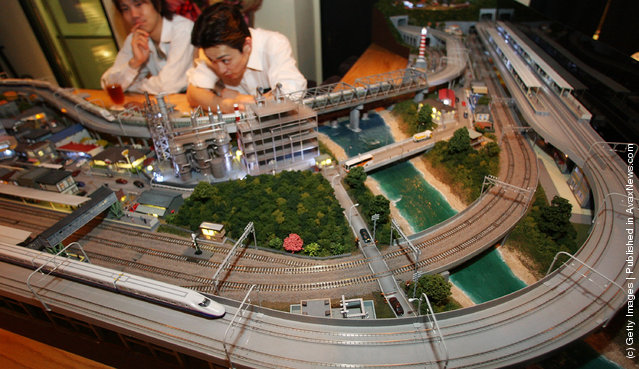
Men watch model trains running along the bar at Bar Ginza Panorama Shibuya Branch on June 3, 2009 in Tokyo, Japan. The bar caters to model train enthusists and customers are able to bring their own model trains to run on the tracks. (Photo by Junko Kimura/Getty Images)
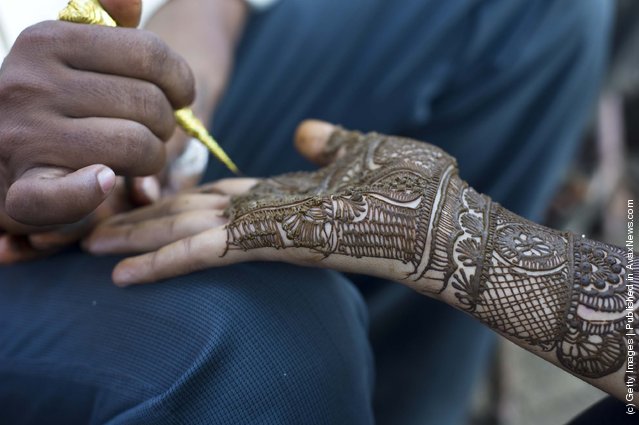
“Mehndi or menhdi is the application of henna as a temporary form of skin decoration in India, as well as by expatriate communities from the country. The word mehndi is derived from the Sanskrit word mendhikā. The use of mehndi and turmeric is described in the earliest Vedic ritual books. Haldi (Staining oneself with turmeric paste) as well as mehndi are important Vedic customs as a symbolic representation of the Outer and the Inner Sun. Vedic customs are meant to awaken the “inner light” and so the gold of the inner Sun has an important symbolic function”. – Wikipedia
Photo: Application of henna or “Mehndi” to a girls hand in a market on October 18, 2010 in Jaipur, India. (Photo by Simon de Trey-White/Getty Images)
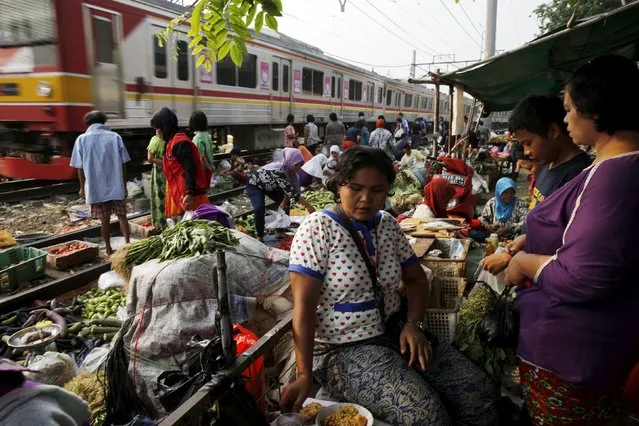
A vendor (C) serves customers at a vegetable market as a commuter train passes in Jakarta October 2, 2015. Indonesia's high annual inflation rate cooled in September and should drop more by year-end, but it likely will be 2016 before the central bank can cut interest rates to help an economy growing at its slowest pace in six years. (Photo by Reuters/Beawiharta)
The Belgian photographer Anton Kusters spent two years photographing the Yakuza, Japan’s most notorious gang. He returned with some amazing images that he made into a book called “Odo Yakuza Tokyo”. (Odo means “the way of the cherry blossom” and is the credo of the Yakuza family he followed. Photo: An erotic danser picks up fake 2-dollar bills during a private dance with a Yakuza customer in a strip tease bar in Kabukicho, a bar which is controlled by the ODO family – 2010. (Photo and caption by Anton Kusters)
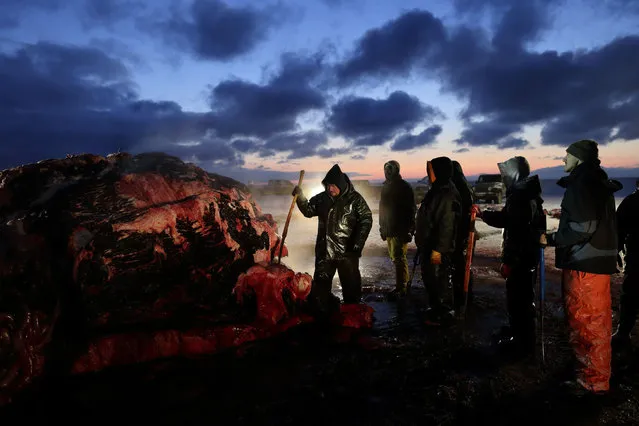
In this October 7, 2014, photo, Fredrick Brower, center, helps cut up a bowhead whale caught by Inupiat subsistence hunters on a field near Barrow, Alaska. Drawing on tradition, and keeping within the closely monitored Aboriginal subsistence whaling guidelines, a bowhead whale is carved and divided by a crew armed with knives and hooks, and then shared according to custom. (Photo by Gregory Bull/AP Photo)
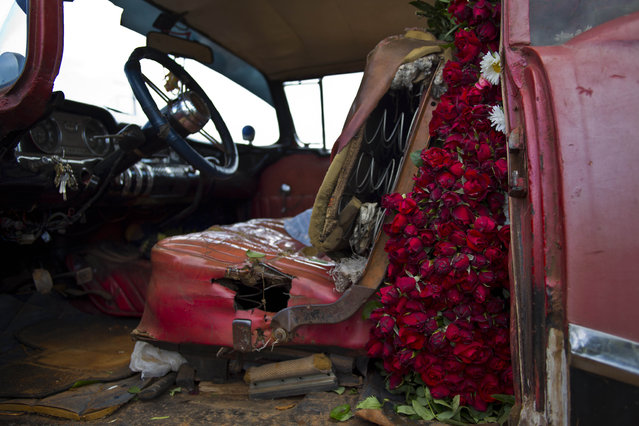
In this Thursday, January 29, 2015 photo, the backseat of a rented 1957 Buick is packed to the brim with flowers, to be transported to Havana from San Antonio de los Banos, Cuba. Every Monday and Thursday morning, self-employed flower vendor Yaima Gonzalez Matos leaves her home to visit a dozen farmers who sell her sunflowers, roses, lilies and other blooms. She loads the flowers into the rented American classic and delivers to customers in the capital. (Photo by Ramon Espinosa/AP Photo)
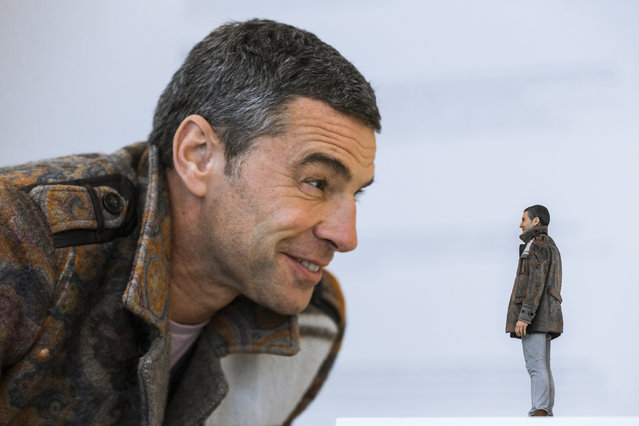
Customer Andreas Kroker looks at a 3D-printed figure of himself at the Twinkind 3D printing studio in Berlin, December 13, 2013. A 3D-printed likeness is produced by taking a 360 degree photographic scan of a person, which is then rendered into a 3D digital model and retouched to meet the requirements for printing. The printing machine uses this digital model to produce a high-resolution solid figure. Twinkind co-founder Timo Schaedel said, people often come to the session well-groomed, with fresh hair-cuts and their best clothes, “just as they used to do in the past, when they had their portrait taken in a photo studio”. (Photo by Thomas Peter/Reuters)